
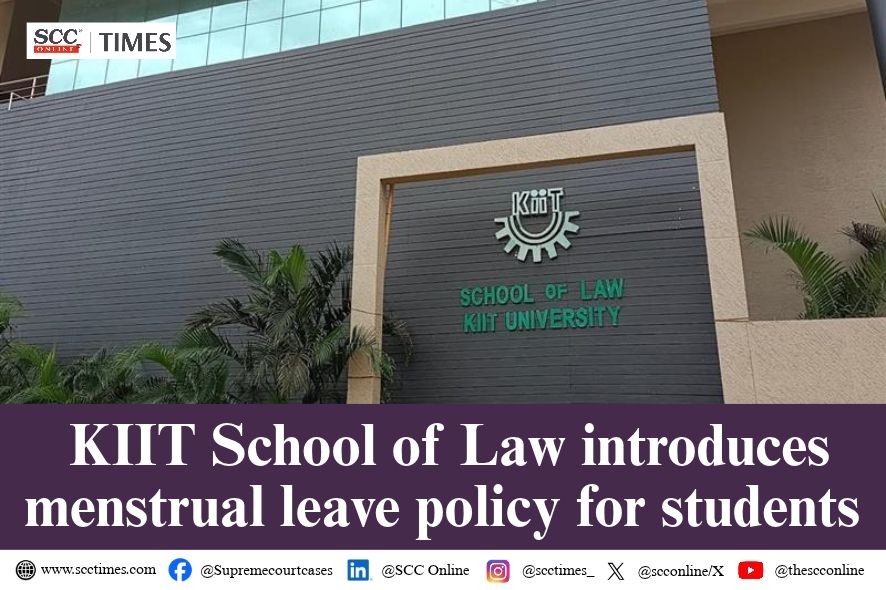
KIIT School of Law: Proposes 2-Day Monthly Menstrual Leave Policy
Summary
- KIIT School of Law has proposed the KIIT School of Law Menstrual Leave Policy, 2026, for its undergraduate and postgraduate students.
- The policy grants two days of menstrual leave per calendar month with deemed attendance, requiring only self-declaration.
- Students with certified menstrual disorders can receive enhanced accommodation of up to five days monthly.
- The policy aims to ensure student welfare, dignity, equality, and access to education by preventing academic disadvantage due to menstruation.
- Its development was influenced by the Supreme Court of India's November 2025 White Paper on Menstrual Leave and frameworks from other National Law Universities.
Policy Introduction
By formalizing support for students experiencing menstruation-related discomfort, the policy reinforces principles of equality and access to education, ensuring that academic progress is not hindered by natural biological processes.
The KIIT School of Law, a constituent of KIIT (Deemed-to-be-University) located in Bhubaneswar, has unveiled a proposed framework for a menstrual leave policy. Designated as the KIIT School of Law Menstrual Leave Policy, 2026, this initiative is designed to benefit both undergraduate and postgraduate students enrolled at the institution. The core objective of this policy is to formally acknowledge menstrual health as a vital component of student welfare, upholding dignity, promoting equality, and ensuring equitable access to education.
This progressive policy specifically aims to mitigate any academic disadvantages that students might face due to pain or discomfort associated with menstruation. Under its provisions, students would be entitled to two days of ordinary menstrual leave each calendar month. A key feature of this entitlement is that all scheduled classes missed on approved leave days will be considered as deemed attendance, thereby preventing any adverse impact on academic records.
Specific Provisions and Inclusivity
The KIIT School of Law Menstrual Leave Policy, 2026, establishes a straightforward process for students to avail ordinary menstrual leave, requiring only a self-declaration. This means that students are not obligated to provide a medical certificate, a formal diagnosis, their medical history, or any proof of symptom severity to access the standard two-day monthly leave.
For students who experience medically certified menstrual disorders or related conditions, the policy provides an enhanced accommodation, allowing for up to five days of leave per calendar month. This extended allowance is inclusive of the ordinary two-day entitlement. Beyond the leave provisions, the policy also incorporates robust confidentiality safeguards, ensures non-discrimination, and commits to providing appropriate menstrual health support services across the campus. A dedicated grievance-redressal mechanism is also established to address any concerns or issues that may arise.
Notably, the policy adopts an inclusive approach, extending its benefits to all students who menstruate, irrespective of their gender identity. It further specifies that medical information will only be requested when it is absolutely necessary for a student to access the enhanced accommodation provisions.
Influencing Legal and Academic Context
The development of the KIIT School of Law Menstrual Leave Policy, 2026, is significantly informed by broader national guidance and academic precedents. A key influencing document is the White Paper on Menstrual Leave, which was published by the Centre for Research and Planning of the Supreme Court of India in November 2025. This white paper provides a crucial legal and ethical foundation, guiding institutions across the nation in formulating their own menstrual leave policies.
Furthermore, the KIIT policy has also taken into consideration various menstrual leave frameworks that have been deliberated or implemented at several National Law Universities throughout India. This demonstrates a growing trend within the Indian higher education sector to formalize support for menstrual health, aligning with evolving standards for student welfare policy in India. The policy's reliance on these influential documents underscores a concerted effort to integrate menstrual health into mainstream institutional frameworks.
Broader Implications
The introduction of the KIIT School of Law Menstrual Leave Policy, 2026, represents a pivotal moment in recognizing and addressing menstrual health within India's educational landscape. By formalizing support for students experiencing menstruation-related discomfort, the policy reinforces principles of equality and access to education, ensuring that academic progress is not hindered by natural biological processes.
This initiative contributes significantly to the ongoing discourse surrounding menstrual health policy universities India, potentially setting a precedent for other institutions to consider similar student welfare policy India measures. The policy's inclusive approach, which covers all menstruating students regardless of gender identity, further highlights a progressive understanding of health and equity. Its foundation in the Supreme Court of India menstrual leave white paper signals a national movement towards integrating menstrual health into institutional frameworks, which could influence future legislative or regulatory developments across the country.
Practical Implications
This development signals a growing trend in India towards formalizing menstrual leave policies in educational institutions, drawing from Supreme Court guidance. Lawyers advising universities, colleges, or even corporate entities in India should monitor these evolving standards as they may influence future legislative requirements or best practices for employee/student welfare and HR policies.
Source
How does this affect you?
Get an AI analysis of this article grounded in your jurisdictions, practice areas, and any policy documents you've uploaded to Wansom.
Finish Reading the Full Story and the Expert Analysis.
Wansom is AI and can make mistakes.