
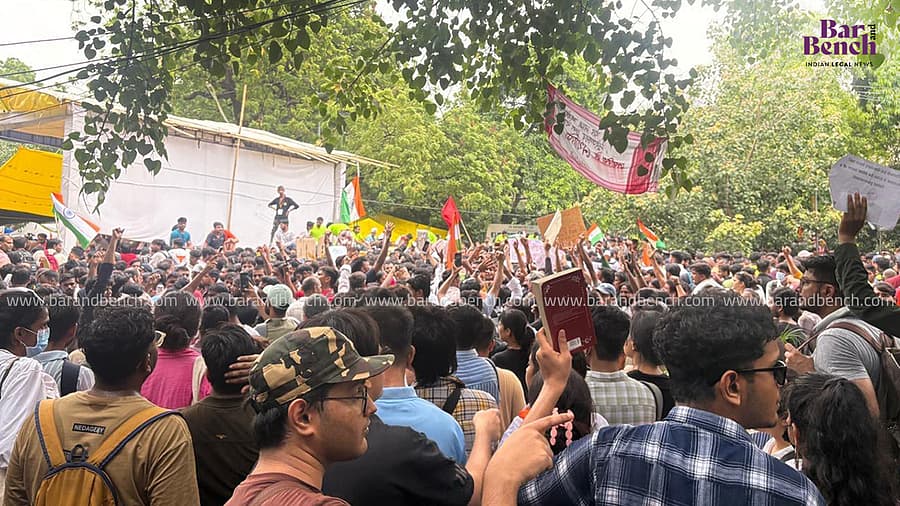
Calcutta High Court Rejects TMC Solidarity Rally Permission in Kolkata
Abstract
The Calcutta High Court has rejected a petition from the student wing of All India Trinamool Congress (YMC) seeking permission to hold a solidarity rally with Jantar Mantar protestors in Kolkata. The court cited concerns about escalating tensions and potential untoward incidents, stating that it would be held responsible if such an incident occurred. This decision comes amidst growing student unrest in major cities, including Kolkata.
Introduction
The Calcutta High Court on Saturday rejected a petition moved by the student wing of All India Trinamool Congress (YMC) seeking permission to hold a rally to express solidarity with the Jantar Mantar protestors who recently faced police excesses in Delhi. The court's decision was made during a special hearing held on Saturday afternoon, where Justice Saugata Bhattacharyya expressed concerns about escalating tensions and potential untoward incidents. This development has significant implications for the student wing of Trinamool Congress and its efforts to organize rallies in support of Jantar Mantar protestors.
Background
The petition was moved by Priyanka Adhikary, the President of Trinamool Chhatra Parishad (TMCP), which is the student wing of the Trinamool Congress led by former Chief Minister Mamata Banerjee. The students had applied for permission to hold a rally in Kolkata, but their request was denied by the police. In response, Adhikary challenged the denial of permission and sought an order from the court to allow the rally. This development is part of a larger context of growing student unrest in major cities across India.
Analysis
The Calcutta High Court's decision to reject the petition has significant implications for the student wing of Trinamool Congress and its efforts to organize rallies in support of Jantar Mantar protestors. The court's concerns about escalating tensions and potential untoward incidents are understandable, given the recent police excesses at Jantar Mantar. However, this decision also raises questions about the limits of free speech and assembly in India. Can student organizations be prohibited from holding solidarity rallies with other groups, even if they pose no immediate threat to public order? These questions will likely continue to be debated in the coming days.
Conclusion
The Calcutta High Court's decision to reject the petition has significant implications for the student wing of Trinamool Congress and its efforts to organize rallies in support of Jantar Mantar protestors. Practitioners should closely monitor this development, as it may set a precedent for future cases involving student organizations and their right to free speech and assembly.
How does this affect you?
Get an AI analysis of this article grounded in your jurisdictions, practice areas, and any policy documents you've uploaded to Wansom.
Finish Reading the Full Story and the Expert Analysis.
Wansom is AI and can make mistakes.