
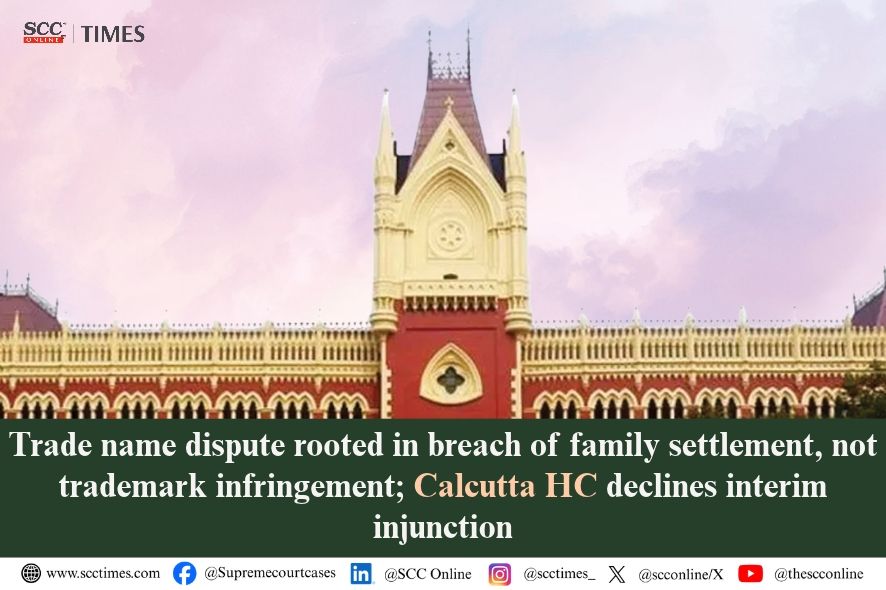
Calcutta HC: Trade Name Family Settlement is Breach, Not IP Infringement
Summary
- The Calcutta High Court declined an interim injunction in a trade name dispute.
- The court found the dispute stemmed from a breach of a family settlement, not direct intellectual property infringement.
- The suit was deemed maintainable before the Commercial Division despite the nature of the underlying cause.
- This ruling clarifies that the absence of direct IP infringement allegations can impact the grant of interim relief.
- It emphasizes the importance of correctly characterizing the cause of action in such complex cases.
The Court's Ruling
Lawyers advising on trade name disputes must carefully assess whether the claim is a direct "trademark infringement India" action or if it originates from a breach of a prior agreement, such as a family settlement.
The Calcutta High Court recently issued a significant ruling concerning a trade name dispute, opting to decline an interim injunction sought by one of the parties. This decision hinged on the court's finding that the core of the legal action did not allege an infringement of a right pertaining to the trade name itself or any other form of intellectual property. Instead, the dispute was identified as stemming from a breach of a family settlement, fundamentally altering the legal characterization of the case.
This distinction is critical in the landscape of a trade name dispute in India, where the nature of the claim directly influences the available remedies and the court's approach to interim relief. The court's refusal to grant a Calcutta High Court interim injunction in this scenario underscores that the absence of a direct intellectual property infringement allegation can significantly impact the immediate protective measures a litigant can secure, even when a valuable trade name is at the heart of the disagreement.
Jurisdictional Clarity
A key aspect of the Calcutta High Court's determination was its affirmation that the suit remained maintainable before the Commercial Division. This jurisdictional clarity is vital, as it indicates that even though the primary cause of action was rooted in a family settlement breach, the Commercial Division was deemed the appropriate forum to adjudicate the matter. This suggests that disputes involving commercial assets, such as trade names, that arise from personal agreements like family settlements, can still fall under the specialized jurisdiction designed for commercial disputes.
The ruling provides important guidance on the interplay between "family settlement breach jurisdiction" and the purview of the "commercial division intellectual property" framework. It clarifies that the involvement of intellectual property, even if not the direct subject of an infringement claim, does not automatically preclude the Commercial Division from hearing cases where the underlying grievance is a contractual breach within a family arrangement. This nuanced approach helps define the boundaries for commercial courts when dealing with complex disputes that blend personal agreements with business assets.
Implications for Litigants
This decision by the Calcutta High Court carries substantial implications for parties involved in trade name disputes, particularly those arising from family arrangements. It highlights the paramount importance of accurately identifying the true nature of the cause of action. Lawyers advising on trade name disputes must carefully assess whether the claim is a direct "trademark infringement India" action or if it originates from a breach of a prior agreement, such as a family settlement. This distinction is not merely academic; it directly influences the legal strategy, the type of evidence required, and crucially, the likelihood of obtaining an interim injunction.
The court's stance reinforces that an interim injunction, typically sought to prevent immediate harm in intellectual property cases, may not be granted if the alleged harm is primarily a consequence of a broken family agreement rather than a direct violation of IP rights. Therefore, parties seeking to protect a trade name in such circumstances might need to focus their arguments on the breach of the settlement agreement itself, rather than solely on trademark infringement, to secure appropriate relief. The Calcutta HC trade name family settlement ruling thus serves as a critical reminder of the need for precise legal characterization in complex commercial and family-related disputes.
Practical Implications
Lawyers advising on trade name disputes must carefully assess the underlying cause of action, as this ruling clarifies that disputes rooted in family settlement breaches, rather than direct IP infringement, may fall under the Commercial Division's jurisdiction and alter the grounds for obtaining interim injunctions.
Source
Source: Original reporting via SCC Times
How does this affect you?
Get an AI analysis of this article grounded in your jurisdictions, practice areas, and any policy documents you've uploaded to Wansom.
Wansom is AI and can make mistakes.