
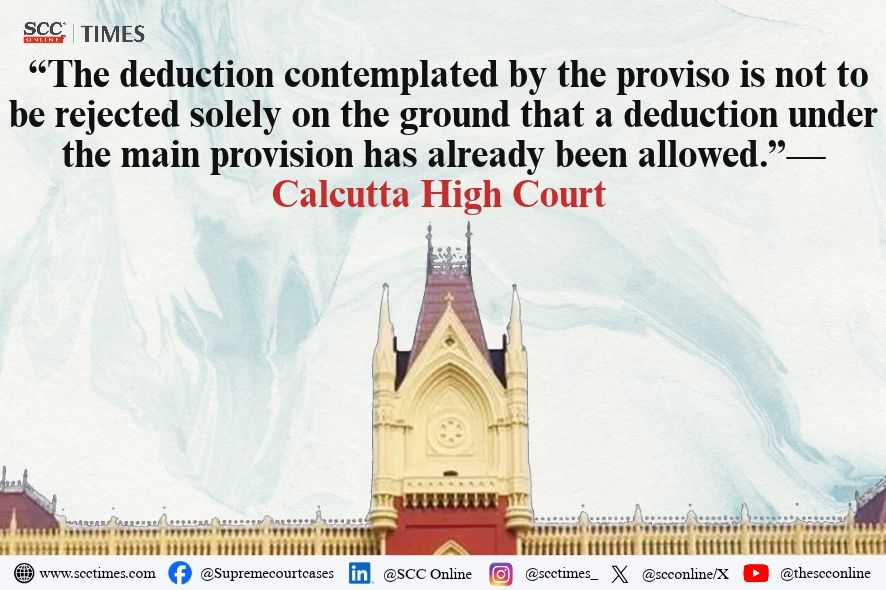
Calcutta High Court: Indian Bank Allowed ₹96.65 Crore Doubtful Assets Deduction
Summary
- The Calcutta High Court allowed Indian Bank's deduction claim of ₹96.65 Crore.
- The claim was for doubtful and loss assets under Section 36(1)(vii-a)(a) of the Income-tax Act, 1961.
- The court ruled that administrative circulars cannot override the explicit statutory language.
- The phrase "at its option" in the section must be given its ordinary meaning and cannot be treated as surplusage.
Court Upholds Bank's Claim
The ruling firmly established that administrative circulars, issued by tax authorities, cannot supersede or alter the explicit language of a statute.
The Calcutta High Court recently delivered a significant ruling concerning tax deductions for financial institutions, specifically allowing a substantial claim made by Indian Bank. The court's decision permits the bank to deduct an amount of ₹96.65 Crore related to its doubtful and loss assets. This outcome underscores a critical interpretation of the Income-tax Act, 1961, particularly Section 36(1)(vii-a)(a), which governs such deductions. The ruling provides clarity on the scope of discretion available to banks when claiming these specific tax benefits.
The dispute centered on the precise application of statutory provisions versus administrative directives in determining eligible deductions. Indian Bank's assertion of its right to claim the deduction for these specific asset categories was ultimately affirmed by the High Court, marking a notable victory for the institution in its tax assessment. This Calcutta HC Indian Bank deduction claim highlights the ongoing tension between legislative intent and the practical implementation of tax laws through various administrative circulars.
Statutory Language vs. Administrative Directives
At the heart of the Calcutta High Court's judgment was the interpretation of the phrase "at its option" as it appears within Section 36(1)(vii-a)(a) of the Income-tax Act, 1961. This particular section pertains to the deduction for doubtful and loss assets. The Court explicitly stated that this expression, "at its option," cannot be considered mere surplusage within the legislative text. Furthermore, the judiciary emphasized that the ordinary meaning of these words must be preserved and applied, reflecting the clear intent of the legislature.
The ruling firmly established that administrative circulars, issued by tax authorities, cannot supersede or alter the explicit language of a statute. When a statutory provision, such as Section 36(1)(vii-a)(a), grants an assessee a clear option, that discretion cannot be curtailed or removed by subsequent administrative guidance. This principle reinforces the hierarchy of legal instruments, where the primary legislation holds precedence over any subordinate instructions. The Indian Bank tax ruling thus serves as a powerful reminder of the limits of administrative authority in interpreting and applying tax law.
Implications for Financial Institutions
This Calcutta HC Indian Bank deduction claim carries significant implications for financial institutions across India, particularly regarding their ability to claim deductions for doubtful and loss assets under Section 36(1)(vii-a)(a) Income-tax Act. The High Court's unequivocal stance that administrative circulars cannot override clear statutory language provides a crucial precedent. It empowers taxpayers to challenge assessments where tax authorities might have relied on circulars that contradict the plain reading of the Act.
The decision reinforces the fundamental legal principle that legislative text must be given its full and ordinary meaning, preventing its dilution by administrative interpretations. For banks and other financial entities, this means greater certainty in exercising their statutory options for tax deductions, such as the ₹96.65 Crore claimed by Indian Bank. It underscores the importance of scrutinizing administrative circulars against the backdrop of the primary legislation, ensuring that the rights and options explicitly granted by law are not inadvertently or intentionally diminished. This ruling will likely influence future disputes involving the interplay between statutory provisions and administrative guidance in tax matters.
Practical Implications
Lawyers should advise financial institution clients that administrative circulars cannot override clear statutory language, particularly when claiming deductions for doubtful and loss assets under Section 36(1)(vii-a)(a) of the Income-tax Act. This ruling provides a precedent for challenging tax assessments that rely on circulars contradicting the Act's provisions.
Source
Source: Original reporting via SCC Times
How does this affect you?
Get an AI analysis of this article grounded in your jurisdictions, practice areas, and any policy documents you've uploaded to Wansom.
Finish Reading the Full Story and the Expert Analysis.
Wansom is AI and can make mistakes.