
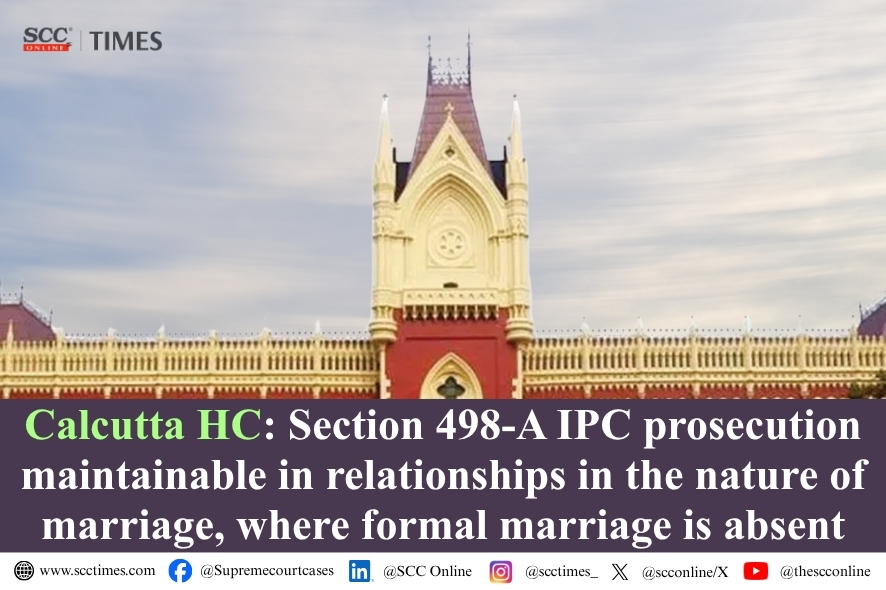
Calcutta High Court: Allows 498A IPC for Live-in Relationships
Summary
- The Calcutta High Court has ruled on the maintainability of Section 498-A IPC.
- Prosecution under Section 498-A IPC is now applicable to relationships in the nature of marriage.
- This includes domestic cohabitation where a formal marriage is absent.
- The decision addresses the conflict between technical statutory defenses and lived realities.
What Happened
The ruling is a significant step towards bridging the gap between legal frameworks and social realities.
The Calcutta High Court has recently delivered a significant ruling concerning the applicability of Section 498-A of the Indian Penal Code (IPC). This decision clarifies that prosecution under this particular section is permissible even in instances where a formal marriage ceremony has not taken place. The court specifically addressed relationships that are "in the nature of marriage," affirming that individuals in such domestic arrangements can seek legal recourse under Section 498-A IPC.
This judicial pronouncement underscores a fundamental tension between strict legal definitions and the evolving social landscape of domestic partnerships. The court's stance acknowledges the "lived realities of domestic cohabitation," indicating a move towards aligning statutory protections with contemporary societal structures. By extending the scope of Section 498-A IPC to include relationships lacking a traditional marital bond, the Calcutta High Court has navigated a complex legal area where "technical statutory defences" might otherwise impede justice.
Legal Context
Section 498-A of the Indian Penal Code is a crucial provision designed to protect women from cruelty inflicted by their husband or his relatives. Historically, the application of this section has been primarily confined to legally wedded couples, with the term "husband" often interpreted in its conventional sense. However, the legal landscape in India has been gradually adapting to recognize various forms of domestic partnerships, particularly "live-in" relationships, which are increasingly common.
The concept of a "relationship in the nature of marriage" has gained prominence in Indian jurisprudence, particularly in the context of domestic violence legislation. While the source text does not explicitly detail the court's reasoning, this phrase typically refers to cohabitation arrangements that share characteristics of a marital union, such as a shared household, pooling of resources, social acknowledgment, and a sexual relationship, but without the formal rites or registration. The Calcutta High Court's ruling effectively extends the protective umbrella of Section 498-A IPC to these non-traditional unions, ensuring that the absence of a marriage certificate does not preclude victims from seeking redress for cruelty. This interpretation reflects a broader judicial trend towards a more inclusive understanding of family structures.
Why It Matters
This decision by the Calcutta High Court carries substantial implications for individuals in live-in relationships across India, particularly for women who may experience domestic cruelty without the formal protections traditionally afforded by marriage. By affirming the maintainability of Section 498-A IPC prosecution in such arrangements, the court has provided a vital legal avenue for redress that was previously ambiguous or unavailable. It reinforces the principle that the substance of a relationship, rather than merely its formal status, can determine the applicability of protective laws.
The ruling is a significant step towards bridging the gap between legal frameworks and social realities. It ensures that perpetrators of cruelty cannot evade accountability simply by arguing the absence of a formal marriage. This progressive interpretation by the Calcutta High Court strengthens the legal safeguards for vulnerable individuals in domestic cohabitation, aligning the law with the evolving societal norms and offering a more comprehensive approach to combating domestic cruelty, regardless of the marital status of the parties involved.
Source
Source: Reporting based on SCC Times.
How does this affect you?
Get an AI analysis of this article grounded in your jurisdictions, practice areas, and any policy documents you've uploaded to Wansom.
Finish Reading the Full Story and the Expert Analysis.
Get the latest legal & regulatory intelligence in India
Wansom is AI and can make mistakes.