
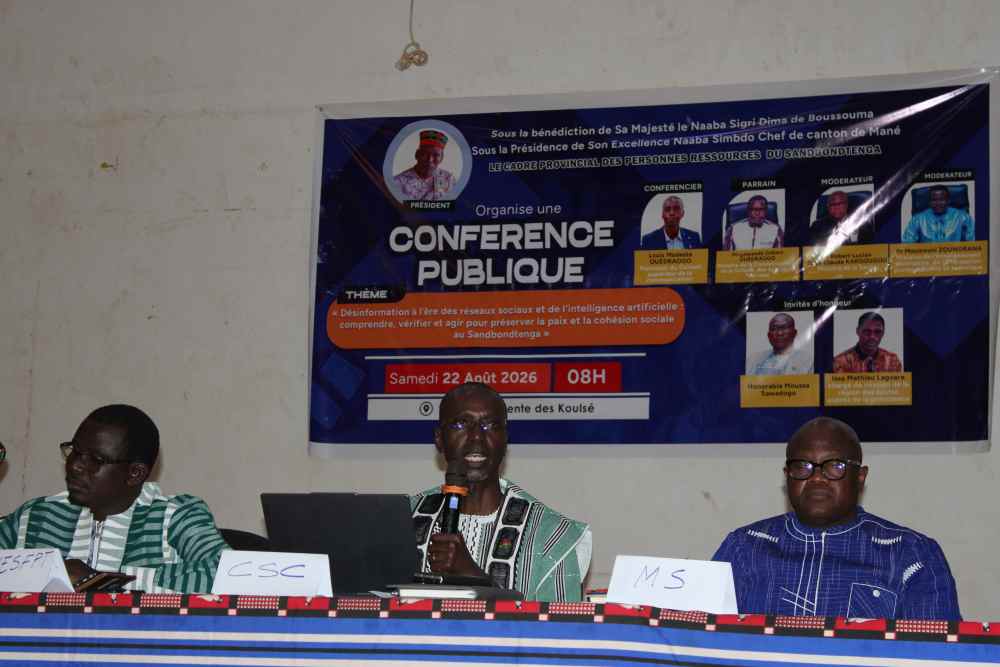
Burkina Faso: Disinformation Regulation Conference Targets Social Networks, AI
Summary
- A public conference on disinformation was held in Kaya on Saturday, August 22, 2026.
- The event, organized by Le cadre provincial des personnes ressources du Sandbondtenga, focused on disinformation in social networks and artificial intelligence.
- Robert Kargougou, the Minister of Health, and Moumouni Zoungrana, the Minister of Basic Education, Literacy and Promotion of National Languages, jointly moderated the conference.
- Its primary objective was to raise awareness among internet users for responsible social media engagement.
Event Overview
The involvement of both the Minister of Health and the Minister of Basic Education, Literacy and Promotion of National Languages as moderators at the Kaya conference signals a comprehensive governmental recognition of disinformation as a cross-cutting societal problem.
On Saturday, August 22, 2026, a public conference was held in Kaya, addressing the critical issue of disinformation. This significant event was organized by Le cadre provincial des personnes ressources du Sandbondtenga, bringing together participants to discuss the challenges presented by misinformation in the contemporary digital landscape. The conference specifically focused on disinformation as it manifests within social networks and through the advancements of artificial intelligence, with an overarching goal to promote responsible online conduct.
The proceedings were notably moderated by two prominent government figures: Robert Kargougou, who serves as the Minister of Health, and Moumouni Zoungrana, who serves as the Minister of Basic Education, Literacy and Promotion of National Languages. Their joint moderation highlighted the interdisciplinary nature of the fight against disinformation, signaling its relevance across various public sectors. The core purpose of this public forum was to enhance awareness among internet users, guiding them towards a more judicious and responsible utilization of social media platforms.
Addressing Digital Challenges
The proliferation of social media platforms and the rapid evolution of artificial intelligence have fundamentally reshaped how information is created, disseminated, and consumed. While these technologies offer unprecedented connectivity and access to knowledge, they also present fertile ground for the spread of disinformation, which can have profound societal consequences. This context underscores the urgency behind initiatives like the Kaya conference, as unchecked misinformation can erode public trust, polarize communities, and even undermine democratic processes.
Disinformation campaigns, often amplified by algorithmic biases and echo chambers inherent in social networks, pose particular threats to public health and education. False health information can lead to dangerous practices or vaccine hesitancy, directly impacting public well-being and straining healthcare systems. Similarly, the spread of misleading narratives within educational contexts can hinder critical thinking skills, distort historical understanding, and compromise the integrity of academic discourse. Addressing these multifaceted challenges requires a concerted effort to equip citizens with the tools to discern credible information from falsehoods.
Multi-Sectoral Engagement
The involvement of both the Minister of Health and the Minister of Basic Education, Literacy and Promotion of National Languages as moderators at the Kaya conference signals a comprehensive governmental recognition of disinformation as a cross-cutting societal problem. Their presence indicates that the issue is not confined to technology or communication ministries but is understood to have direct impacts on public welfare and the foundational development of future generations. This multi-sectoral approach is crucial, as effective strategies against disinformation must integrate perspectives from various domains.
For the health sector, combating disinformation means safeguarding public health initiatives from false narratives that can undermine trust in medical science and public health campaigns. The Minister of Health's participation highlights the direct link between accurate information and community well-being. Concurrently, the Minister of Basic Education, Literacy and Promotion of National Languages's role emphasizes the importance of media literacy and critical evaluation skills within the educational curriculum, preparing young people to navigate complex information environments responsibly. Such high-level engagement underscores a commitment to fostering a more resilient and informed populace.
Fostering Responsible Digital Citizenship
The overarching goal of the public conference in Kaya—to raise awareness among internet users for responsible social media use—represents a foundational step in building a more robust information ecosystem. By focusing on user education and responsible engagement, the initiative aims to empower individuals to become active participants in the fight against disinformation, rather than passive recipients of misleading content. This emphasis on digital citizenship is vital for cultivating a society capable of discerning truth from falsehoods and contributing positively to online discourse.
Such awareness campaigns are often integral components of broader national strategies to manage and mitigate the risks associated with digital platforms. While the Kaya event was an awareness campaign, it contributes to the ongoing national dialogue around how to best address the challenges of online misinformation. This includes discussions that may inform future policy directions or even contribute to the framework of a Burkina Faso disinformation regulation conference or similar initiatives aimed at creating a safer and more reliable digital space. Ultimately, fostering responsible online behavior through education is a proactive measure designed to strengthen societal resilience against the corrosive effects of disinformation.
Source
How does this affect you?
Get an AI analysis of this article grounded in your jurisdictions, practice areas, and any policy documents you've uploaded to Wansom.
Wansom is AI and can make mistakes.