
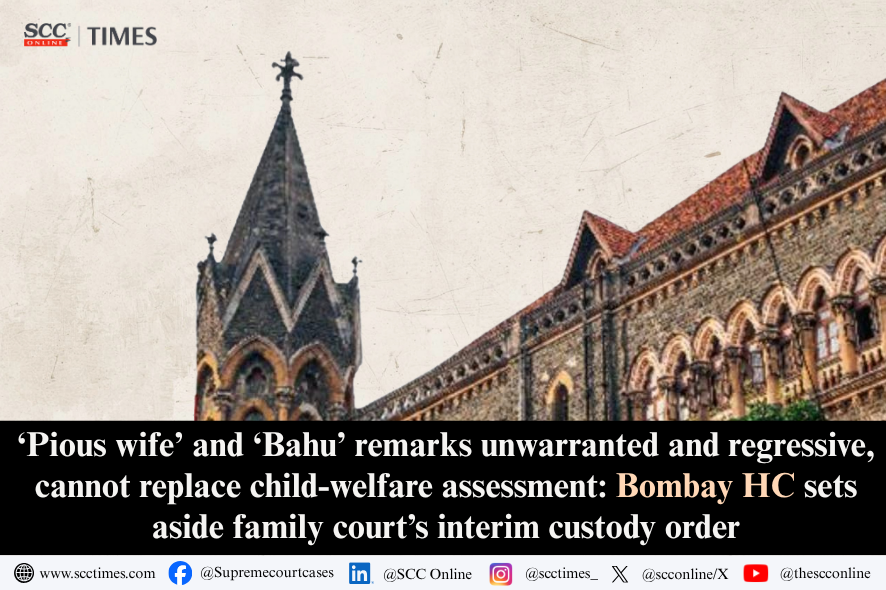
Bombay HC: Sets Aside Order for Flawed Child Welfare Custody Assessment
Summary
- The Bombay High Court set aside a family court's interim custody order, finding it based on "unwarranted and regressive" remarks.
- The family court had relied on characterizations like "pious wife" and "bahu" instead of a proper child-welfare assessment.
- The High Court ruled that the family court failed to appreciate the jurisdictional parameters of Section 12 of the Guardians and Wards Act.
- The family court did not independently assess the child's physical, emotional, educational, or psychological welfare.
- This decision emphasizes that subjective character judgments cannot replace objective child welfare criteria in custody matters.
Bombay HC Overturns Custody Order Citing Flawed Assessment
The Bombay High Court explicitly deemed these observations as "unwarranted and regressive," asserting that such subjective characterizations have no place in determining a child's custody.
The Bombay High Court recently intervened in a child custody dispute, setting aside an interim order issued by a family court. The higher court determined that the family court's decision, which had directed a change in interim custody, was fundamentally flawed due to its reliance on inappropriate and subjective character judgments rather than a proper assessment of the child's well-being. This ruling underscores a critical principle in Indian family law concerning the paramount importance of a child's welfare in custody matters.
The family court's original order was based on remarks characterizing one parent as a "pious wife" and "bahu" (daughter-in-law). The Bombay High Court explicitly deemed these observations as "unwarranted and regressive," asserting that such subjective characterizations have no place in determining a child's custody. The court emphasized that these remarks could not, and should not, serve as a substitute for a comprehensive child-welfare assessment, which is a mandatory requirement in such cases.
This decisive action by the Bombay High Court sends a clear message to lower courts regarding the standards expected when adjudicating child custody. It highlights a judicial commitment to ensuring that decisions impacting children are rooted in objective criteria directly related to their welfare, rather than societal stereotypes or personal opinions about a parent's character.
Legal Framework and Assessment Failures
Central to the Bombay High Court's decision was its finding that the family court had failed to properly understand and apply the jurisdictional parameters outlined in Section 12 of the Guardians and Wards Act. This specific section of the law mandates a thorough and independent evaluation of a child's welfare before any interim custody orders can be issued or altered. The family court's oversight in this regard was a primary reason for the High Court's intervention.
The High Court pointed out that the family court had neglected its duty to independently assess several crucial aspects of the child's welfare. These include the child's physical, emotional, educational, and psychological well-being. The absence of such a comprehensive and objective evaluation meant that the family court's order lacked the necessary legal foundation, rendering it unsustainable. The Guardians and Wards Act Section 12 explicitly requires courts to prioritize these factors, ensuring that any custody arrangement serves the child's best interests above all else.
By failing to conduct this independent assessment and instead relying on superficial character judgments, the family court deviated significantly from established legal principles. The Bombay High Court's ruling serves as a vital reminder that the welfare of the child is paramount in India, and courts must rigorously adhere to the prescribed legal framework for evaluating parental fitness and custody arrangements.
Implications for Child Custody Assessments
This ruling by the Bombay High Court carries significant implications for how family courts approach child custody assessments across the country. It firmly establishes that subjective moral judgments or traditional societal roles, such as those implied by "pious wife" and "bahu" remarks, are irrelevant and impermissible as criteria for determining a child's custody. Instead, the focus must remain squarely on the child's holistic development and well-being.
The decision reinforces the necessity for family courts to conduct a meticulous and independent assessment of all factors contributing to a child's welfare. This includes a detailed examination of the child's physical health, emotional stability, educational needs, and psychological state, ensuring that the custody arrangement promotes their optimal growth. The Bombay HC child welfare custody assessment criteria, as highlighted in this case, demand a scientific and child-centric approach, moving away from archaic biases.
Ultimately, this judgment from the Bombay High Court provides crucial guidance for legal practitioners and judges alike. It underscores that any family court custody assessment criteria must strictly align with the principles enshrined in the Guardians and Wards Act, prioritizing the child's best interests as the sole determinant. This judicial stance strengthens the legal framework designed to protect children and ensures that interim custody decisions are made on sound, welfare-centric grounds.
Practical Implications
Lawyers advising on child custody matters in India must ensure their arguments and evidence strictly adhere to the child's welfare assessment criteria under Section 12 of the Guardians and Wards Act, as the Bombay HC has clarified that regressive character judgments are irrelevant and grounds for overturning interim orders. This ruling reinforces the need to focus solely on the child's physical, emotional, educational, and psychological well-being.
Source
Source: Original reporting via SCC Times
How does this affect you?
Get an AI analysis of this article grounded in your jurisdictions, practice areas, and any policy documents you've uploaded to Wansom.
Finish Reading the Full Story and the Expert Analysis.
Wansom is AI and can make mistakes.