
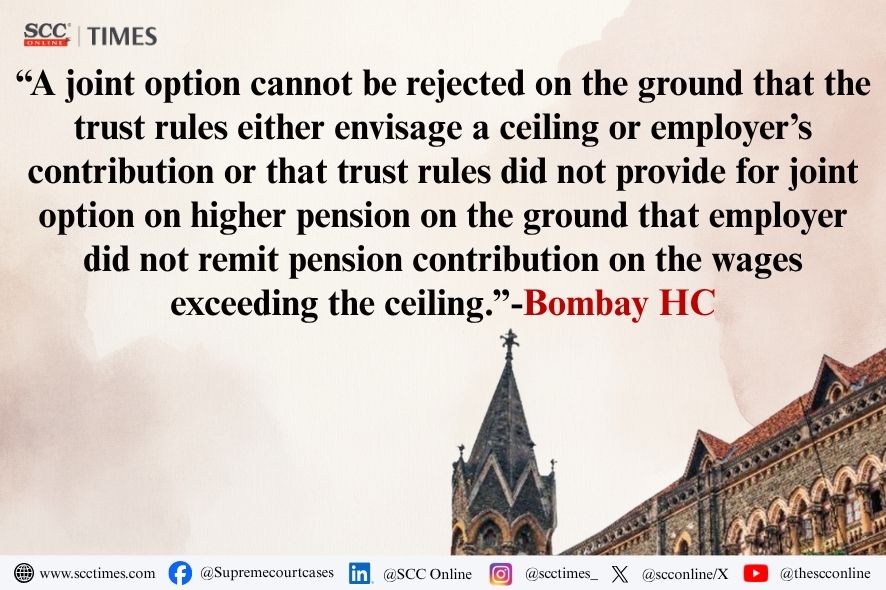
Bombay High Court: Higher Pension for Exempted Establishments Affirmed
Summary
- The Bombay High Court ruled that employees of exempted establishments are entitled to the same higher pension benefits under EPS 1995 as those in unexempted establishments.
- Provident fund trust rules cannot override statutory rights outlined in Paras 11(3) and 11(4) of the EPS 1995.
- Applications for higher pension cannot be denied solely due to trust rules imposing wage ceilings or not providing for contributions on actual wages.
- This decision ensures equitable access to enhanced pension provisions for employees in exempted organizations.
- Exempted establishments must now review their trust rules and pension application processes to comply with this ruling.
What Happened
Lawyers must now inform their clients that their internal trust rules cannot restrict employees' statutory right to higher pensions under EPS 1995, irrespective of any internal wage ceilings or contribution policies that may have been in place.
The Bombay High Court recently issued a significant ruling affirming the entitlement of employees in exempted establishments to higher pension benefits under the Employee Pension Scheme (EPS) 1995. This decision clarifies that these employees possess the same rights as their counterparts in unexempted organizations, ensuring equitable access to enhanced pension provisions. The court's pronouncement directly addresses a long-standing point of contention regarding pension eligibility.
Central to the court's judgment is the principle that the internal regulations governing provident fund trusts cannot supersede the statutory rights conferred by the EPS 1995. Specifically, the court highlighted that provisions within Paras 11(3) and 11(4) of the scheme establish entitlements that trust rules are legally bound to respect. This means that any application for a higher pension cannot be rejected on the basis of conflicting internal policies.
The ruling explicitly states that denials of higher pension applications are impermissible if they are solely based on the trust's internal rules imposing wage ceilings or failing to provide for contributions calculated on actual wages. This judicial stance reinforces the supremacy of statutory pension rights over the specific operational frameworks of individual exempted provident fund trusts. The Bombay High Court's decision sets a clear precedent for how these pension claims must be evaluated moving forward.
Legal Context
Exempted establishments are those that have been granted an exemption from the requirement to contribute to the Employees' Provident Fund Organisation (EPFO) directly, instead managing their own provident fund trusts. While these trusts operate under their own rules, they are still subject to the broader framework of the Employees' Provident Funds and Miscellaneous Provisions Act, 1952, and the EPS 1995. The dispute often arises when the trust's internal regulations, particularly concerning wage limits for contributions, clash with the provisions for higher pension under the EPS 1995.
The EPS 1995, specifically through its Paras 11(3) and 11(4), outlines the conditions and mechanisms for employees to opt for contributions on their actual wages, thereby qualifying for a higher pension upon retirement. Historically, some exempted provident fund trusts have maintained rules that either cap the wages on which contributions are made or do not explicitly facilitate contributions on actual wages beyond a certain threshold. This practice has led to employees of these establishments being denied the opportunity to secure a higher pension, despite the statutory provisions.
The Bombay High Court's recent ruling decisively resolves this conflict by asserting that the statutory rights enshrined in the EPS 1995 take precedence. It underscores that the operational autonomy granted to exempted provident fund trusts does not extend to curtailing fundamental pension entitlements. This interpretation ensures that the intent of the EPS 1995 higher pension ruling to provide benefits to eligible employees is upheld, irrespective of the specific internal governance of their employer's provident fund.
Why It Matters
This landmark decision from the Bombay High Court carries significant implications for a vast number of employees working in exempted establishments across various sectors. It effectively removes a barrier that previously prevented many from accessing their full pension entitlements, ensuring that their contributions on actual wages can translate into a commensurately higher pension. The ruling reinforces the principle that an employee's statutory rights cannot be diminished by the specific administrative arrangements of their employer's provident fund.
For legal professionals advising exempted provident fund establishments, this ruling necessitates an immediate review of existing trust deeds, rules, and pension application procedures. Lawyers must now inform their clients that their internal trust rules cannot restrict employees' statutory right to higher pensions under EPS 1995, irrespective of any internal wage ceilings or contribution policies that may have been in place. Compliance officers within these organizations are similarly tasked with auditing their current pension schemes and application processes to ensure full alignment with the court's directive.
The judgment serves as a critical reminder that while exempted provident fund trusts offer flexibility, this flexibility does not permit them to override or circumvent the fundamental statutory protections afforded to employees. Any denial of higher pension claims based on outdated or non-compliant trust provisions will now be legally indefensible. This ensures that the spirit and letter of the Bombay High Court EPS 1995 decision are universally applied, safeguarding the retirement benefits of countless individuals.
Practical Implications
Lawyers advising exempted provident fund establishments must inform clients that their trust rules cannot restrict employees' statutory right to higher pensions under EPS 1995, irrespective of internal wage ceilings or contribution policies. Compliance officers should review existing pension schemes and application processes to ensure they align with this ruling and avoid denying higher pension claims based on outdated trust provisions.
Source
How does this affect you?
Get an AI analysis of this article grounded in your jurisdictions, practice areas, and any policy documents you've uploaded to Wansom.
Finish Reading the Full Story and the Expert Analysis.
Wansom is AI and can make mistakes.