
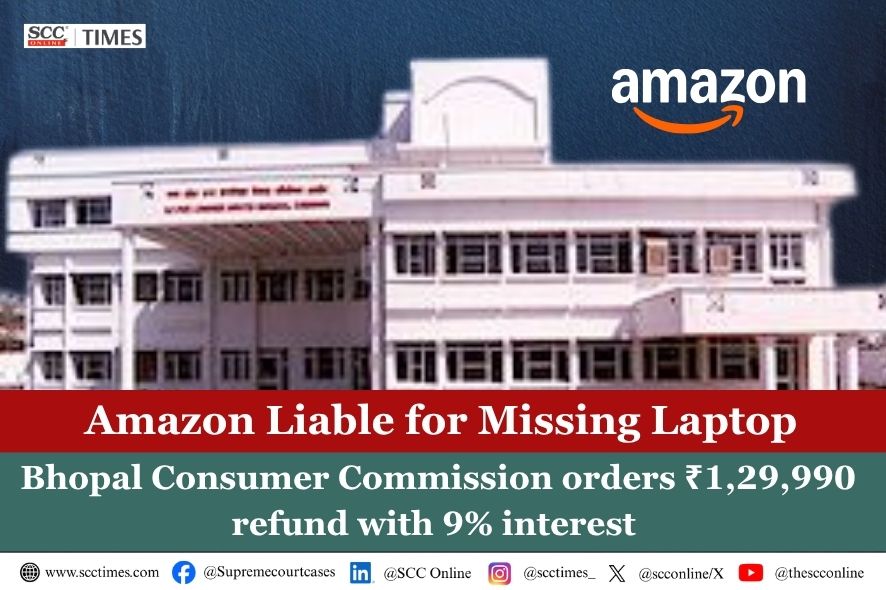
Bhopal Consumer Commission: Amazon Liable for E-Waste Laptop Delivery
Summary
- The District Consumer Disputes Redressal Commission, Bhopal, found Amazon liable for delivering e-waste instead of a laptop.
- The ordered laptop was valued at ₹1,29,990, which Amazon was ordered to refund.
- Amazon must also pay 9% interest on the refunded amount.
- The Commission rejected Amazon's defense of being a marketplace and its reliance on an OTP delivery record.
- This ruling sets a significant precedent for e-commerce marketplace liability in India regarding incorrect deliveries.
What Transpired
This significant decision by the District Consumer Disputes Redressal Commission, Bhopal, carries substantial implications for the entire e-commerce sector, particularly concerning e-commerce marketplace liability in India.
A recent decision by the District Consumer Disputes Redressal Commission, Bhopal, has placed significant liability on Amazon, stemming from a consumer's complaint regarding a fraudulent delivery. The case involved a customer who had placed an order for a laptop valued at ₹1,29,990 through the e-commerce giant's platform. However, upon receiving the package, the consumer discovered that instead of the high-value electronic device, the parcel contained e-waste. This unexpected and unacceptable substitution immediately triggered a dispute, leading the aggrieved customer to seek redressal from the consumer protection body.
The core of the consumer's grievance centered on the failure of Amazon's delivery mechanism to ensure the correct product reached its destination. The delivery of e-waste in place of a brand-new laptop represented a complete breach of the purchasing agreement and a significant financial loss for the individual. This incident underscores the challenges faced by consumers in the digital marketplace when discrepancies arise between ordered goods and delivered items, particularly when the items are of considerable value.
The Commission's Definitive Ruling
In its adjudication of the matter, the District Consumer Disputes Redressal Commission, Bhopal, issued a clear and decisive ruling, holding Amazon directly accountable for the misdelivery. The Commission explicitly stated that Amazon could not evade responsibility by invoking its status as merely a marketplace operator. This finding is particularly noteworthy as it challenges the common defense strategy employed by many e-commerce platforms, which often seek to distance themselves from the direct transaction between buyer and seller. The Commission's stance firmly established Amazon consumer liability India in this specific instance.
Furthermore, the District Consumer Disputes Redressal Commission, Bhopal, ruling also dismissed Amazon's reliance on an OTP (One-Time Password) delivery record as conclusive proof of a successful and correct delivery. The presence of an OTP confirmation, typically used to verify receipt, was deemed insufficient to absolve Amazon of liability when the contents of the package were demonstrably incorrect and fraudulent. Consequently, the Commission ordered Amazon to refund the full amount of ₹1,29,990 to the consumer. In addition to the principal amount, Amazon was also mandated to pay interest at a rate of 9 percent, further penalizing the company for the lapse in service and the subsequent consumer distress.
Broader Implications for E-commerce Platforms
This significant decision by the District Consumer Disputes Redressal Commission, Bhopal, carries substantial implications for the entire e-commerce sector, particularly concerning e-commerce marketplace liability in India. The ruling signals a growing expectation from regulatory bodies that online platforms will take greater responsibility for the integrity of deliveries, moving beyond a purely facilitative role. It suggests that simply providing a platform for transactions and relying on standard delivery verification methods like OTPs may no longer be sufficient to shield companies from liability when consumers receive incorrect or fraudulent items, especially in cases involving high-value goods like the Amazon e-waste laptop incident.
The case highlights a critical aspect of consumer protection e-waste delivery and online shopping dispute resolution. E-commerce companies, including major players, are now on notice that their operational frameworks, including their terms of service and delivery protocols, must be robust enough to prevent and address such serious discrepancies. This ruling could prompt a re-evaluation of how online retailers manage their supply chains, verify package contents, and handle customer complaints related to misdeliveries, ensuring that consumer trust in the digital marketplace is maintained. It reinforces the principle that consumers should be adequately protected against fraudulent practices, even when transactions occur through third-party platforms.
Practical Implications
Lawyers advising e-commerce platforms should review their terms of service and delivery verification processes (e.g., OTP) to ensure they adequately address liability for incorrect or fraudulent deliveries, as this ruling indicates marketplace status may not shield them. Compliance officers should assess their company's exposure to similar consumer claims in India.
Source
Source: Original reporting via SCC Times
How does this affect you?
Get an AI analysis of this article grounded in your jurisdictions, practice areas, and any policy documents you've uploaded to Wansom.
Finish Reading the Full Story and the Expert Analysis.
Wansom is AI and can make mistakes.