
Bhagalpur Blinding Case: India's Right to Free Legal Aid Affirmed
Summary
- Between 1979 and 1980, prisoners in Bhagalpur, Bihar, were subjected to blinding by police officers while in custody.
- The Supreme Court intervened, treating correspondence about the atrocities as a writ petition under Article 32.
- The landmark case of Khatri (II) v. State of Bihar established the State's obligation to provide free legal aid to indigent accused.
- This right to free legal aid begins from the moment an accused is first produced before a Magistrate, who must inform them of it.
- The ruling significantly impacted Article 21, affirming the constitutional promise of legal assistance regardless of affordability.
The Bhagalpur Atrocities
The Supreme Court unequivocally held that the State bears the constitutional obligation to provide free legal aid to any indigent accused person.
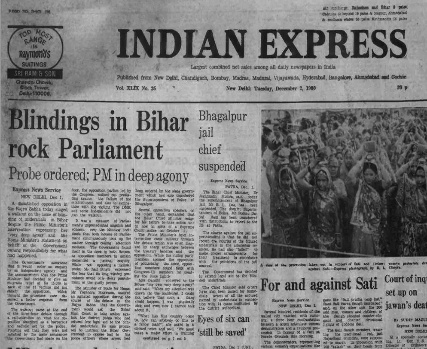
Between 1979 and 1980, the city of Bhagalpur in Bihar became the scene of one of independent India's most egregious instances of custodial violence. Prisoners, many of whom were still awaiting trial and thus presumed innocent, suffered horrific blinding at the hands of police officers while in custody and within the Bhagalpur Central Jail. This shocking episode transcended mere police excess, raising fundamental questions about the State's responsibility to its citizens, even those accused of crimes.
Accounts presented to the Supreme Court in the winter of 1980 detailed unimaginable torture, including eyes being pierced with needles, bicycle spokes, and similar instruments, followed by acid being poured into the wounds. Court records indicated that six prisoners were blinded between October 1979 and May 1980, with an additional twelve suffering the same fate from June 11 to July 25, 1980. While press reports at the time cited higher figures, ranging from 24 to 33, the court's figures specifically covered the cases brought before it. The incident later served as inspiration for Prakash Jha's 2003 film, "Gangaajal."
For months, the severity of these events remained largely hidden within the criminal justice system. Despite complaints and petitions from the jail reaching officials, the violence persisted, and the victims' plight seemed destined to be swallowed by institutional silence. It was only when letters and newspaper reports detailing the atrocities reached the Supreme Court that the full extent of the tragedy began to emerge.
Landmark Legal Precedent
Upon receiving the disturbing correspondence and news reports, the Supreme Court took an unusual procedural step for its time: it treated the communication itself as a writ petition under Article 32 of the Constitution. This action initiated the proceedings that would become known as `Khatri v. State of Bihar`, a pivotal case in Indian legal history.
Medical reports submitted to the Supreme Court painted a grim picture, confirming the extent of the injuries. One representative case documented the complete collapse of both eyeballs and total loss of eyesight, with medical experts attributing the damage to the use of corrosive substances and sharp instruments. The court explicitly noted that these findings revealed a flagrant violation of constitutional safeguards and acknowledged the irreparable physical harm inflicted upon the victims.
The subsequent ruling in `Khatri (II) v. State of Bihar` profoundly impacted `Article 21 right to legal aid`. The Supreme Court unequivocally held that the State bears the constitutional obligation to provide `free legal aid` to any `indigent accused` person. Crucially, this right commences from the very moment the accused is first produced before a Magistrate, and the Magistrate is mandated to inform the accused of this fundamental entitlement. This established a critical precedent for `India indigent accused legal representation`.
The Enduring Constitutional Mandate
The `Bhagalpur blinding case free legal aid` ruling underscored a vital principle: the State's responsibility to protect its citizens, even when they are accused, and to ensure access to justice regardless of economic status. The tragedy exposed the profound helplessness of individuals who, despite being under the protection of the Constitution, were denied even the most basic guarantees of human dignity and personal liberty. This case highlighted that the constitutional promise of legal assistance should not be contingent on a person's ability to afford it.
This landmark judgment remains a cornerstone for ensuring that `custodial violence legal aid India` is not just a theoretical right but a practical reality. It serves as a powerful reminder that the State must actively facilitate legal representation for those who cannot afford it, particularly at the earliest stages of interaction with the criminal justice system. The precedent set by `Khatri (II) v. State of Bihar` is crucial for ensuring access to justice and challenging instances where this fundamental right is denied.
The principles established through this case continue to guide the provision of `free legal services` and emphasize the ongoing need for vigilance to uphold the constitutional mandate that no individual should be left without legal assistance simply due to their financial circumstances.
Practical Implications
Lawyers must be aware of the constitutional mandate, stemming from the Bhagalpur blinding case and Khatri (II) v. State of Bihar, that indigent accused have a right to free legal aid from the moment they are first produced before a magistrate, and magistrates must inform them of this right. This precedent is crucial for ensuring access to justice and challenging instances where this fundamental right is denied.
Source
How does this affect you?
Get an AI analysis of this article grounded in your jurisdictions, practice areas, and any policy documents you've uploaded to Wansom.
Finish Reading the Full Story and the Expert Analysis.
Get the latest legal & regulatory intelligence in India
Wansom is AI and can make mistakes.