
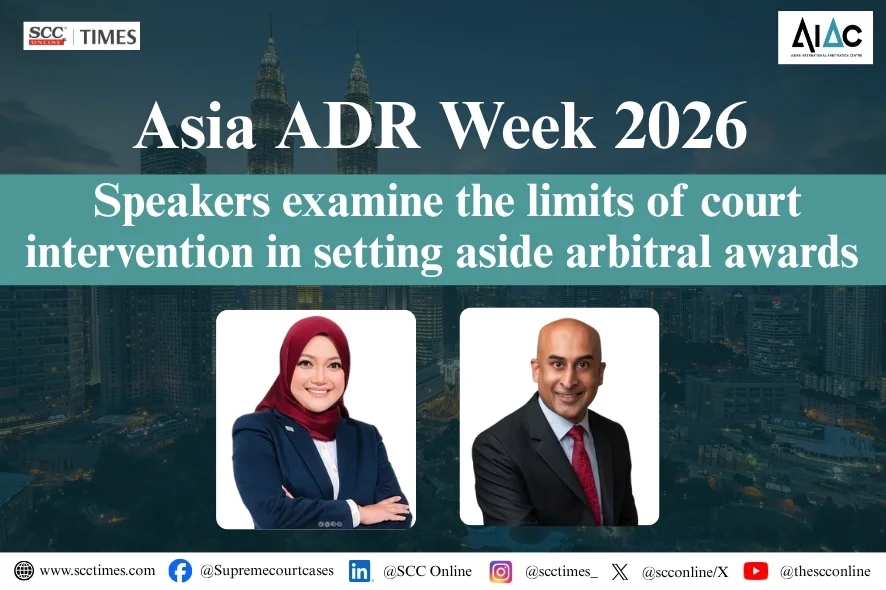
Asia ADR Week 2026: Defining Arbitral Award Challenge Limits in India
Summary
- Day 1 of Asia ADR Week 2026 focused on the specific conditions under which arbitral awards can be challenged in court.
- Discussions highlighted a key distinction between errors in a tribunal's reasoning and legitimate legal grounds for intervention.
- The recognized legal grounds for challenging an award include jurisdictional issues, public policy violations, and breaches of natural justice.
- These strict limitations aim to prevent courts from acting as an appellate body for arbitral decisions.
- The event emphasized the high bar for court intervention, reinforcing the finality of arbitration.
Key Discussions at Asia ADR Week 2026
The discussions clarified that courts typically intervene only under very specific circumstances, which include fundamental jurisdictional issues, violations of public policy, and breaches of natural justice.
The inaugural day of Asia ADR Week 2026 featured extensive discussions centered on the parameters within which an arbitral award can be subjected to judicial scrutiny. Experts convened to delineate the critical difference between a tribunal's flawed reasoning and the specific, legally recognized justifications for court intervention in arbitration proceedings. This focus underscored the event's commitment to exploring the nuanced aspects of alternative dispute resolution.
The core of the debate revolved around when courts are permitted to set aside arbitral awards, emphasizing that not every perceived error by an arbitral tribunal warrants judicial interference. Instead, the discourse highlighted that challenges must align with established legal grounds, thereby reinforcing the principle of arbitral finality. The event provided a platform for legal professionals to delve into the intricacies of these limitations.
Legal Framework for Challenging Awards
Attendees at Asia ADR Week 2026 were particularly interested in the precise grounds for challenging arbitral awards. The discussions clarified that courts typically intervene only under very specific circumstances, which include fundamental jurisdictional issues, violations of public policy, and breaches of natural justice. These categories represent the narrow gateway through which an arbitral award can be challenged, distinguishing them sharply from mere disagreements with a tribunal's factual findings or legal interpretations.
For instance, a challenge based on public policy arbitral award India would require demonstrating that the award contravenes the most basic notions of morality or justice within the country's legal system. Similarly, a natural justice breach arbitration India would involve proving that a party was denied a fair hearing or an opportunity to present its case. These stringent requirements illustrate the high bar for court intervention arbitration India, ensuring that the arbitral process remains largely autonomous and efficient.
Why These Limits Matter
The emphasis on the strict limits of court intervention in setting aside arbitral awards is crucial for maintaining the integrity and effectiveness of arbitration as a dispute resolution mechanism. By clearly distinguishing between a tribunal's substantive errors and procedural or fundamental legal flaws, the system aims to prevent disgruntled parties from using judicial review as a de facto appeal process. This approach reinforces the finality of arbitral decisions, which is a cornerstone of their appeal over traditional litigation.
Understanding these narrow grounds for challenging arbitral awards is vital for legal practitioners and businesses engaged in international and domestic arbitration. It provides clarity on the viability of challenging an award and the significant hurdles involved, thereby promoting greater certainty in commercial dealings. The discussions at Asia ADR Week 2026 underscored that while judicial oversight exists, it is designed to be exceptional, preserving the autonomy and efficiency of the arbitral process.
Practical Implications
Lawyers and compliance officers should note the emphasized narrow grounds for court intervention in arbitral awards (jurisdiction, public policy, natural justice breaches) to accurately advise clients on the viability of challenging an award and the high bar for success, reinforcing the finality of arbitration.
Source
Source: Original reporting via SCC Times
How does this affect you?
Get an AI analysis of this article grounded in your jurisdictions, practice areas, and any policy documents you've uploaded to Wansom.
Finish Reading the Full Story and the Expert Analysis.
Get the latest legal & regulatory intelligence in India
Wansom is AI and can make mistakes.