
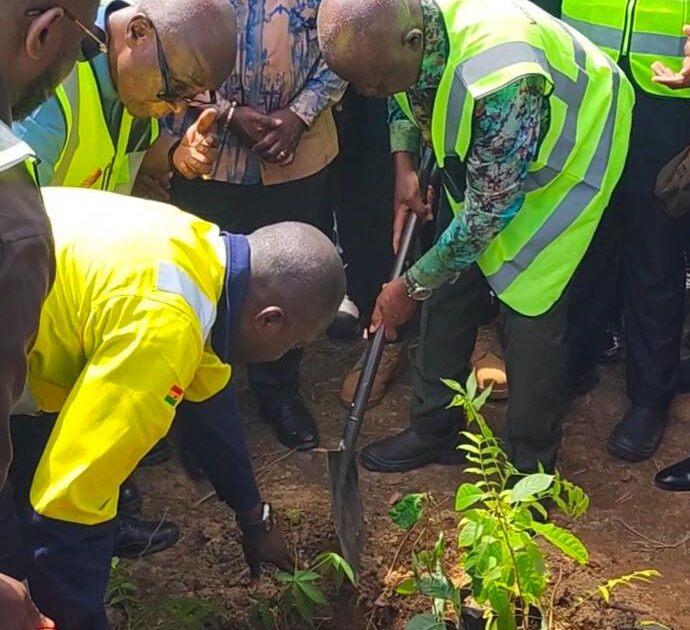
Asantehene: Jimi Watercourse Galamsey Rehabilitation Project Launched
Summary
- The Asantehene, Otumfuo Osei Tutu II, launched the Jimi Land Reclamation and River Watercourse Rehabilitation Project on October 14, 2026, by planting trees near Obuasi.
- The 153-hectare pilot project aims to restore the Jimi Watercourse, a vital water source for over 200,000 people, severely degraded by illegal mining (galamsey).
- Galamsey has caused extensive environmental damage, including contaminated soils, diverted river courses, and increased water treatment costs, leading to water rationing in communities.
- The project employs a six-step restoration model, including replanting with kenaf for land rehabilitation and alternative livelihoods, with technical support from AngloGold Ashanti.
- Ghana's government highlights the national scale of galamsey impact, with 8,000 hectares of forest reserves affected, and views the Asantehene's initiative as a replicable model for national restoration.
What Happened
The Asantehene Jimi Watercourse galamsey rehabilitation effort serves as a powerful example within Ghana's broader struggle against illegal mining.
On October 14, 2026, the Asantehene, Otumfuo Osei Tutu II, initiated a significant environmental restoration effort by planting trees along the Jimi River near Obuasi. This symbolic act marked the official launch of a comprehensive project aimed at reclaiming lands and rehabilitating the Jimi Watercourse, which has been severely damaged by illegal mining activities, commonly known as galamsey. The Asantehene's visit included an inspection of Lot 1 of the Jimi Land Reclamation and River Watercourse Rehabilitation Project, a 153-hectare pilot initiative operating under the broader Green Ashanti Initiative.
This crucial intervention focuses on an area that serves as a primary water source for the Adansi enclave. The project underscores a concerted effort to reverse the extensive environmental degradation caused by galamsey, which has left the landscape scarred with stripped vegetation, contaminated soils, and numerous open pits. The Asantehene's direct involvement highlights the traditional authority's commitment to addressing the ecological crisis stemming from illegal mining in Ghana.
The Devastating Impact of Galamsey
The environmental toll of galamsey on the Jimi River and its surroundings is profound, posing a direct threat to both the river itself and the downstream Jimi Dam. This dam is vital, providing treated water to over 200,000 residents across Obuasi and the wider Adansi area. Illegal mining operations, particularly at Tasliman, have drastically altered the river's natural course, creating massive sand heaps that lead to severe siltation and elevated turbidity levels in the water.
These changes have significant economic and social repercussions. The rising turbidity has substantially increased the cost of water treatment, with AngloGold Ashanti's Director of Engineering, Ing. Eric Broni, reporting that $584,000 was spent last year to treat a reduced volume of water. Furthermore, the decreasing volume of the dam necessitates water rationing for affected communities, indicating a looming crisis in water supply. Ing. Broni expressed concern that water abstraction is likely to decrease further this year as water levels continue to drop, exacerbating the challenges faced by the local population.
A Collaborative Restoration Model
The Jimi Land Reclamation and River Watercourse Project is spearheaded by the Ashanti Green Initiative, under the leadership of Oheneba Nana Kwaku Duah, with the Manhyia Palace providing essential vision and patronage. This ambitious project employs a six-step restoration model designed to systematically reverse the damage. The process includes backfilling hazardous pits, re-grading spoil heaps, terracing slopes to prevent further erosion, containing heavy metal contamination, installing drainage and erosion control systems, restoring nutrient-rich topsoil, and finally, replanting with kenaf.
Kenaf, a rapidly growing fiber crop used for sacks, ropes, and eco-composites, was specifically chosen over traditional food crops. This decision mitigates the risk of residual contamination entering the food chain and simultaneously offers alternative livelihood opportunities for local farmers. In addition to land restoration, the Jimi River and its buffer zones are slated for thorough cleaning and replanting, guided by the Environmental Protection Agency (EPA). AngloGold Ashanti is a key partner, contributing technical and operational support, with Managing Director Samuel Boakye Pobee emphasizing their pride in combating land degradation and the critical role the Jimi River plays for the broader Obuasi community, serving more people outside the mine than within it.
National Context and Call to Action
The Asantehene Jimi Watercourse galamsey rehabilitation effort serves as a powerful example within Ghana's broader struggle against illegal mining. Emmanuel Armah-Kofi Buah, the Minister for Lands and Natural Resources, revealed the alarming statistic that approximately 8,000 hectares across 188 forest reserves nationwide have been impacted by galamsey, yet only 150 hectares have been successfully reclaimed to date. This stark contrast underscores the immense scale of the challenge and the urgent need for more widespread intervention.
Minister Buah stressed that government success in addressing this issue is contingent upon robust partnerships, particularly given that 80% of the nation's water originates from forest reserves, making this a matter of human survival. He lauded the Asantehene's commitment as a model for all traditional chiefs. Echoing this sentiment, Mahama Ayariga, the Minister for Local Government, Chieftaincy and Religious Affairs, characterized the project as a "national crusade," urging traditional leaders to collaborate with civil society, mining companies, and the government to lead the charge in restoring Ghana's degraded lands. The Green Ashanti Initiative's tree planting at Jimi is thus envisioned as more than a symbolic gesture; it represents a replicable model for Ghana galamsey impact mitigation, aiming to protect clean water sources and restore livelihoods across the nation.
Practical Implications
Companies operating in Ghana, particularly in resource extraction or land development, should note the intensified, multi-stakeholder approach to combating galamsey and rehabilitating degraded lands. This signals increased regulatory scrutiny, potential for stricter environmental compliance, and the necessity of robust ESG strategies and community engagement to mitigate operational risks and align with national restoration efforts led by traditional authorities and government.
Source
How does this affect you?
Get an AI analysis of this article grounded in your jurisdictions, practice areas, and any policy documents you've uploaded to Wansom.
Finish Reading the Full Story and the Expert Analysis.
Get the latest legal & regulatory intelligence in Ghana
Wansom is AI and can make mistakes.