
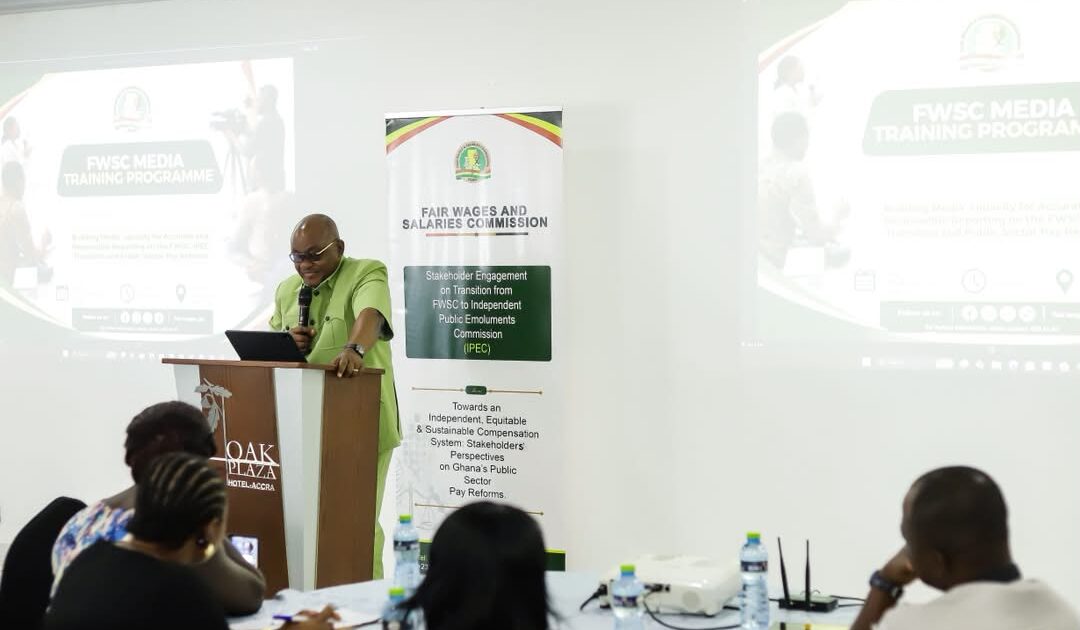
Ghana FWSC: Prepares Media for IPEC Public Sector Transition
Summary
- The Fair Wages and Salaries Commission (FWSC) held a workshop on October 14, 2026, to discuss the proposed transition to the Independent Public Emoluments Commission (IPEC).
- The reform aims to address persistent inequalities in Ghana's public sector compensation by establishing a more coordinated, transparent, and accountable system.
- The current Single Spine Pay Policy (SSPP) has not fully resolved disparities, as allowances and other benefits create significant differences in total remuneration.
- IPEC's mandate includes developing a national framework for public sector remuneration, encompassing job evaluation, salary structures, and supporting collective bargaining with reliable data.
- The transition will involve phased implementation, starting with stakeholder consultations and legislative action, while preserving lawful collective bargaining.
What Happened
The proposed IPEC framework is specifically designed to address these identified gaps by taking into account the entire spectrum of financial rewards associated with public employment and office.
The Fair Wages and Salaries Commission (FWSC) recently concluded a two-day capacity-building workshop for select media professionals, focusing on the impending transition to the Independent Public Emoluments Commission (IPEC). Held on October 14, 2026, the event aimed to inform participants about the proposed Commission's mandate, the underlying reasons for this significant shift, and its broad implications for public sector remuneration, collective bargaining processes, and the overall management of public funds in Ghana. This initiative underscores the government's commitment to transparent communication regarding the Ghana IPEC transition public sector reform.
Dr. George Smith Graham, the Chief Executive of the FWSC, addressed the attendees, emphasizing that this reform represents a crucial opportunity to tackle long-standing disparities within public sector compensation. He articulated a vision for a more coordinated, transparent, and accountable system, designed to rectify existing inequities. The workshop served as a platform to clarify the objectives and operational framework of the proposed IPEC, ensuring that media personnel are well-equipped to report accurately on these developments.
The Rationale for Comprehensive Reform
Dr. Graham highlighted that a common basic salary structure, such as that provided by the Single Spine Pay Policy (SSPP), has proven insufficient on its own to resolve every inequity in public sector compensation. While the SSPP established a unified basis for job evaluation and determining basic salaries, significant disparities persist due to variations in allowances, benefits, and other institutional arrangements. This situation often leads to scenarios where two employees with comparable basic salaries receive vastly different total remuneration packages, influenced by factors like housing, transport, additional benefits, or specific institutional agreements.
The proposed IPEC framework is specifically designed to address these identified gaps by taking into account the entire spectrum of financial rewards associated with public employment and office. This holistic approach aims to move beyond just basic salaries, ensuring that all components of compensation are considered in the pursuit of fairness. The Ghana public sector remuneration reform seeks to create a more equitable system that recognizes the full scope of an employee's financial package.
IPEC's Mandate and Operational Framework
The Independent Public Emoluments Commission mandate encompasses the development and ongoing maintenance of a national framework for public sector remuneration. This comprehensive framework will include critical elements such as job evaluation methodologies, grading structures, salary scales, and defined pay bands. Beyond establishing these foundational components, the IPEC is also tasked with strengthening the assessment and certification processes for all covered remuneration arrangements.
Furthermore, the Commission will play a pivotal role in supporting collective bargaining efforts by providing reliable data, thereby making negotiations more predictable and grounded in transparent parameters and proper assessments of affordability. It is also expected to significantly enhance monitoring mechanisms and public accountability regarding compensation decisions. Dr. Graham clarified that fairness in remuneration does not equate to identical salaries for all, acknowledging that different roles carry varying responsibilities, require scarce expertise, or involve greater risk, hardship, or leadership demands. A truly fair system, he asserted, must recognize and provide evidence for these justified differences.
Implementation and Stakeholder Assurance
Remuneration proposals under the new framework will undergo rigorous assessment against legal, technical, and fiscal considerations before their implementation, subject to the powers granted by the final legislation. This process will involve answering several key questions: Is the proposal lawful? Is it supported by job and institutional evidence? Is it equitable compared to similar arrangements? Has its full cost been assessed? And is there adequate budget provision? Dr. Graham cautioned that compensation decisions can create financial obligations that extend beyond immediate beneficiaries, impacting pensions, arrears, and future demands from other institutions.
Crucially, the FWSC Chief Executive provided assurances to organized labor that the proposed reform will uphold lawful collective bargaining. He affirmed that workers and their representatives will remain essential participants in decisions affecting their livelihoods. The implementation of the Ghana IPEC transition public sector will proceed in phases, commencing with extensive stakeholder consultations, followed by the preparation and passage of the necessary legislation. This phased approach aims to ensure a smooth and inclusive transition.
Practical Implications
Lawyers advising public sector entities, unions, or employees in Ghana should closely monitor the legislative progress and stakeholder consultations regarding the proposed Independent Public Emoluments Commission (IPEC). Its establishment will introduce a new national framework for public sector remuneration, impacting job evaluation, salary structures, and collective bargaining, requiring a review of existing compensation practices for compliance and strategic planning.
Source
How does this affect you?
Get an AI analysis of this article grounded in your jurisdictions, practice areas, and any policy documents you've uploaded to Wansom.
Finish Reading the Full Story and the Expert Analysis.
Get the latest legal & regulatory intelligence in Ghana
Wansom is AI and can make mistakes.