
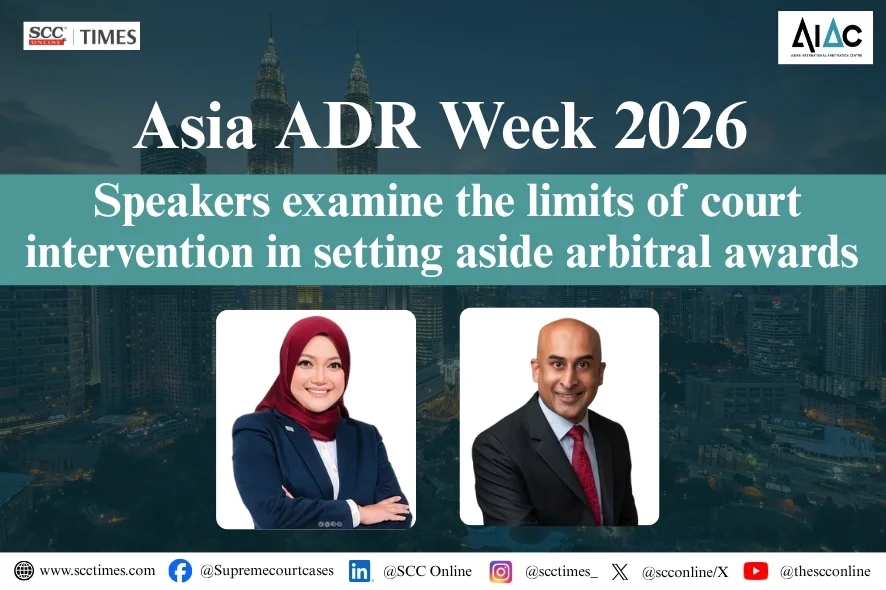
Arbitral Awards: Limits of Court Intervention Examined at Asia ADR Week
During Asia ADR Week 2026, speakers discussed the limits of court intervention in setting aside arbitral awards, emphasizing the crucial distinction between errors in a tribunal’s reasoning and the narrow legal grounds for judicial interference, such as jurisdictional issues, public policy, and breaches of natural justice. This discussion highlights the ongoing global commitment to the principle of minimal judicial oversight in arbitration.
This topic holds immense legal significance for practitioners in arbitration and commercial litigation, as it reinforces the finality and enforceability of arbitral awards, which are cornerstones of effective alternative dispute resolution. For businesses, understanding these limits provides certainty regarding the binding nature of arbitration clauses and awards, encouraging greater reliance on arbitration for dispute resolution. The discussion underscores that courts are not appellate bodies for arbitral tribunals, and their role is generally confined to reviewing procedural fairness and adherence to fundamental legal principles, not re-examining the merits of a case.
The legal context for challenging arbitral awards in India is primarily found in Section 34 of the Arbitration and Conciliation Act, 1996, which enumerates the specific grounds for setting aside an award. These grounds are exhaustive and include instances where a party was under some incapacity, the arbitration agreement is invalid, proper notice was not given, the award deals with a dispute not contemplated by or falling outside the terms of the submission to arbitration, or the composition of the arbitral tribunal or the arbitral procedure was not in accordance with the agreement of the parties. Crucially, the Act also allows for setting aside if the award is in conflict with the public policy of India or is vitiated by patent illegality appearing on the face of the award.
The key parties involved in this discussion were the speakers at Asia ADR Week 2026, representing various perspectives on international and domestic arbitration. While no specific court or case was mentioned, the discussions would undoubtedly draw upon a rich body of jurisprudence from the Supreme Court of India and various High Courts, which have consistently interpreted and applied Section 34, often emphasizing a pro-arbitration stance and a narrow construction of the grounds for intervention. The outcome of the discussions was not a ruling but rather an academic and practical exploration of existing legal principles.
Practitioners must therefore meticulously prepare their cases during arbitration to avoid procedural pitfalls that could later form grounds for challenge. Furthermore, when advising clients on challenging an award, attorneys must rigorously assess whether the grounds fall strictly within the narrow confines of Section 34, rather than attempting to re-litigate the merits. This requires a deep understanding of both domestic arbitration law and international best practices, ensuring that the integrity and efficiency of the arbitral process are maintained.
How does this affect you?
Get an AI analysis of this article grounded in your jurisdictions, practice areas, and any policy documents you've uploaded to Wansom.
Finish Reading the Full Story and the Expert Analysis.
Get the latest legal & regulatory intelligence in India
Wansom is AI and can make mistakes.