
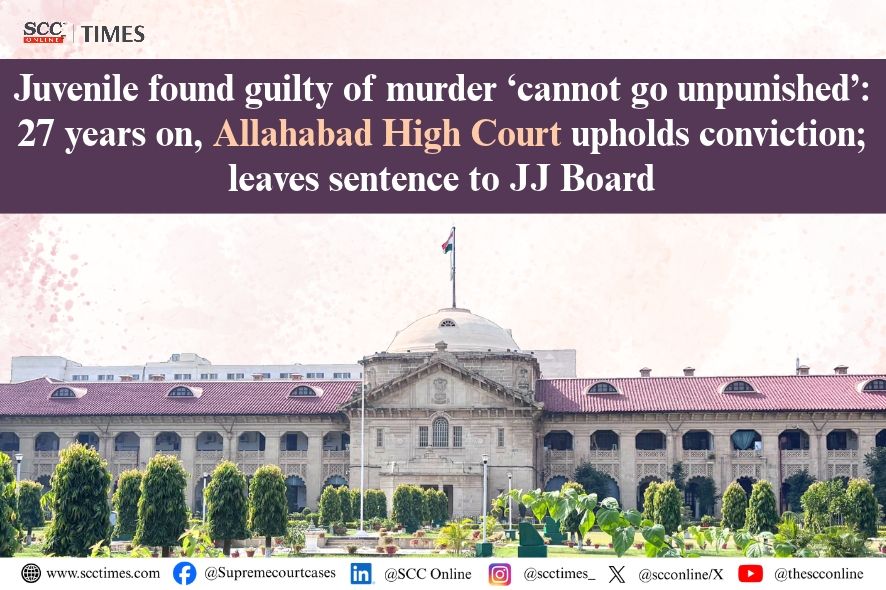
Allahabad High Court: Affirms Juvenile Murder Conviction, Defers Sentencing to JJB
Summary
- The Allahabad High Court upheld a murder conviction against an individual who was a juvenile at the time of the offense.
- This conviction was affirmed 27 years after the crime took place.
- The Court ruled that a juvenile found guilty of an offense cannot go unpunished.
- However, the responsibility for determining the specific punishment rests solely with the Juvenile Justice Board.
- The Juvenile Justice Board is constituted under the relevant Act to handle juvenile sentencing.
What Happened
Lawyers handling juvenile criminal cases in India must note that while conviction for serious offenses like murder can be upheld even decades later, the sentencing authority remains exclusively with the Juvenile Justice Board.
The Allahabad High Court recently affirmed a murder conviction against an individual who was a juvenile at the time the offense was committed, a decision rendered 27 years after the initial incident. This significant ruling underscores the principle that even when a serious crime like murder is attributed to a juvenile, the individual cannot evade accountability. The court's judgment specifically addressed the long-standing case, confirming the factual guilt established against the then-minor.
Despite upholding the conviction for the grave offense, the High Court delineated a clear separation of powers regarding the punitive measures. It explicitly stated that while the finding of guilt was within its purview, the determination of the appropriate punishment for the juvenile offender falls exclusively to the Juvenile Justice Board. This distinction highlights the unique procedural framework governing juvenile criminal cases in India, even when they involve severe charges and decades-long legal battles. The court's pronouncement ensures that the legal process, though protracted, ultimately leads to a definitive finding of responsibility.
Legal Context
The ruling by the Allahabad High Court reinforces the specialized legal framework established for juvenile offenders under Indian law, particularly concerning the Juvenile Justice Board sentencing. According to the court, the responsibility for meting out punishment to a juvenile found guilty of an offense, including murder, rests solely with the Juvenile Justice Board (JJB) as constituted under the relevant Act. This statutory body is specifically designed to handle the rehabilitation and sentencing aspects for minors in conflict with the law, differentiating their treatment from adult offenders.
This judicial interpretation clarifies that even when a higher court, such as the Allahabad High Court, confirms a juvenile murder conviction India, its role is limited to the factual and legal validity of the conviction itself. The actual "JJ Act punishment juvenile" is a matter reserved for the JJB, which considers various factors unique to juvenile justice, including the best interests of the child, rehabilitation potential, and the specific circumstances of the case. This division of authority ensures that while serious crimes are acknowledged, the sentencing process remains aligned with the protective and reformative principles of juvenile law.
Why It Matters
This decision from the Allahabad High Court holds considerable weight for the landscape of criminal law in India, particularly for cases involving juvenile offenders. It firmly establishes that the passage of time, even as long as 27 years, does not diminish the legal system's capacity to confirm a conviction for a serious crime like murder committed by a juvenile. This aspect is crucial for maintaining public trust in the justice system's ability to address grave offenses, regardless of the offender's age at the time of the crime.
Furthermore, the ruling serves as a critical reminder for legal practitioners and the judiciary about the precise boundaries of their roles in juvenile criminal cases. Lawyers handling juvenile criminal cases in India must note that while conviction for serious offenses like murder can be upheld even decades later, the sentencing authority remains exclusively with the Juvenile Justice Board. This emphasizes the distinct procedural framework for juvenile offenders, ensuring that the specialized expertise and mandate of the JJB are respected in determining the appropriate response to a juvenile's culpability. The judgment thus reinforces the dual objectives of accountability for serious crimes and the distinct, reform-oriented approach to juvenile justice.
Practical Implications
Lawyers handling juvenile criminal cases in India must note that while conviction for serious offenses like murder can be upheld even decades later, the sentencing authority remains exclusively with the Juvenile Justice Board, emphasizing the distinct procedural framework for juvenile offenders.
Source
Source: Original reporting via SCC Times
How does this affect you?
Get an AI analysis of this article grounded in your jurisdictions, practice areas, and any policy documents you've uploaded to Wansom.
Finish Reading the Full Story and the Expert Analysis.
Wansom is AI and can make mistakes.