
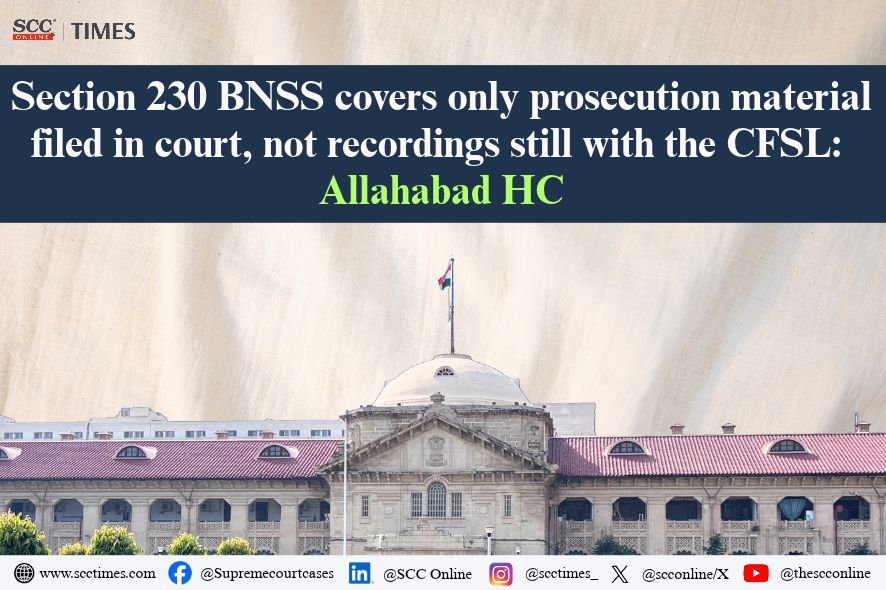
Allahabad High Court: Section 230 BNSS CFSL Recordings Not Supplied If Not Filed
Summary
- The Allahabad High Court recently ruled on the supply of evidence to an accused person.
- Original telephonic recordings sent to CFSL for expert opinion had not yet been filed with the trial court.
- The court determined that material not filed on the trial court's record cannot be supplied to an accused.
- This ruling clarifies the timing of evidence disclosure under Section 230 BNSS.
The Court's Observation
The court explicitly stated that any material, irrespective of its nature or potential significance to the case, which has not been formally filed on the trial court’s record, cannot be supplied to an accused person.
The Allahabad High Court recently clarified the procedural requirements for evidence disclosure, specifically addressing the provision of material to an accused person when that material has not yet been formally presented to the trial court. The case involved original recordings of telephonic conversations, which had been dispatched to the Central Forensic Science Laboratory (CFSL) for expert analysis and opinion. At the time of the court's consideration, these crucial telephonic recordings had not yet been formally placed on the record of the trial court.
The court's observation underscored a fundamental principle of evidence management within the Indian legal system. It was noted that since these specific telephonic recordings were still undergoing forensic examination and had not been officially submitted to the trial court, they did not constitute part of the formal court record. This status was central to the High Court's determination regarding their immediate availability to the accused.
Legal Framework for Disclosure under BNSS
Under the framework of the Bharatiya Nagarik Suraksha Sanhita (BNSS), particularly Section 230, the process of evidence supply to an accused is governed by specific procedural stages. The Allahabad High Court's ruling reinforces the established understanding that material must first be formally brought onto the trial court's record before it becomes accessible for disclosure to the defense. This principle ensures that only authenticated and officially recognized evidence forms the basis of the proceedings and is subject to scrutiny by all parties.
The court explicitly stated that any material, irrespective of its nature or potential significance to the case, which has not been formally filed on the trial court’s record, cannot be supplied to an accused person. This directive provides clarity on the timing of evidence disclosure, particularly concerning items that are still undergoing preliminary analysis or have not yet been formally tendered by the prosecution. The ruling effectively delineates the point at which the obligation for evidence supply under Section 230 BNSS is triggered.
Implications for Defense and Forensic Evidence
This pronouncement from the Allahabad High Court carries significant implications for defense lawyers in India, particularly in cases involving complex forensic evidence such as CFSL recordings. It clarifies that the accused cannot demand copies of material, including telephonic recordings sent to CFSL for expert opinion, until such time as these items are formally presented and filed with the trial court. This impacts the timing of discovery strategies and the window available for challenging the prosecution’s evidence.
Defense counsel must therefore adjust their approach to evidence disclosure, understanding that certain materials, even if known to exist and be in the possession of investigative agencies, are not immediately accessible if they have not yet become part of the official court record. This ruling on telephonic recordings non-supply India, especially when they are undergoing forensic analysis, means that the defense may need to await the completion of expert reports and the subsequent filing of these materials by the prosecution before they can obtain accused copies and formulate their responses. The Allahabad High Court evidence disclosure standard, as articulated here, emphasizes the procedural formality over immediate access to all investigative material.
Practical Implications
Defense lawyers in India should note this Allahabad High Court ruling clarifying that material, such as telephonic recordings sent to CFSL, need not be supplied to the accused until formally filed with the trial court. This impacts discovery strategies and the timing of challenges to prosecution evidence, particularly in cases involving forensic analysis.
Source
How does this affect you?
Get an AI analysis of this article grounded in your jurisdictions, practice areas, and any policy documents you've uploaded to Wansom.
Finish Reading the Full Story and the Expert Analysis.
Wansom is AI and can make mistakes.