
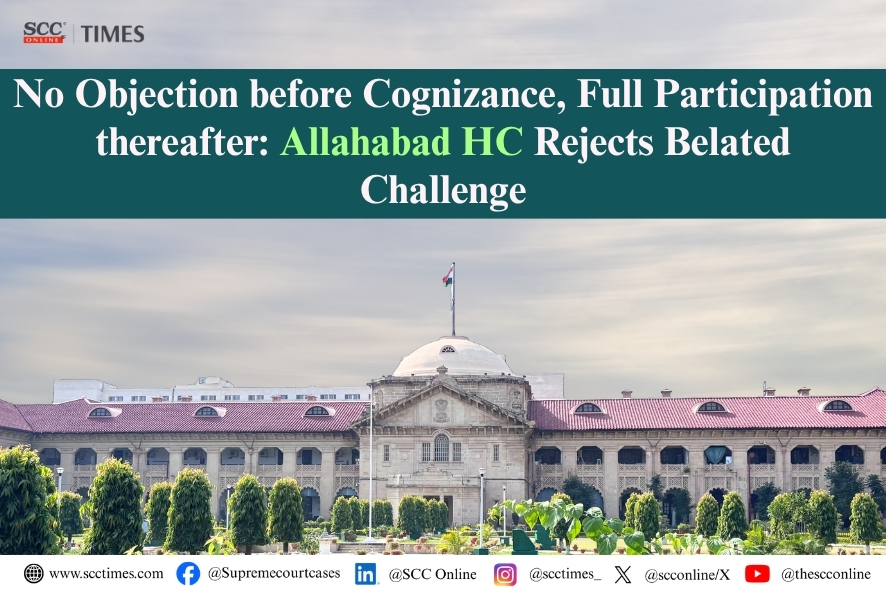
Allahabad HC Rejects Belated Cognizance Challenge After Counsel Change
Summary
- The Allahabad High Court rejected a challenge to a cognizance order that was raised during the final submissions stage of a trial.
- The court ruled that a mere change of counsel is not a sufficient ground to entertain such a belated objection.
- The decision emphasizes the importance of raising procedural objections, particularly concerning cognizance, at an early stage of criminal proceedings.
- Substantial participation in a trial without prior objection to cognizance can lead to the waiver of that right.
- This ruling reinforces the need for procedural diligence among legal practitioners in India.
Allahabad High Court Rejects Belated Challenge
The Allahabad High Court recently delivered a significant ruling, affirming that a challenge to a court's cognizance order cannot be entertained when raised at the advanced stage of hearing final submissions, particularly if the sole ground for such a challenge is a mere change of legal counsel.
The Allahabad High Court recently delivered a significant ruling, affirming that a challenge to a court's cognizance order cannot be entertained when raised at the advanced stage of hearing final submissions, particularly if the sole ground for such a challenge is a mere change of legal counsel. This decision underscores the judiciary's emphasis on procedural diligence and the timely raising of objections in criminal proceedings.
The court's pronouncement came in a scenario where an objection to the initial cognizance of a case was brought forth only as the trial neared its conclusion, specifically during the phase dedicated to final arguments. The challenge was deemed belated, given the substantial participation in the proceedings that had already occurred without any prior protest regarding the cognizance order. The High Court made it clear that such a late intervention, predicated solely on a new legal representative taking over the case, lacks sufficient merit to disrupt the ongoing judicial process.
Understanding Cognizance in Indian Criminal Procedure
In the Indian legal system, the taking of cognizance by a court marks a pivotal moment in a criminal case. It signifies the point at which a magistrate or judge applies their mind to the facts of a case, either through a complaint, police report, or other information, with a view to taking further action. This initial step is crucial as it determines whether there are sufficient grounds to proceed against an accused person, thereby initiating the judicial process.
Challenges to a cognizance order are typically raised at an early stage of the proceedings, often immediately after the order is passed, on grounds such as lack of jurisdiction, insufficient evidence, or procedural irregularities. The timely raising of such objections is fundamental to ensuring a fair trial and preventing the wastage of judicial resources. The Allahabad High Court's stance reinforces the expectation that any perceived flaws in the cognizance order should be brought to the court's attention without undue delay, allowing for prompt rectification or dismissal.
Rationale Behind the Court's Stance
The High Court's decision highlights a core principle of criminal jurisprudence: the importance of procedural regularity and the concept of waiver. By participating fully in the trial proceedings, often for an extended period, without raising an objection to the Allahabad High Court cognizance order, a party implicitly waives their right to challenge that particular procedural step later on. Allowing a challenge to cognizance after participation, especially at the final submissions stage, would not only lead to undue delays but could also be exploited to derail trials that are nearing completion.
The court explicitly stated that a mere change of counsel cannot serve as a legitimate basis to revive or introduce objections that should have been raised much earlier. This ruling prevents litigants from using a change in legal representation as a pretext to reopen settled procedural matters or to introduce belated objections that could have been addressed at the appropriate juncture. It underscores the judiciary's commitment to ensuring that trials proceed efficiently and that procedural challenges are not used as dilatory tactics.
Implications for Legal Practice and Procedural Diligence
This ruling from the Allahabad High Court serves as a critical reminder for legal practitioners regarding the imperative of early procedural diligence. Lawyers must ensure that any objections to a court's cognizance of a case are raised promptly and not belatedly. Failure to do so, particularly when coupled with substantial participation in trial proceedings, will likely result in the forfeiture of the right to challenge the cognizance order at a later stage.
The judgment reinforces the principle that the criminal procedure cognizance India framework expects parties to be vigilant and proactive in asserting their rights and raising objections. It sends a clear message that the judicial system will not entertain challenges that are brought forward without proper justification after significant progress has been made in a trial, thereby upholding the integrity and efficiency of the legal process.
Practical Implications
Lawyers must ensure that any objections to a court's cognizance of a case are raised promptly and not belatedly, as the Allahabad High Court has reinforced that substantial participation in trial proceedings will preclude later challenges, even if there's a change of counsel. This ruling emphasizes the importance of early procedural diligence to avoid forfeiture of rights.
Source
Source: Original reporting via SCC Times
How does this affect you?
Get an AI analysis of this article grounded in your jurisdictions, practice areas, and any policy documents you've uploaded to Wansom.
Finish Reading the Full Story and the Expert Analysis.
Get the latest legal & regulatory intelligence in India
Wansom is AI and can make mistakes.