
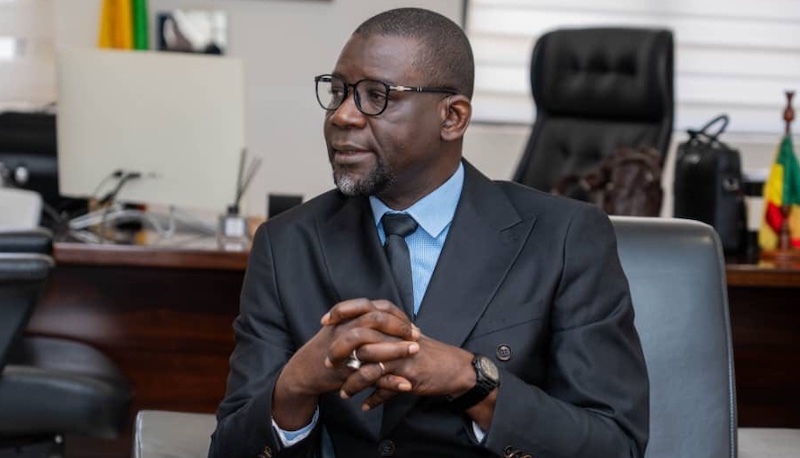
Alioune Badara Dione: Expansive Pouvoir Discrétionnaire for Fonds Spéciaux
Summary
- Alioune Badara Dione PhD argues that special funds are analogous to military resources, necessitating absolute discretionary power for the Head of State.
- He defines the State as embodying authority, armed force, and financial power, justifying broad executive control over strategic financial instruments.
- This position contributes to an ongoing debate in Senegal regarding the transparency and parliamentary oversight of special funds.
- Aminata Touré previously defended special funds, proposing control via settlement law rather than direct National Assembly review.
- Conversely, Pastef deputy Amadou Ba criticized the government's refusal of parliamentary oversight, citing a reversal of transparency commitments.
Dione's Stance on Executive Power and Special Funds
Dr. Dione's central assertion is that there exists no fundamental distinction between the provision of an army and the allocation of special funds.
Alioune Badara Dione PhD recently offered a profound reflection on the scope of the Head of State's discretionary authority concerning strategic instruments of public power, a discussion he initiated during the Gamou. Central to his argument is a direct comparison between two distinct prerogatives: the deployment and maintenance of an army and the utilization of special funds. Dr. Dione posits that there is "no difference between the provision of an army and that of special funds," thereby advocating for an expansive interpretation of executive control.
His reasoning extends to assert that "everything must be left to the absolute discretionary power of the Head of State" when it comes to these critical resources. This perspective frames the State not merely as an administrative entity managing procedures and resources, but as a formidable institution defined by its inherent authority, its armed forces, and its financial might. Dr. Dione encapsulates this view with the powerful declaration: "A State is serious: an authority, an armed and financial force all at once!!!"
The State's Strategic Instruments and Discretionary Authority
Dr. Dione's analysis underscores a critical question about the latitude granted to the executive branch's highest office when dealing with instruments considered vital for national sovereignty and security. By drawing a parallel between military capabilities and special funds, he elevates the latter to a status demanding similar levels of unconstrained executive decision-making. This framing is particularly relevant in the ongoing public discourse surrounding the management and oversight of public finances in Senegal, especially concerning the "Alioune Badara Dione pouvoir discrétionnaire fonds spéciaux" debate.
His argument suggests that the very nature of state power, encompassing both physical force and financial capacity, necessitates a degree of executive autonomy that transcends typical administrative oversight. This interpretation of "pouvoir discrétionnaire Chef de l'État" implies that certain strategic financial allocations, much like military operations, are inherently unsuitable for detailed external scrutiny, aligning with a robust view of executive prerogative in matters of national interest.
Conflicting Views on Special Funds Oversight
Dr. Dione's intervention comes at a time when the use and control of special funds are already subjects of intense institutional discussion within Senegal, highlighting a broader "fonds spéciaux Sénégal débat." On August 18, 2026, Aminata Touré, High Representative of the President of the Republic and a prominent figure, publicly defended the principle behind these credits, referencing decree n° 2004-1186. She proposed that their control could be effectively managed through the settlement law, rather than through direct oversight by the National Assembly, suggesting an indirect parliamentary role.
However, this stance met with opposition. Around the same period, Amadou Ba, a deputy from the Pastef party, voiced strong criticism regarding the government's refusal to allow direct parliamentary control over special funds. Ba characterized this refusal as a "360-degree turn" from previously stated commitments to transparency, emphasizing the need for greater accountability. This divergence of opinion highlights the tension between executive claims of strategic necessity and legislative demands for "transparence fonds publics Sénégal" and "contrôle parlementaire fonds spéciaux."
Reframing the Debate on Executive Power and Accountability
The comparison drawn by Alioune Badara Dione PhD significantly reorients the discussion, shifting it towards the intricate relationship between executive authority, sovereign means, and the fundamental role of the army in the state apparatus. This perspective, rooted in "droit public sénégalais," suggests that certain financial instruments are so intrinsically linked to the core functions of state power that they warrant exceptional treatment regarding transparency and oversight.
Adding another layer to this complex issue, Babacar Justin Ndiaye, on August 21, 2026, advocated for a balanced approach, urging a reconciliation between the imperatives of transparency and national security. Ndiaye specifically suggested differentiating credits allocated for intelligence activities from ordinary government funding, implying that not all special funds require the same level of public disclosure. This ongoing "fonds spéciaux Sénégal débat" signals potential shifts in the interpretation and application of executive power and parliamentary oversight concerning public funds in Senegal, with significant implications for government accountability and resource allocation.
Practical Implications
This ongoing debate signals potential shifts in the interpretation and application of executive power and parliamentary oversight concerning public funds in Senegal. Lawyers specializing in public law, constitutional law, or public finance should monitor these discussions for implications on government accountability, resource allocation, and potential future legislative reforms or judicial challenges regarding the President's discretionary authority.
Source
Source: Original reporting via leral.net
How does this affect you?
Get an AI analysis of this article grounded in your jurisdictions, practice areas, and any policy documents you've uploaded to Wansom.
Wansom is AI and can make mistakes.