
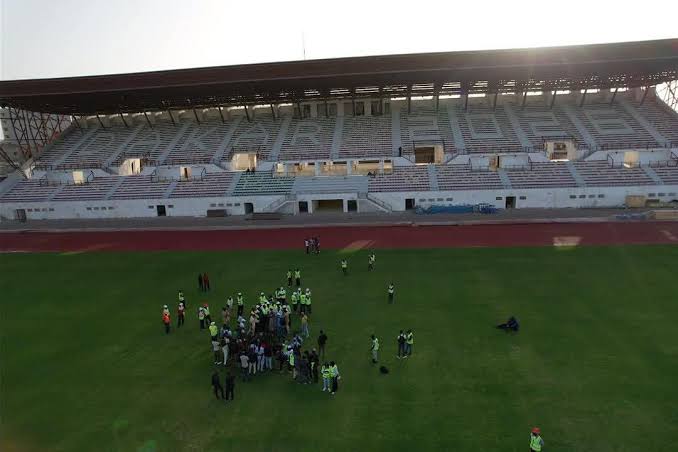
Senegal: Nigerian Security Agents Referred for Stade Iba Mar Diop Theft
Summary
- Two Nigerian security agents, C. J. Obidilé (39) and C. Okéké (30), were referred to the prosecutor's office by Médina police.
- They face charges of criminal association and theft committed by multiple persons.
- The agents are suspected of stealing material from their employer at the Stade Iba Mar Diop construction site.
- The case highlights criminal liability risks for employees, especially foreign nationals, in Senegal.
- Employers are urged to review security protocols and employment contracts to mitigate such risks.
What Happened
This case serves as a stark reminder of the criminal liability risks that employees, particularly foreign nationals, can face when implicated in theft and criminal association within Senegal.
Two Nigerian security personnel have been formally referred to the prosecutor's office in Senegal following allegations of criminal association and theft. The individuals, identified as C. J. Obidilé, aged 39, and C. Okéké, aged 30, were presented by the Médina police station. They are suspected of having stolen equipment from the construction site of the Stade Iba Mar Diop, an act allegedly committed against their own employer.
The referral to the prosecutor's office, known as 'défèrement' in the Senegalese legal system, marks a significant step in the judicial process, indicating that the police investigation has concluded and sufficient evidence exists to warrant further legal action. The charges of 'vol en réunion' (theft committed by multiple persons) and 'association de malfaiteurs' (criminal association) carry serious implications under Senegalese penal law, reflecting the gravity with which such offenses are treated, particularly when involving employees betraying their employer's trust.
This incident at the Stade Iba Mar Diop construction site underscores the vulnerabilities faced by organizations, even from within their own security ranks. The involvement of foreign nationals in such alleged criminal activities also draws attention to the legal and practical challenges that can arise for both employers and employees in a cross-border context. The case, as reported by Libération, highlights a specific instance where security agents, tasked with protecting assets, are now accused of their misappropriation.
Legal Context in Senegal
The charges leveled against C. J. Obidilé and C. Okéké — criminal association and theft committed by multiple persons — fall under the purview of Senegalese criminal law, specifically concerning property offenses and organized crime. 'Vol en réunion Sénégal' typically refers to a form of aggravated theft, where the involvement of more than one perpetrator can lead to harsher penalties compared to a solitary act of theft. This classification acknowledges the increased threat and planning often associated with group criminal activity.
Furthermore, the charge of 'association malfaiteurs Sénégal' (criminal association) implies that the individuals allegedly formed an agreement or understanding to commit criminal acts. This offense targets the preparatory stages of crime, aiming to dismantle organized criminal groups before or during their operations. The combination of these charges suggests that the authorities, specifically the `parquet Médina agents nigérians` are treating this as a premeditated and coordinated act rather than an opportunistic individual offense, emphasizing the seriousness of the allegations under `droit pénal Sénégal vol`.
The process of 'défèrement' means that the police have completed their initial investigation and have handed the case over to the public prosecutor. The prosecutor will now review the evidence and decide whether to formally charge the individuals and bring them before a judge for trial. This stage is critical, as it determines the trajectory of the legal proceedings and the potential for conviction and sentencing for the accused Nigerian security agents.
Why It Matters
This case serves as a stark reminder of the criminal liability risks that employees, particularly foreign nationals, can face when implicated in theft and criminal association within Senegal. For employers, the incident at the Stade Iba Mar Diop construction site highlights the critical need to meticulously review and strengthen security protocols, especially for sensitive sites and valuable materials. The alleged involvement of security personnel themselves in the theft underscores a potential breach of trust that necessitates robust internal controls and oversight mechanisms.
Beyond security measures, employers are also prompted to re-evaluate their employment contracts and vetting processes, particularly when engaging foreign staff. Understanding the legal framework and potential consequences for employees under Senegalese law is crucial for mitigating risks. This incident could have far-reaching implications, not only for the individuals involved but also for the reputation and operational integrity of the employer, emphasizing the importance of due diligence in hiring and ongoing supervision.
The prosecution of these `agents sécurité nigérians vol Stade Iba Mar Diop` also sends a clear message regarding the enforcement of `droit pénal Sénégal vol` against all individuals, regardless of nationality or employment status. It underscores the principle that criminal acts, such as `vol en réunion Sénégal` and `association malfaiteurs Sénégal`, will be pursued through the legal system, reinforcing the rule of law and the protection of property rights for businesses operating within the country. The outcome of this case will be closely watched for its implications on employee conduct and employer responsibilities.
Practical Implications
This case highlights the criminal liability risks for employees, particularly foreign nationals, involved in theft and criminal association in Senegal. It serves as a reminder for employers to review security protocols and employment contracts to mitigate such risks and understand the potential legal consequences for their staff.
Source
How does this affect you?
Get an AI analysis of this article grounded in your jurisdictions, practice areas, and any policy documents you've uploaded to Wansom.
Finish Reading the Full Story and the Expert Analysis.
Wansom is AI and can make mistakes.