
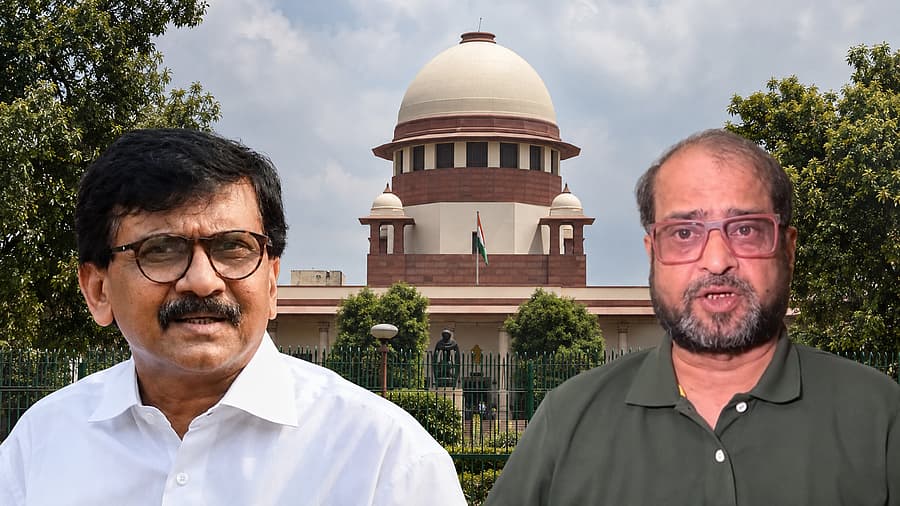
AG Consent Contempt: Nikhil Wagle, Sanjay Raut Face Action for CJI Kant
Summary
- Attorney General R Venkataramani has consented to a criminal contempt case against journalist Nikhil Wagle and MP Sanjay Raut.
- The Supreme Court Bar Association filed the petition concerning remarks made about Chief Justice of India Surya Kant.
- Wagle's comment included an expletive on X, while Raut criticized judges attending political events and dinners.
- The AG deemed the statements "prima-facie scandalous" and intended to lower the Supreme Court's and CJI's esteem.
- This action was taken under Section 15(1)(b) of the Contempt of Courts Act, 1971, on October 15.
What Transpired
In his official consent letter, Attorney General R Venkataramani articulated his considered view that the social media posts by Nikhil Wagle and the public comments by Sanjay Raut were "prima-facie scandalous, intended to lower the esteem of the Hon'ble the Supreme Court of India and particularly the Chief Justice of India."
Attorney General for India, R Venkataramani, has formally approved the initiation of criminal contempt of court proceedings against prominent journalist Nikhil Wagle and Shiv Sena (UBT) Rajya Sabha Member of Parliament, Sanjay Raut. This significant development stems from a petition lodged by the Supreme Court Bar Association (SCBA) concerning public statements made by both individuals regarding Chief Justice of India (CJI) Surya Kant. The SCBA submitted its petition on October 15, and the Attorney General provided his crucial consent on the very same day, paving the way for potential legal action.
The controversy arose following a decision by CJI Surya Kant to decline a personal meeting with a delegation representing various opposition parties. Instead of a direct meeting, the Chief Justice advised the delegation to formally present their concerns through a petition filed before the Supreme Court. In response to a report by The Hindu detailing the CJI's stance, Nikhil Wagle subsequently posted a highly inflammatory message, "**** you CJI!", from his X account. Separately, remarks made by Sanjay Raut to the media were disseminated by IANS on X on October 12. Raut was quoted stating, "We have also seen judges attending political programs of the BJP in states where it is in power, and chief ministers organizing dinners to welcome High Court and Supreme Court judges." The petition further noted that Raut also referenced photographs depicting judges engaged in badminton.
Legal Framework and AG's Rationale
The Attorney General's consent is a prerequisite for initiating criminal contempt proceedings in India, specifically under Section 15(1)(b) of the Contempt of Courts Act, 1971. This section empowers the Supreme Court or a High Court to take cognizance of criminal contempt on a motion made by the Attorney General or Solicitor General, or with their consent, by any other person. Criminal contempt, as defined by the Act, includes the publication of any matter or the doing of any other act whatsoever which scandalizes or tends to scandalize, or lowers or tends to lower the authority of any court; or prejudices, or interferes or tends to interfere with, the due course of any judicial proceeding; or interferes or tends to interfere with, or obstructs or tends to obstruct, the administration of justice in any other manner.
In his official consent letter, Attorney General R Venkataramani articulated his considered view that the social media posts by Nikhil Wagle and the public comments by Sanjay Raut were "prima-facie scandalous, intended to lower the esteem of the Hon'ble the Supreme Court of India and particularly the Chief Justice of India." This assessment underscores the gravity with which the Attorney General views public criticism that he believes crosses the line into undermining the judiciary's authority and public perception. The AG consent contempt Nikhil Wagle Sanjay Raut CJI Kant case thus highlights the stringent legal boundaries surrounding public discourse concerning judicial figures and institutions in India.
Implications for Public Discourse
This development holds significant implications for the landscape of public commentary and criticism of judiciary India legal. The decision by Attorney General R Venkataramani to grant his contempt consent for the Supreme Court Bar Association contempt petition against Nikhil Wagle and Sanjay Raut serves as a potent reminder of the potential legal repercussions for individuals, including journalists and political figures, who make disparaging remarks about the judiciary. It reinforces the notion that while freedom of speech is a fundamental right, it is not absolute, especially when it pertains to the authority and dignity of the courts.
The case, centered on remarks concerning CJI Surya Kant, underscores the strict interpretation of what constitutes criminal contempt of court India. The Attorney General's swift approval on the same day the petition was filed indicates a serious view of the alleged transgressions. This action is likely to prompt lawyers and compliance officers to advise caution regarding public statements that could be perceived as scandalous or as attempts to diminish the standing of the Supreme Court and its judges. It sets a precedent for how the state's highest law officer perceives and acts upon perceived affronts to judicial integrity, emphasizing the legal framework designed to protect the judiciary from unwarranted attacks.
Practical Implications
Lawyers and compliance officers should note this development as it clarifies the Attorney General's stance on public remarks deemed scandalous or intended to lower the esteem of the Supreme Court and its judges. It reinforces the potential for criminal contempt proceedings under Section 15(1)(b) of the Contempt of Courts Act, 1971, for individuals, including journalists and public figures, who make disparaging comments about the judiciary. This case serves as a reminder of the strict boundaries surrounding free speech when it pertains to judicial authority in India.
Source
How does this affect you?
Get an AI analysis of this article grounded in your jurisdictions, practice areas, and any policy documents you've uploaded to Wansom.
Finish Reading the Full Story and the Expert Analysis.
Get the latest legal & regulatory intelligence in India
Wansom is AI and can make mistakes.