
Abdoulaye Daouda Diallo: Refus Audition Parlementaire au Sénégal
Summary
- Abdoulaye Daouda Diallo, President of the Economic, Social and Environmental Council of Senegal and a former minister, has refused to appear before a parliamentary inquiry commission under its proposed terms.
- His scheduled hearing was set for October 15, 2026, at 3 PM, but he cited a lack of clarity on the subject and insufficient information.
- The commission is investigating the authorization of an Ecobank guarantee fund from 2012-2013 for the "Un étudiant, un ordinateur" program.
- This program was managed by the ministry responsible for higher education.
- The refusal raises questions about parliamentary oversight and the obligations of former public officials in Senegal.
Former Minister Declines Parliamentary Summons
Such developments carry significant implications, particularly for legal professionals advising financial institutions or former public officials within Senegal.
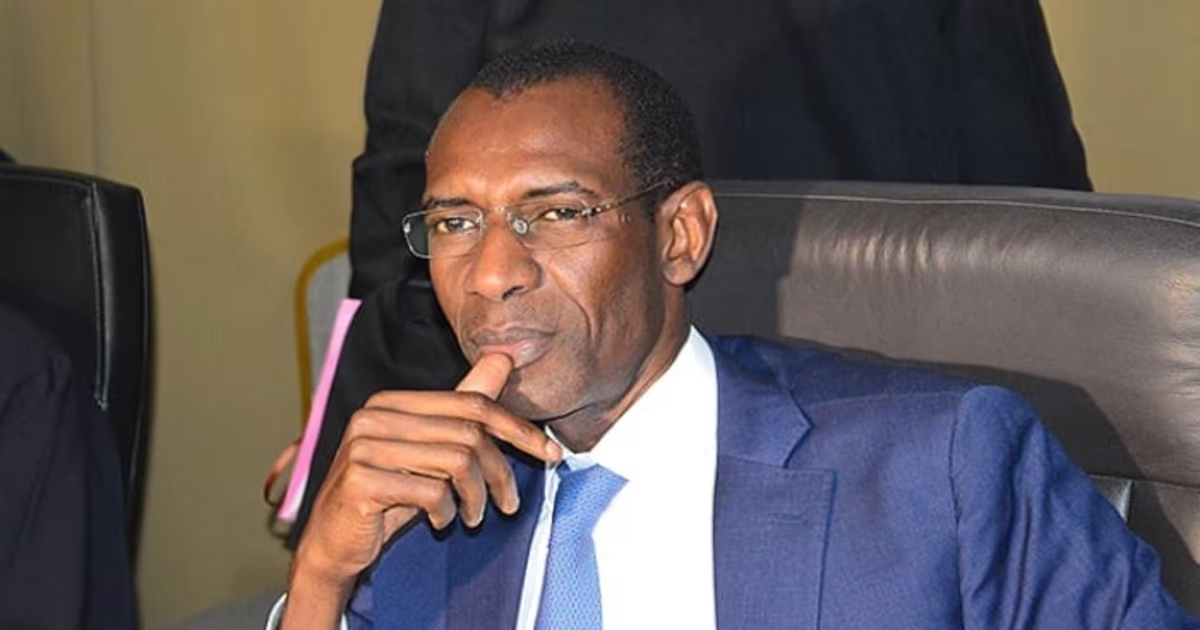
Abdoulaye Daouda Diallo, President of the Economic, Social and Environmental Council of Senegal and a former minister, has communicated his decision not to appear before an ongoing parliamentary inquiry commission under the terms currently proposed for his testimony. His scheduled appearance before the legislative body was set for Thursday, October 15, 2026, at 3 PM. This significant development was conveyed through a formal letter, dated Wednesday, October 14, 2026, which the former official dispatched to the president of the commission, articulating his specific reservations concerning the organization of the planned hearing.
Within his correspondence, Diallo explicitly cited a lack of precision regarding the exact subject matter intended for discussion during his testimony. Furthermore, he indicated that he had not been provided with adequate information concerning the specific administrative act that forms the core of the commission's investigation. This firm stance by Abdoulaye Daouda Diallo, marking his refusal to participate in the audition parlementaire as currently structured, underscores potential procedural challenges and disagreements that can arise within the framework of legislative oversight processes.
Parliamentary Inquiry into Public Finance
The parliamentary commission is currently engaged in a detailed investigation primarily focused on the "Un étudiant, un ordinateur" program, a significant government initiative. A central element of this inquiry involves a thorough examination of the authorization, if any, that was granted for the establishment of a guarantee fund with Ecobank during the 2012-2013 fiscal period. This specific financial mechanism is directly linked to the aforementioned student computer distribution program, which, at the time of its implementation, fell under the administrative and policy purview of the ministry responsible for higher education.
This comprehensive examination by the Commission d'enquête parlementaire Sénégal highlights a broader national commitment to Sénégal audit public finance and the rigorous assessment of past financial arrangements. The commission's mandate is to meticulously review the decisions and processes surrounding the Ecobank fonds de garantie 2012 and its integral role in the execution of the programme Un étudiant un ordinateur, with the ultimate goal of ensuring transparency, accountability, and proper governance in the utilization of public resources.
Implications for Oversight and Accountability
The decision by Abdoulaye Daouda Diallo to decline the parliamentary summons, citing procedural ambiguities and insufficient information, introduces critical considerations regarding the effectiveness of legislative oversight and the expected cooperation from former public officials. While the commission seeks Abdoulaye Daouda Diallo témoignage as a vital component to clarify various aspects of the "Un étudiant, un ordinateur" program and the associated Ecobank guarantee fund, his refusal, predicated on perceived informational deficiencies, could potentially influence future interactions between parliamentary investigative bodies and individuals summoned for questioning.
Such developments carry significant implications, particularly for legal professionals advising financial institutions or former public officials within Senegal. They underscore an increasing trend of scrutiny directed towards past public financial arrangements and highlight the critical importance of understanding and adhering to the procedural obligations incumbent upon individuals summoned for testimony. This situation reinforces the necessity for robust and clearly defined public accountability mechanisms to maintain integrity and trust in the nation's governance structures.
Practical Implications
Lawyers advising financial institutions or former public officials in Senegal should monitor the ongoing parliamentary inquiry into the 'Un étudiant, un ordinateur' program and the Ecobank guarantee fund, as it signals increased scrutiny of past public financial arrangements and the procedural obligations of individuals summoned for testimony.
Source
Source: Original reporting via Senenews.
How does this affect you?
Get an AI analysis of this article grounded in your jurisdictions, practice areas, and any policy documents you've uploaded to Wansom.
Finish Reading the Full Story and the Expert Analysis.
Get the latest legal & regulatory intelligence in Senegal
Wansom is AI and can make mistakes.