
Zambia: World Justice Project Rule of Law Index 2026 Shows Decline
Summary
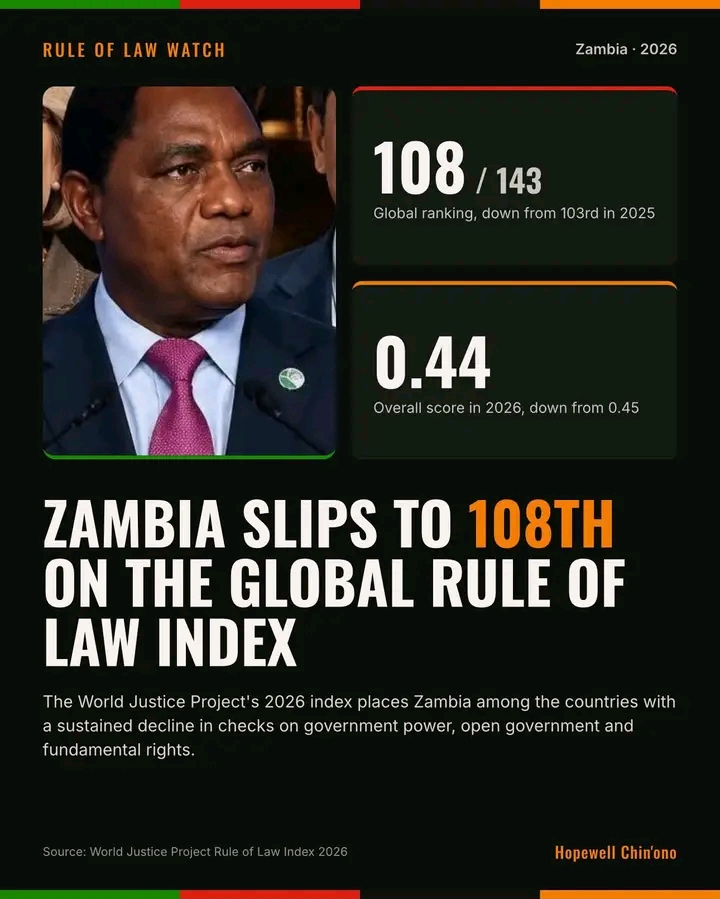
- Zambia's rule of law standing has significantly deteriorated in the 2026 World Justice Project Rule of Law Index.
- The country's overall score fell to 0.44, indicating a concerning state of its legal environment.
- Zambia is now ranked 108th out of 143 countries globally.
- This represents a five-place drop from its 103rd position in the previous year's index.
- The ongoing decline suggests increased legal and operational risks for businesses and investors in Zambia.
Recent Developments in Zambia's Rule of Law Standing
The continued downturn in Zambia's rule of law standing carries substantial implications for both domestic and international stakeholders, particularly those involved in investment and commercial operations within the country.
Zambia's position in the global assessment of adherence to the rule of law has seen a notable deterioration, according to the latest findings. The 2026 World Justice Project Rule of Law Index, which was recently unveiled, indicates a significant slide for the Southern African nation. This annual evaluation provides a comprehensive overview of how the rule of law is experienced by ordinary people in countries worldwide.
The country's overall performance metric in the index registered a score of 0.44. This figure places Zambia at 108th out of a total of 143 nations assessed globally. This current standing represents a marked decline when compared to its previous ranking. In the preceding year's index, Zambia held the 103rd position, demonstrating a downward trajectory in its rule of law standing over the past twelve months. The consistent decline in the Zambia WJP Rule of Law Ranking highlights a concerning trend in the nation's governance and legal framework.
Analysis of Zambia's Declining Legal Environment
The reported Zambia rule of law score of 0.44 is a critical indicator of the state of the country's legal and institutional environment. A score below 0.50 typically suggests significant challenges in various dimensions of the rule of law, which include constraints on government powers, absence of corruption, open government, fundamental rights, order and security, regulatory enforcement, civil justice, and criminal justice. While the specific sub-factors contributing to Zambia's score are not detailed in the immediate findings, the overall figure points to systemic weaknesses that warrant close examination.
The drop from 103rd to 108th, placing Zambia 108th rule of law globally, signifies more than just a numerical shift; it reflects a perceived worsening of the legal landscape relative to other nations. This five-place fall within a single year indicates that the pace of decline may be accelerating or that other countries are making greater strides in improving their rule of law frameworks. Such a trend can have far-reaching consequences, influencing perceptions of stability and fairness within the country's governance structures. The persistent Zambia legal environment decline, as evidenced by the 2026 World Justice Project Rule of Law Index, suggests an erosion of foundational principles that underpin a predictable and just society.
Implications for the Zambian Legal and Business Landscape
The continued downturn in Zambia's rule of law standing carries substantial implications for both domestic and international stakeholders, particularly those involved in investment and commercial operations within the country. A weakened rule of law environment, as suggested by the Zambia World Justice Project Rule of Law Index 2026, often correlates with increased legal and operational risks for businesses. This can manifest in various forms, including heightened uncertainty regarding property rights, potential for arbitrary decision-making by authorities, and a less transparent regulatory framework.
For legal professionals and compliance officers advising clients on ventures in Zambia, this trend necessitates a more rigorous approach to due diligence and risk assessment. Challenges in contract enforcement may become more pronounced, as the reliability and impartiality of the judicial system could be perceived as diminished. Furthermore, a less predictable regulatory environment can complicate business planning and increase compliance burdens, potentially deterring new foreign direct investment and impacting existing operations. The overall decline in the rule of law underscores the importance of thoroughly evaluating the legal and governance risks associated with operating in Zambia.
Practical Implications
Lawyers and compliance officers advising on investments or operations in Zambia should note the country's declining rule of law ranking, as it may indicate increased legal and operational risks, potential challenges in contract enforcement, and a less predictable regulatory environment. This trend necessitates heightened due diligence and risk assessment for clients.
Source
How does this affect you?
Get an AI analysis of this article grounded in your jurisdictions, practice areas, and any policy documents you've uploaded to Wansom.
Finish Reading the Full Story and the Expert Analysis.
Get the latest legal & regulatory intelligence in Zambia
Wansom is AI and can make mistakes.