
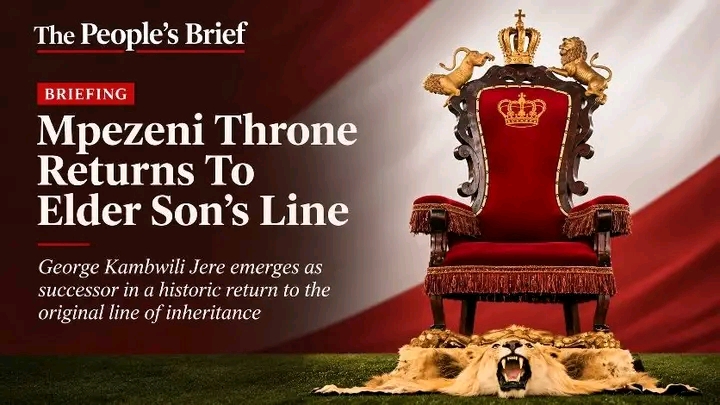
Zambia Mpezeni Throne Succession: George Kambwili Jere Declared Successor
Summary
- George Kambwili Jere has been named the successor to Zambia's Ngoni paramount Mpezeni throne.
- Royal indunas made this decision, resolving a succession dispute dating back to 1981.
- Mr. Jere was passed over for the throne as an infant more than four decades ago.
- The decision returns the Mpezeni throne to the elder son's line after 44 years.
What Happened
The resolution of the Mpezeni throne succession, after a protracted 44-year period, carries substantial implications for the Ngoni community in Zambia.
The Ngoni paramount throne in Zambia, specifically the Mpezeni throne, has recently seen a definitive resolution to its long-standing succession question. After more than four decades, royal indunas, who serve as the traditional kingmakers, have formally declared George Kambwili Jere as the chosen successor. This pivotal decision aims to bring closure to a complex dispute that has persisted since 1981, marking a significant moment for the Ngoni people.
Mr. Jere's selection is particularly noteworthy as it signifies the return of the Mpezeni throne to the lineage of the elder son, a fundamental principle within Ngoni traditional succession protocols. This outcome addresses a historical situation where George Kambwili Jere himself was passed over for the paramountcy as an infant, over 40 years ago. The recent pronouncement by the indunas effectively rectifies this decades-old oversight, establishing a new and historically validated chapter for the Ngoni paramountcy and its leadership. The 44-year period since the initial passing over underscores the enduring nature of this particular succession challenge.
Traditional Leadership and Succession
In Zambia, the process of determining traditional leadership, particularly for paramount chieftaincies like the Ngoni's Mpezeni throne, rests with a council of royal indunas. These respected elders are tasked with interpreting customary law and lineage to identify the appropriate successor. Their decisions are considered final within the traditional framework, carrying immense weight for the community and its governance.
The resolution of the Mpezeni throne succession underscores the enduring influence of these traditional structures. The indunas' recent determination regarding George Kambwili Jere highlights their authority in navigating complex historical claims and ensuring adherence to established customary practices, even when addressing issues that have spanned multiple generations. This system operates distinctly from the national legal framework, yet holds profound significance for the cultural and social fabric of the Ngoni people.
Why It Matters
The resolution of the Mpezeni throne succession, after a protracted 44-year period, carries substantial implications for the Ngoni community in Zambia. The formal selection of George Kambwili Jere and the subsequent return of the paramountcy to the elder son's line is widely anticipated to foster greater stability and unity within the traditional leadership structure. Prolonged succession disputes often lead to internal divisions, uncertainty, and potential challenges to authority, making this definitive decision a crucial step towards communal harmony.
This outcome not only settles a specific historical grievance that originated in 1981 but also powerfully reaffirms the legitimacy and enduring authority of the royal indunas in upholding and interpreting traditional customs. The decision demonstrates the deep-rooted commitment to lineage principles within the Ngoni tradition, ensuring that the Mpezeni throne, a vital symbol of cultural heritage and continuity, continues under a recognized and historically validated lineage. This move is expected to strengthen the traditional governance framework and provide clear leadership for the Ngoni people.
Practical Implications
This article details a traditional leadership succession decision by royal indunas, which does not present a direct, actionable legal implication for lawyers or compliance officers in terms of new statutory obligations, court precedents, or compliance exposures based on the information provided.
Source
How does this affect you?
Get an AI analysis of this article grounded in your jurisdictions, practice areas, and any policy documents you've uploaded to Wansom.
Finish Reading the Full Story and the Expert Analysis.
Get the latest legal & regulatory intelligence in Zambia
Wansom is AI and can make mistakes.