
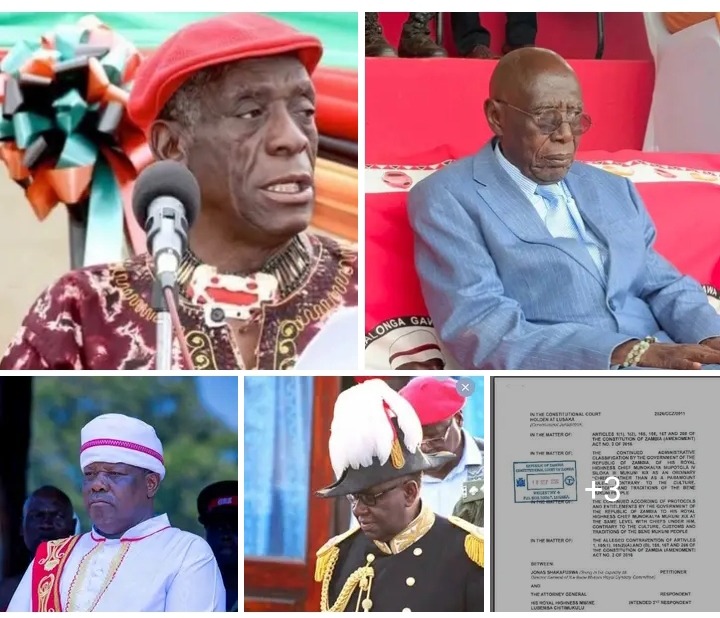
Zambia ConCourt: Chief Mukuni Joinder Application Rejected
Summary
- The Zambian Constitutional Court rejected an application by three paramount chiefs to join a petition.
- The petition seeks the official recognition and reclassification of Chief Mukuni XIX of the Toka Leya people as a Paramount Chief.
- The court's decision indicates a potentially strict interpretation of who may intervene in chieftaincy disputes.
- This ruling sets a precedent for future joinder applications in traditional leadership cases before the Constitutional Court.
The Constitutional Court's Ruling
This decision clarifies the Constitutional Court's procedural stance on joinder applications in chieftaincy disputes, indicating a potentially strict interpretation of who may intervene.
The Zambian Constitutional Court recently issued a significant procedural determination, rejecting an application submitted by three paramount chiefs. These traditional leaders had sought to be formally included as parties in an existing legal challenge. The underlying petition, which they aimed to join, pertains to the official status of Chief Mukuni XIX, who leads the Toka Leya people. This specific petition requests a formal declaration that Chief Mukuni XIX should be officially recognized and subsequently reclassified by the government as a Paramount Chief.
The court's decision to decline the joinder application means that the three paramount chiefs will not be permitted to participate as formal parties in the ongoing proceedings related to Chief Mukuni XIX's reclassification. This ruling directly addresses the scope of participation in legal matters concerning traditional leadership, setting a clear boundary for third-party involvement in this particular case before the `Zambia ConCourt Chief Mukuni joinder` proceedings.
Context of the Reclassification Petition
At the core of the legal proceedings is a petition advocating for an elevated status for Chief Mukuni XIX. This legal action aims to secure a formal acknowledgment and reclassification of the Toka Leya leader as a Paramount Chief by the government. Such a reclassification holds considerable importance within Zambia's intricate traditional governance structures, often influencing authority, access to resources, and historical recognition within the nation's cultural landscape.
The original `Chief Mukuni XIX reclassification petition` seeks to establish this higher designation, a process that typically involves a thorough review of historical claims, community support, and governmental policies concerning traditional leadership. The attempt by other paramount chiefs to join this specific case underscores the broader significance and potential implications that such reclassification petitions can have across the country's traditional hierarchy and for `Paramount Chief recognition Zambia` more generally.
Procedural Stance on Intervention
The Constitutional Court's rejection of the joinder application illuminates its specific procedural stance regarding third-party intervention in ongoing legal disputes, particularly those involving traditional leadership. A joinder application, in legal terms, is a formal request by an entity not originally named in a lawsuit to be added as a party, typically because they possess a direct interest in the outcome or their rights could be affected. In this instance, the court's refusal suggests a potentially strict interpretation of the criteria for allowing external parties to participate in cases, even when those cases touch upon sensitive issues like `Zambia traditional leadership disputes`.
This ruling indicates that the court may be inclined to limit participation to only the most directly involved parties in such matters, thereby aiming to streamline proceedings and maintain focus on the core dispute between the original petitioners and the respondent government. The `Zambian Constitutional Court joinder application` outcome provides a critical insight into the court's approach to managing complex litigation involving multiple stakeholders.
Implications for Future Disputes
This decision carries notable implications for future `Zambia traditional leadership disputes` and how `Zambian Constitutional Court joinder application` requests will be evaluated. For legal practitioners advising traditional leaders or government bodies on `Chief Mukuni XIX reclassification petition` or similar matters, this precedent is particularly significant. It signals that the Constitutional Court is adopting a cautious approach to expanding the scope of parties in chieftaincy cases, potentially requiring a very direct and compelling interest for any third party to be granted joinder.
The outcome reinforces the idea that while traditional leadership issues are often interconnected, the court will carefully scrutinize attempts by additional parties to intervene, thereby shaping the procedural landscape for `Toka Leya Chief Mukuni legal status` and other recognition efforts. This decision clarifies the Constitutional Court's procedural stance on joinder applications in chieftaincy disputes, indicating a potentially strict interpretation of who may intervene. Lawyers advising on such matters should note this precedent regarding third-party involvement.
Practical Implications
This ruling clarifies the Constitutional Court's procedural stance on joinder applications in chieftaincy disputes, indicating a potentially strict interpretation of who may intervene. Lawyers advising traditional leaders or government on reclassification petitions should note this precedent regarding third-party involvement.
Source
How does this affect you?
Get an AI analysis of this article grounded in your jurisdictions, practice areas, and any policy documents you've uploaded to Wansom.
Finish Reading the Full Story and the Expert Analysis.
Wansom is AI and can make mistakes.