
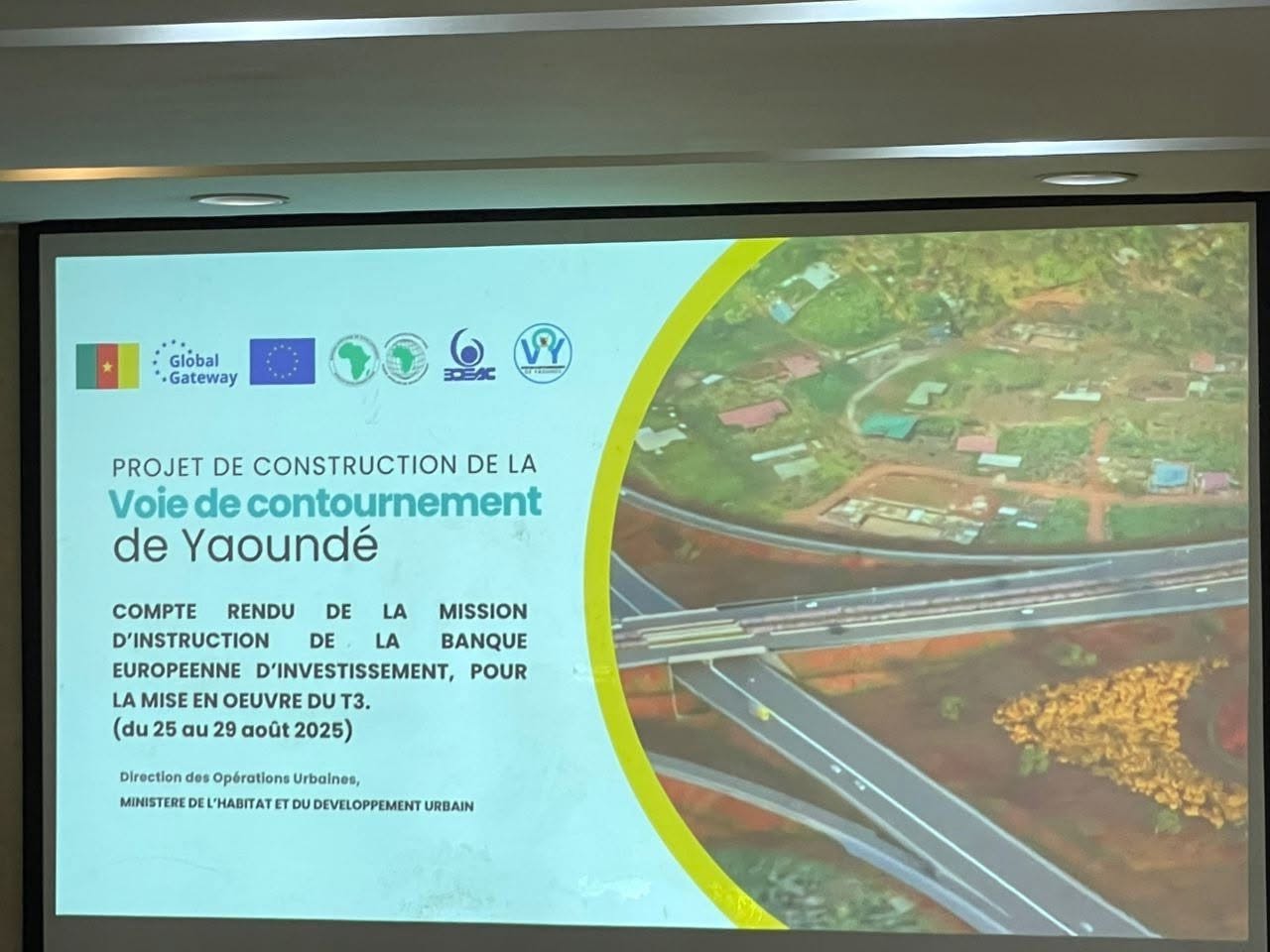
Cameroon: Yaoundé Rocade Financement of 196 Million Euros Approved
Summary
- President Paul Biya authorized financing for the priority T3 section of the Yaoundé bypass on November 5, 2026.
- The European Investment Bank and the European Union are providing 196.86 million euros for this phase of the Yaoundé rocade financement.
- The 22.8 km T3 section will connect Nkozoa to Minkoameyos, aiming to divert transit traffic from Yaoundé.
- Four new urban development poles, totaling 1,200 hectares, are planned near the bypass to manage urban growth and foster economic activity.
- The full Yaoundé bypass project, spanning 90.54 km, represents a total projected investment of 1,263.7 billion FCFA before taxes.
Major Infrastructure Initiative Underway
The Ministry of Housing has outlined the subsequent critical steps, which include finalizing all financing agreements, completing environmental and social impact assessments, and implementing necessary procedures for compensation and resettlement action plans, before the commencement of works on the T3 section.
Cameroon is moving forward with a significant infrastructure project aimed at transforming urban mobility and fostering new economic centers around its capital. A presidential decree, signed by Paul Biya on November 5, 2026, officially authorized the Minister of Economy, Planning and Regional Development to finalize the necessary funding agreements. This mandate specifically targets the construction of the priority T3 section of the Yaoundé bypass, a crucial component of the larger development plan.
The financing for this initial phase, totaling 196.86 million euros, has been secured through a combination of international support. The European Investment Bank (BEI) is providing a loan of 150 million euros, which translates to approximately 98.39 billion FCFA. Complementing this, the European Union is contributing 46.86 million euros, or nearly 30.7 billion FCFA, encompassing both an investment grant and technical assistance. This substantial European funding package, amounting to roughly 129.1 billion FCFA, underscores the international commitment to the development of the Yaoundé rocade.
The Strategic Role of Rocade T3
The T3 section of the Cameroun rocade Yaoundé, spanning approximately 22.8 kilometers, is designed to connect Nkozoa on National Road N°1 with Minkoameyos, located on the Yaoundé-Douala highway. This vital segment will feature a dual carriageway with two separate lanes and seven interchanges, engineered to significantly improve traffic flow. Its immediate objective is to divert a substantial portion of the transit traffic that currently traverses Yaoundé's city center.
This diversion is particularly critical for commercial flows originating from the ports of Douala and Kribi, destined for landlocked nations such as Chad and the Central African Republic. The European Investment Bank (BEI) views this specific segment as a key driver for enhancing regional fluidity and alleviating congestion within the capital. By rerouting heavy transit vehicles, the project aims to make Yaoundé a more accessible and less gridlocked urban environment.
Catalyzing New Economic Hubs
Beyond its function as a bypass, the Yaoundé rocade is envisioned as a powerful instrument for comprehensive territorial development. The government's strategy includes the establishment of four new urban development poles strategically located near the infrastructure. These future economic centers, situated in the municipalities of Mbankomo, Mfou, Soa, and Okola, will collectively cover an expansive area of 1,200 hectares, distributed across the four cardinal points surrounding Yaoundé.
The primary goal of these pôles économiques Yaoundé Mbankomo Mfou is to manage and organize urban expansion, accommodate new economic activities, and provide essential services that will naturally arise from the new bypass. This proactive approach seeks to prevent further population and economic concentration in the capital's already dense core. The development of these hubs is expected to attract commercial, industrial, logistical, and service facilities along the future rocade, thereby stimulating local employment, boosting the real estate sector, enhancing transport networks, and fostering the growth of small and medium-sized enterprises.
Long-Term Vision and Next Steps
The T3 section represents only a fraction of the broader Yaoundé bypass program, which is projected to extend approximately 90.54 kilometers with a total of 22 lanes. This extensive network will traverse multiple departments, including Mfoundi, Lekié, Mefou-et-Afamba, and Mefou-et-Akono. The overall road construction component is estimated at 794.7 billion FCFA excluding taxes, while the development of the four urban poles is valued at 469 billion FCFA excluding taxes, bringing the total projected investment for the entire program to 1,263.7 billion FCFA before taxes.
The overarching aim of this ambitious undertaking is to transform Yaoundé into a more fluid, safer, and competitive urban space by alleviating congestion, redirecting transit traffic, and establishing new zones for economic activity. The Ministry of Housing has outlined the subsequent critical steps, which include finalizing all financing agreements, completing environmental and social impact assessments, and implementing necessary procedures for compensation and resettlement action plans, before the commencement of works on the T3 section.
Practical Implications
Lawyers should advise clients on potential land acquisition and compensation issues arising from the Yaoundé bypass and new economic hubs, as well as compliance with international environmental and social standards (EIB, EU) for businesses involved in or impacted by this major infrastructure development.
Source
How does this affect you?
Get an AI analysis of this article grounded in your jurisdictions, practice areas, and any policy documents you've uploaded to Wansom.
Finish Reading the Full Story and the Expert Analysis.
Get the latest legal & regulatory intelligence in Cameroon
Wansom is AI and can make mistakes.