
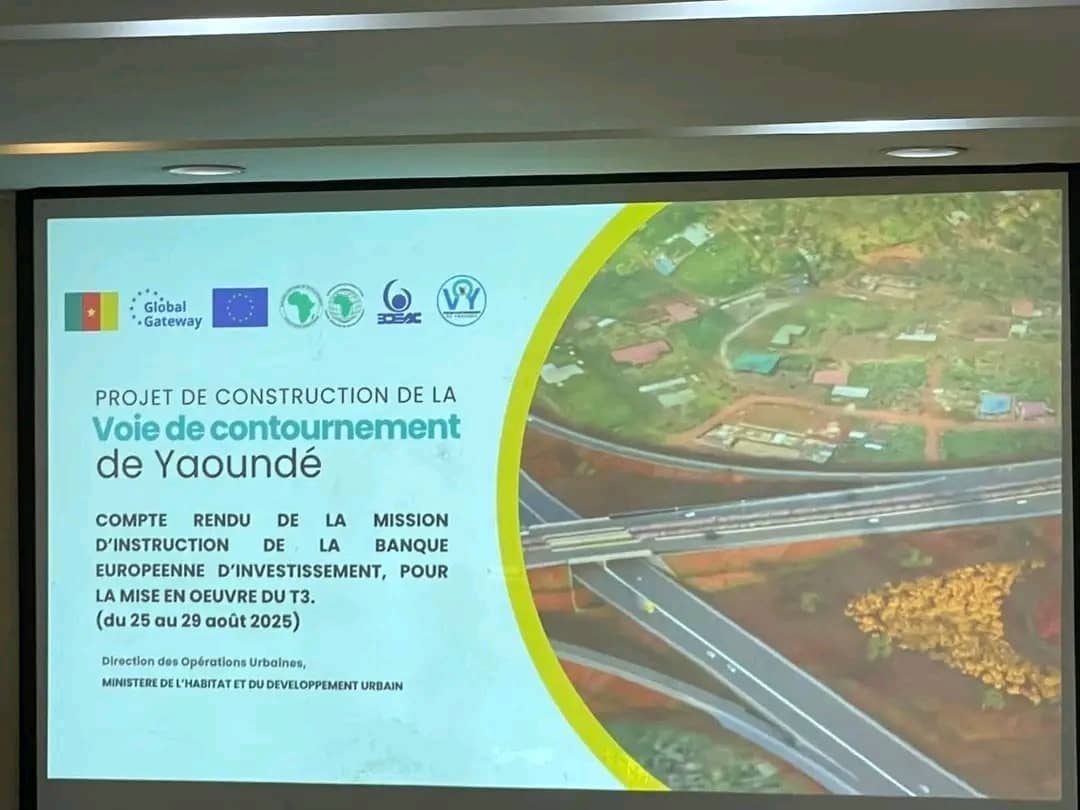
Cameroon: Paul Biya Authorizes Yaoundé Bypass T3 BEI Loan
Summary
- President Paul Biya authorized financing agreements for the Yaoundé bypass T3 section on November 5, 2026.
- The European Investment Bank is providing a 150 million euro loan, complemented by a 46.86 million euro EU grant and technical assistance.
- The 22.8-kilometer T3 section will link Nkozoa to Minkoameyos, featuring two lanes and seven interchanges.
- The project aims to decongest Yaoundé by diverting transit traffic from Douala and Kribi ports to Chad and the Central African Republic.
- Valued at 129.1 billion FCFA, the bypass is also intended to create four new development poles and facilitate regional planning.
Key Financing Agreements Approved
Beyond its immediate function as a traffic decongestion measure, the Yaoundé bypass project is envisioned as a fundamental instrument for broader regional planning and territorial development within Cameroon.
On November 5, 2026, President Paul Biya of Cameroon issued a decree authorizing the finalization of crucial financing agreements for the priority Section T3 of the Yaoundé bypass. This significant infrastructure undertaking, valued at 129.1 billion FCFA, aims to alleviate traffic congestion within the capital city and foster the establishment of four new economic development hubs. The presidential directive specifically empowered the Minister of Economy, Planning, and Regional Development to proceed with securing the necessary funds for the construction of this vital section.
The financial package for the project is predominantly European, totaling 196.86 million euros. This sum comprises a substantial loan of 150 million euros, equivalent to approximately 98.39 billion FCFA, provided by the European Investment Bank (BEI). Complementing this loan is a contribution from the European Union amounting to 46.86 million euros, which translates to nearly 30.7 billion FCFA. This EU contribution is structured to include both an investment grant and essential technical assistance, underscoring a comprehensive approach to the project's success.
The Yaoundé Bypass T3: Route and Design
The priority Section T3 of the Yaoundé bypass is designed to span approximately 22.8 kilometers, connecting Nkozoa, situated on National Road N°1, with Minkoameyos, where it will link to the Yaoundé-Douala highway. This critical segment of the bypass is engineered to feature a dual carriageway, incorporating two separate lanes to ensure efficient traffic flow. Furthermore, the design includes the construction of seven distinct interchanges, facilitating smooth transitions and connectivity along its route.
The primary objective of this specific section is to redirect transit traffic that currently traverses the heart of Yaoundé. This diversion is particularly crucial for the substantial volume of goods and vehicles moving along the vital corridors that connect the ports of Douala and Kribi to landlocked nations such as Chad and the Central African Republic. By rerouting these heavy transit flows, the project seeks to significantly reduce urban congestion and improve overall logistical efficiency for regional trade.
Strategic Vision for Regional Development
Beyond its immediate function as a traffic decongestion measure, the Yaoundé bypass project is envisioned as a fundamental instrument for broader regional planning and territorial development within Cameroon. The government's strategic intent extends to leveraging this infrastructure to stimulate economic growth by creating the aforementioned four new development poles. This holistic approach signifies a commitment to utilizing major road networks not merely for transportation but as catalysts for comprehensive urban and economic expansion.
The initiative also includes plans for the "viabilisation" of land, indicating a governmental commitment to prepare surrounding areas for future development and habitation. This forward-looking strategy underscores the project's role in accelerating the overall implementation of Cameroon's bypass network, positioning it as a cornerstone for future infrastructure and economic progress under the leadership of President Paul Biya.
Practical Implications
Lawyers advising construction firms, financial institutions, or land developers should monitor the tender processes and contractual frameworks for the Yaoundé bypass T3 project, ensuring compliance with BEI and EU financing standards, public procurement regulations, and environmental impact assessments.
Source
How does this affect you?
Get an AI analysis of this article grounded in your jurisdictions, practice areas, and any policy documents you've uploaded to Wansom.
Finish Reading the Full Story and the Expert Analysis.
Get the latest legal & regulatory intelligence in Cameroon
Wansom is AI and can make mistakes.