
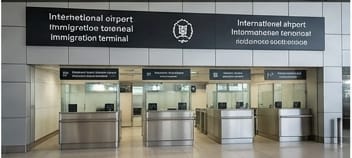
US Supreme Court Decision May Resume Migrant Flights to Liberia
The Supreme Court's recent decision to temporarily allow the United States to resume deporting migrants to third-country destinations could see the resumption of flights to Liberia. About the size of Ohio, the West African country is one of 35 countries the Trump administration is paying to shelter and feed Latin Americans and others living in the U.S. without proper legal status. Some of those receiving nations have a reputation for corruption and human rights abuses , and in most cases, those being deported have no links to the host nation. The policy may ultimately be deemed unconstitutional, but on Sept. 29, 2026, the Supreme Court justices gave the green light for flights to continue while they consider the policy's legality. Follow us on WhatsApp | LinkedIn for the latest headlines So far, at least 20 U.S. deportees have been flown to Liberia. One Colombian national who arrived in the African nation on Aug. 20 told PBS : "Honestly, I had never heard of Liberia." While those being deported to Liberia may not be familiar with the country, the same can't be said for American policymakers. Unlike the other countries participating in the Trump administration's efforts, Liberia has a long history with American immigration policy. As a scholar who has written about that history , I see echoes of past U.S. efforts to move nonwhite people to Liberia in the latest removals. Indeed, it is those past events that gave Liberia its name. Liberia's American roots In the early 1800s, Africa's west coast attracted American leaders who were looking for a place to send those they viewed as unwanted U.S. residents: free people of African descent. The region became the endpoint for America's first massive removal campaign, starting in 1820, focused on relocating Black people " back to Africa ." The chief U.S. organization advocating for this effort was the American Colonization Society , created in 1816. The initial wave of departures was made up of African American intellectuals, church leaders and merchants. The brutality and inhumanity that white Americans inflicted on free and enslaved Black people drove them out. Many abolitionists and Quakers - who fought to ban slavery - initially supported the colonization society's removal efforts as a means for helping Black residents escape the cruelty of American laws, especially the Fugitive Slave Acts . But the true driving force was the slaveholder class, which held a majority in Congress. Those politicians demanded the deportations because they knew the presence of free Black people gave hope to the millions in bondage -- who, in some states, outnumbered white people. These early American settlers named their new home Liberia, for liberty. And by 1847, they fought the colonization society's control over the land and turned the settlement into the first independent republic in Africa . They set up towns and farms along the coastline, which had local indigenous communities estimated to be in the hundreds of thousands . By the end of the century, some 16,000 Black Americans made the journey, many against their will and all on the promise of a better life. Thousands more joined them, some from the Caribbean and at least 6,000 who were rescued from slave-trading vessels, intercepted and sent to Liberia by the U.S. Navy. The colonization society's mass deportation plan was a nationwide effort with powerful political leaders and slaveholders like Henry Clay , who was a U.S. senator, speaker of the House, secretary of state and three-time presidential candidate; Francis Scott Key , a famous U.S. attorney best known for writing "The Star Spangled Banner"; and Bushrod Washington , a Supreme Court justice and nephew of George Washington. Ten Southern state legislatures endorsed the idea by passing laws that allowed the freeing of an enslaved person only when deportation out of the state was arranged and paid for. The colonization society raised the funds to pay for their removal to Liberia. Some abolitio
How does this affect you?
Get an AI analysis of this article grounded in your jurisdictions, practice areas, and any policy documents you've uploaded to Wansom.
Finish Reading the Full Story and the Expert Analysis.
Get the latest legal & regulatory intelligence in Liberia
Wansom is AI and can make mistakes.