
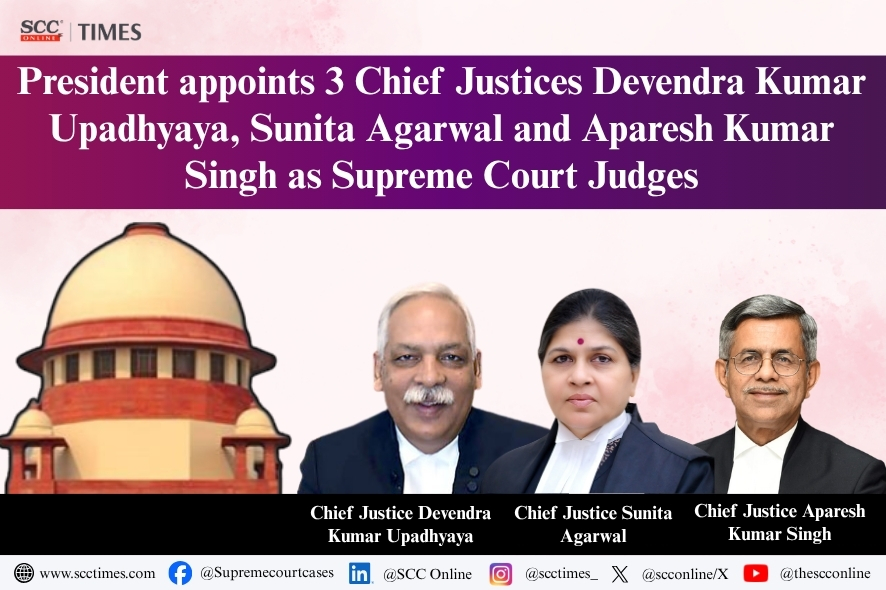
India: Upadhyaya, Agarwal, Singh Named Supreme Court Judges
Summary
- The President of India has appointed Justices Devendra Kumar Upadhyaya, Sunita Agarwal, and Aparesh Kumar Singh as Supreme Court Judges.
- These three individuals previously held positions as Chief Justices in various High Courts.
- The appointments were made based on recommendations from the Supreme Court Collegium.
- The Supreme Court Collegium's recommendations for these elevations were dated September 28, 2026.
- The new judges' presence on the bench is expected to influence judicial interpretations and the direction of jurisprudence.
Key Judicial Appointments Confirmed
Lawyers and compliance officers in India should be aware of these new appointments to the Supreme Court, as the composition of the bench can influence judicial interpretations, case outcomes, and the overall direction of jurisprudence.
The President of India has formally approved the elevation of three distinguished legal figures to the Supreme Court. Justices Devendra Kumar Upadhyaya, Sunita Agarwal, and Aparesh Kumar Singh, who previously served as Chief Justices in various High Courts, have now been appointed as judges to the nation's apex judicial body. This significant development marks a crucial moment in the ongoing evolution of the Indian judiciary.
These appointments bring a wealth of experience and diverse perspectives to the Supreme Court bench. Each of the newly appointed judges, Justice Devendra Kumar Upadhyaya, Justice Sunita Agarwal, and Justice Aparesh Kumar Singh, has a notable track record from their tenures as Chief Justices, indicating their profound understanding of legal principles and judicial administration. Their transition to the Supreme Court is expected to influence the court's future deliberations and decisions.
Process and Context of Elevations
The formalization of these appointments by the President follows the established procedure for Indian judicial appointments, specifically adhering to the recommendations put forth by the Supreme Court Collegium. The Collegium, a body comprising the Chief Justice of India and the four senior-most judges of the Supreme Court, plays a pivotal role in selecting and recommending candidates for judicial office in the higher courts.
The specific recommendations for these three judges were issued by the Supreme Court Collegium on September 28, 2026. This date underscores the structured and deliberative process involved in identifying suitable candidates for the highest judicial office in the country. Such recommendations are a critical step in ensuring the continuity and strength of the Supreme Court's composition.
Implications for Indian Jurisprudence
The induction of Justices Devendra Kumar Upadhyaya, Sunita Agarwal, and Aparesh Kumar Singh into the Supreme Court carries substantial implications for the nation's legal landscape. The composition of the Supreme Court bench is a dynamic factor that can significantly shape judicial interpretations, influence case outcomes, and ultimately steer the overall direction of jurisprudence in India. The arrival of these new judges will undoubtedly contribute to the court's intellectual diversity and judicial philosophy.
Lawyers and compliance officers in India should be aware of these new appointments to the Supreme Court, as the composition of the bench can influence judicial interpretations, case outcomes, and the overall direction of jurisprudence. Understanding the new judges' backgrounds and previous rulings may be crucial for litigation strategy and anticipating future legal developments. The expertise brought by Justice Devendra Kumar Upadhyaya Supreme Court, Justice Sunita Agarwal Supreme Court, and Justice Aparesh Kumar Singh Supreme Court will be closely watched by legal practitioners and scholars alike, as their contributions begin to unfold within the apex court.
Practical Implications
Lawyers and compliance officers in India should be aware of these new appointments to the Supreme Court, as the composition of the bench can influence judicial interpretations, case outcomes, and the overall direction of jurisprudence. Understanding the new judges' backgrounds and previous rulings may be crucial for litigation strategy and anticipating future legal developments.
Source
Source: Original reporting via SCC Times
How does this affect you?
Get an AI analysis of this article grounded in your jurisdictions, practice areas, and any policy documents you've uploaded to Wansom.
Finish Reading the Full Story and the Expert Analysis.
Get the latest legal & regulatory intelligence in India
Wansom is AI and can make mistakes.