
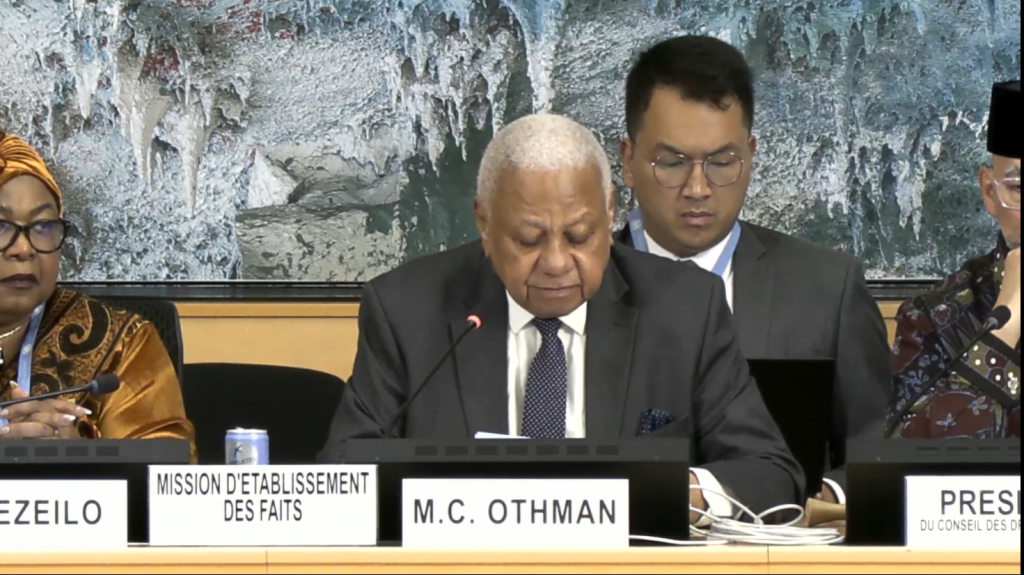
UN Sudan Mission: Urges Wider Arms Embargo Amid War Crimes
Summary
- The UN Fact-Finding Mission on Sudan urged the Human Rights Council to expand the Darfur arms embargo to cover the entire country.
- The mission warned that foreign support, including weapons and personnel from countries like the UAE, Chad, and Libya, is sustaining a conflict where both sides may have committed war crimes.
- Responsibility for potential international crimes could extend to those who finance, supply, or enable violations, prompting a call for states to investigate such entities.
- Sudan's government rejected the expanded embargo, accusing the United Arab Emirates of being the "sponsor of the rebel militia" and prolonging the war.
- The mission emphasized the devastating impact of external support, particularly drones, on civilians and called for an immediate end to unlawful military assistance and full compliance with international humanitarian law.
UN Mission's Urgent Call for Embargo Expansion
Responsibility for potential international crimes could extend to those who provide financial assistance, supply resources, or otherwise facilitate such egregious acts.
The United Nations Fact-Finding Mission on Sudan has issued a stark warning to the Human Rights Council, advocating for the expansion of the existing Darfur arms embargo to encompass the entire nation. This critical recommendation stems from the mission's findings that foreign backing is actively sustaining a brutal conflict, during which both warring factions are believed to have engaged in actions that may constitute war crimes. Mohamed Chande Othman, who chairs the UN Fact-Finding Mission on Sudan, addressed the 63rd session of the Human Rights Council in Geneva, Switzerland, on Monday, emphasizing that numerous documented violations could rise to the level of international crimes.
Othman underscored that culpability for these potential international crimes might extend beyond direct perpetrators to include those who provide financial assistance, supply resources, or otherwise facilitate such egregious acts. The mission's call for a broader Darfur arms embargo expansion is presented as a crucial step to curb the flow of illicit support.
External Support and Battlefield Dynamics
The conflict's landscape has been dramatically altered by the proliferation of drones, a development directly attributed to external support in the form of weaponry, logistical aid, and personnel. The increasing deployment of long-range drones, in particular, has inflicted severe consequences upon civilian populations and vital infrastructure. The UN Fact-Finding Mission on Sudan continues its investigations into specific attacks, including those in El Obeid, which compelled civilians to flee, as well as incidents in Kadugli, Ed Daein, and Yabus.
Othman explicitly stated that both sides involved in the conflict have committed violations that could be classified as war crimes. He detailed a sophisticated cross-border network facilitating military operations, implicating the United Arab Emirates, Chad, and Libya, which allegedly funneled weapons to Nyala. Furthermore, the mission reported the recruitment of Colombian nationals into the Rapid Support Forces, tasked with operating drones and providing training. The investigation into external support for the Sudanese Armed Forces remains ongoing.
Accountability and International Legal Obligations
Beyond merely refraining from committing violations, states bear a fundamental responsibility to implement reasonable measures to prevent such acts when a clear and foreseeable risk exists. The mission highlighted a pervasive climate of intimidation and harassment targeting survivors, witnesses, journalists, legal professionals, and human rights defenders. This pressure, emanating from all parties to the conflict both within and outside Sudan, is particularly acute for those cooperating with investigative bodies.
The mission urged an immediate cessation of hostilities, full adherence to international human rights and humanitarian law, and the implementation of all possible safeguards to protect civilians and civilian objects. It specifically called for an end to unlawful military support and pressed states to investigate individuals and entities under their jurisdiction that provide such assistance. The recommendation for the Darfur arms embargo expansion across Sudan aligns with proposals already under consideration by the UN Security Council. The mission also stressed the importance of preserving evidence, safeguarding victims and witnesses, and ensuring effective aid and remedies for survivors, while advocating for accountability throughout the entire chain of responsibility, encompassing those who commit, order, finance, supply, or facilitate international crimes.
Sudan's Counter-Narrative and Accusations
In a contrasting presentation, Intisar Abdel Aal, Sudan’s attorney general and head of the National Committee for the Investigation of Crimes and Violations of National and International Humanitarian Law, offered a significantly different perspective on the conflict. Characterizing the war as a "proxy war" and citing various international reports, Abdel Aal directly accused the United Arab Emirates of acting as the "sponsor of the rebel militia." She asserted that the UAE's external backing for the Rapid Support Forces is the primary factor prolonging the conflict and enabling atrocities.
Abdel Aal called for the condemnation of the UAE and decisive action to halt its support. However, she firmly rejected calls for a wider arms embargo, dismissing them as an adoption of demands made by the "rebel militia." The attorney general also highlighted the progress made by Sudan's national investigation committee, noting its significant achievements as the Sudanese Armed Forces advanced and security was progressively restored.
Practical Implications
Compliance officers and legal counsel advising entities with operations or supply chains connected to Sudan should review due diligence processes for potential exposure to international crime liability, particularly concerning external support to warring parties, as the UN mission calls for states to investigate such entities. The potential expansion of the arms embargo also necessitates vigilance regarding trade and financial sanctions.
Source
How does this affect you?
Get an AI analysis of this article grounded in your jurisdictions, practice areas, and any policy documents you've uploaded to Wansom.
Finish Reading the Full Story and the Expert Analysis.
Wansom is AI and can make mistakes.