
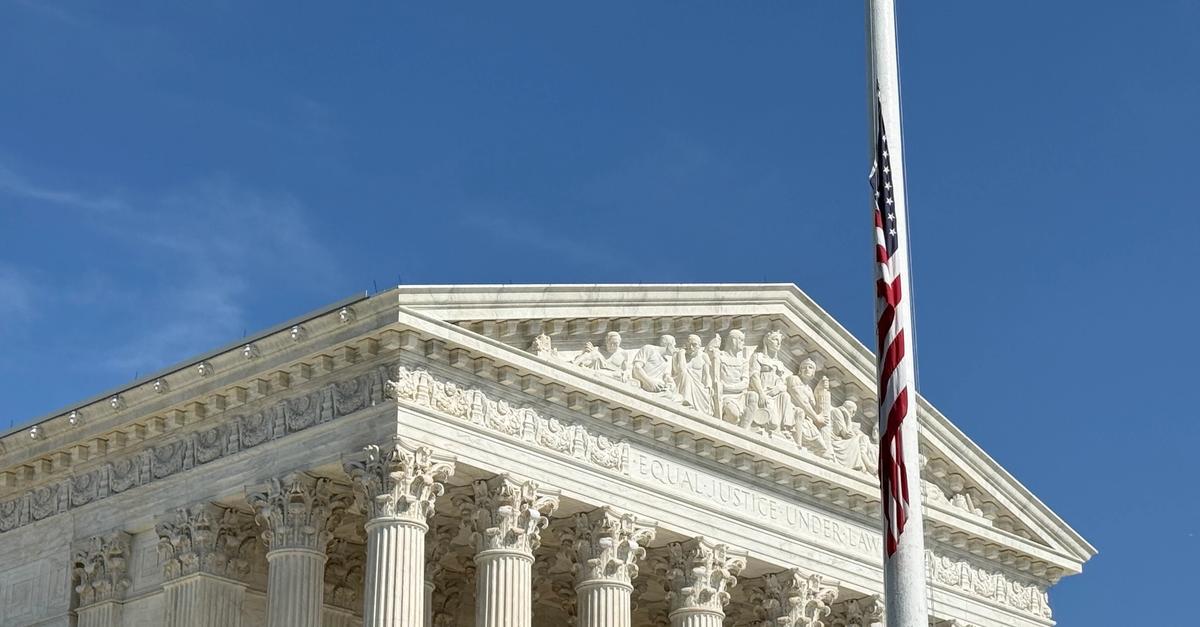
Trump Admin Petitions Supreme Court: Block USPS Mail-In Voting Rule
Summary
- The Trump administration has asked the Supreme Court to temporarily halt a federal judge's order blocking parts of a U.S. Postal Service mail-in ballot rule.
- This marks the second time in less than six weeks the administration has sought Supreme Court intervention to implement mail-in voting restrictions.
- Solicitor General D. John Sauer argued that the blocked rule aims to prevent voter fraud, which he described as undermining election integrity.
- The administration's efforts stem from a March executive order signed by President Trump, directing federal agencies to take steps on mail-in voting.
- Key provisions of the executive order include DHS creating voter lists and the Attorney General prioritizing prosecution of officials issuing ineligible ballots.
Supreme Court Asked to Intervene on Mail-In Voting
A decision by the Court could clarify the extent of executive authority in dictating election procedures, especially those involving federal agencies like the USPS.
The Trump administration recently escalated its efforts to implement new regulations concerning mail-in ballots, petitioning the Supreme Court on Thursday afternoon. This latest move seeks a temporary halt to an order issued by a federal judge in Boston. The judicial directive in question prevents the government from enacting specific components of a U.S. Postal Service (USPS) rule related to mail-in voting.
Representing the administration, U.S. Solicitor General D. John Sauer presented the case to the high court. Sauer contended that the ruling by U.S. District Judge Indira Talwani effectively "partially nullifies the Postal Service’s efforts to address the risk that the federal mails will be used to perpetrate voter fraud." He further characterized voter fraud as "a particularly pernicious species of fraud that dilutes the votes of lawful voters, prevents election results from reflecting the will of the American people, and undermines ‘public confidence in the integrity of the electoral process.’" This appeal underscores the administration's ongoing focus on perceived vulnerabilities within the mail-in voting system.
Executive Order Underpins Administration's Stance
This recent filing marks the second occasion in less than six weeks that the Trump administration has approached the Supreme Court with the aim of advancing restrictions on mail-in voting. The broader initiative stems from an executive order signed by President Donald Trump in March. This order mandated that federal agencies undertake a series of actions pertaining to mail-in voting procedures.
Among its key provisions, the executive order directs the Department of Homeland Security (DHS) to compile comprehensive lists of adult U.S. citizens within each state. These lists are then to be transmitted to the respective states at least 60 days prior to any federal election. Furthermore, the order instructs the U.S. attorney general to "prioritize the investigation and, as appropriate, the prosecution of State and local officials ... who issue Federal ballots to individuals not eligible to vote in a Federal election." These directives illustrate the administration's multi-pronged approach to what it views as critical election integrity issues, particularly concerning USPS mail-in ballot restrictions.
Broader Implications for Election Law and Federal Power
The Supreme Court's consideration of this request regarding the Trump Supreme Court mail-in voting rule carries significant weight for the future of election administration and federal oversight. The arguments put forth by Solicitor General D. John Sauer highlight the administration's concerns about voter fraud and its potential to erode public trust in electoral outcomes. A decision by the Court could clarify the extent of executive authority in dictating election procedures, especially those involving federal agencies like the USPS.
For legal professionals advising on election law, campaign finance, or administrative law, this case warrants close monitoring. The outcome will not only impact voter access by potentially allowing new USPS mail-in ballot restrictions but also establish precedents for the grounds upon which future election challenges might be mounted. The Court’s ruling on Judge Indira Talwani's order will be a crucial indicator of how the judiciary views the balance between federal executive action and state-level election management, particularly in the context of a voter fraud executive order.
Practical Implications
Lawyers advising on election law, campaign finance, or administrative law should closely monitor the Supreme Court's decision on the USPS mail-in voting rule, as it will clarify the scope of federal executive power in election administration and could impact voter access and the grounds for future election challenges.
Source
How does this affect you?
Get an AI analysis of this article grounded in your jurisdictions, practice areas, and any policy documents you've uploaded to Wansom.
Finish Reading the Full Story and the Expert Analysis.
Wansom is AI and can make mistakes.