
Trump: 50% Canada Auto Tariffs Set for 2027 Amid Trade Spat
What Happened
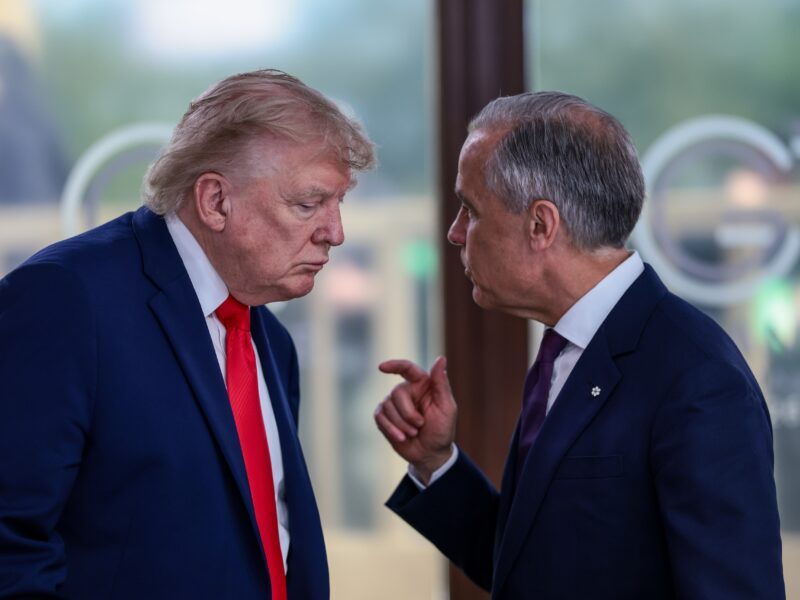
The premier of Ontario — the epicenter of the auto industry in Canada — said Trump "can kiss my ass as far as I'm concerned" after the U.S. president's latest escalation. FILE - President Donald Trump speaks with Canadian Prime Minister Mark Carney, right, at a working lunch with leaders of G7 and the Middle East in Evian-les-Bains, France, Tuesday, June 16, 2026. (Evelyn Hockstein/Pool Photo via AP,File) (CN) — President Donald Trump warned he would impose even more duty fees for Canadian imports in retaliation for Prime Minister Mark Carney’s announcement that Canada would match “dollar-for-dollar” new 50% American tariffs on $20 billion of Canadian goods. Trump revealed tariffs on Canadian automobile parts, cars and trucks would increase from their current 25% to 50% in January 2027. “Canada will be treated like a State no longer! On Trade, and in other ways, also, they are among the worst Nations in the World to deal with. They feel entitled, and yet, WE DON’T NEED CANADA, THEY NEED US!” he wrote on Truth Social. Last Tuesday night, with hope of an agreement dwindling just an hour before the 50% tariffs were set to take effect, Trump pushed the deadline back to Friday and insisted a deal was almost finalized. Yet, that day came, and Canadian and American representatives spent the day at the table, still negotiating the finer points. Abruptly, Canada walked away from the trade talks late into the evening after stating that unexpected demands were added by Washington. In a statement Friday night, Carney said the “U.S. proposed terms were unfair, uneconomic and called into question the reliability of any deal.” The prime minister held a press conference Saturday where he revealed some of these terms, notably that Washington wanted the right to limit Canada’s ability to trade with other countries, to keep tariffs on heavy vehicles and trucks, and to remove the mandatory regulations for French language, notably on labels and content. “We were not prepared to compromise Canada’s sovereignty or undermine our key industries,” Carney said. “We were not prepared to compromise on the protection of the French language and our culture.” Ottawa’s countermeasures matching the American tariffs “to protect our workers and businesses” are set to take effect Sept. 8. U.S. Trade Representative Jamieson Greer, who led the negotiations for Washington, denied Carney’s claims Monday and blamed Canada for the collapse of the trade talks. “Simply, they wanted more,” he said. The latest U.S. tariff threats are presumably meant to pressure Ottawa into walking back its countermeasures, notably in the dairy and automobile industries. Trump often invokes the impact of the Canadian dairy quotas on American farmers to justify his stance against Canada. Canada’s dairy system works through a supply management program put in place in 1972, with the goal of controlling price fluctuations. American dairy producers currently have access to 3.9% of the Canadian market — not enough, according to Washington. In Canada, the main importers of U.S. dairy are processors with fewer incentives to buy quality products, which impacts American farmers. For the White House, this system is tantamount to discrimination against Americans. The automobile industry has been a key point in trade talks. Ottawa was trying to lower the current 25% tariffs imposed in March 2025 during the negotiations. The industry is intrinsically connected between the two countries, and automotive parts can cross the border often in the process of building cars. The new tariffs on automotive parts that should come into effect next year is another blow for Canadian automakers suffering since last year. The province of Ontario is the epicenter of the auto industry in Canada. Their Premier Doug Ford did not mince his words in an interview with Toronto radio station Newstalk 1010, saying the
Practical Implications
Lawyers and compliance officers should advise clients in the automotive and dairy sectors on potential supply chain disruptions and increased import costs due to the escalating US-Canada trade dispute. They must monitor these tariff threats closely for implementation, which could necessitate re-evaluating trade strategies and compliance frameworks.
Source
How does this affect you?
Get an AI analysis of this article grounded in your jurisdictions, practice areas, and any policy documents you've uploaded to Wansom.
Wansom is AI and can make mistakes.