
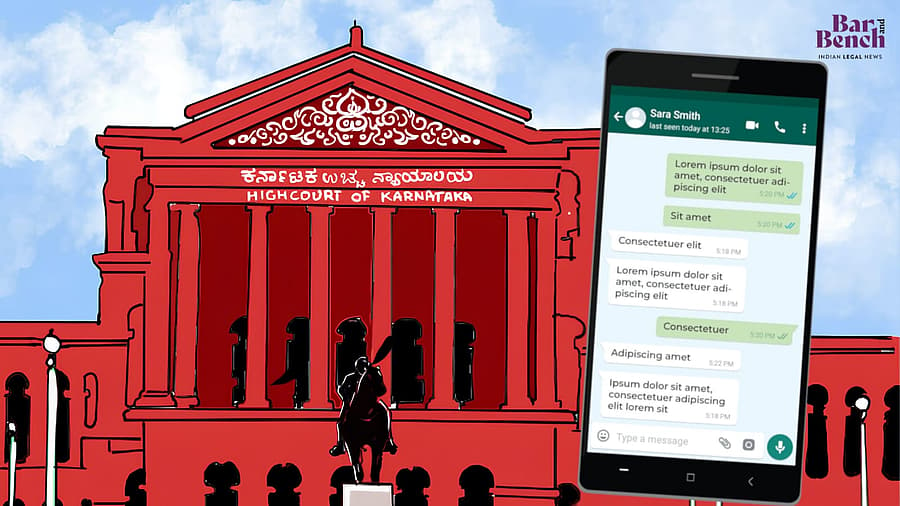
Karnataka High Court: Thufail Ahmed v. State Section 69 BNS Stay On Proceedings
Summary
- The Karnataka High Court has issued an interim stay on criminal proceedings against a man accused under Section 69 of the Bharatiya Nyaya Sanhita (BNS), 2023.
- Justice M Nagaprasanna observed that the petitioner's alleged 'ghosting' and 'seen-zoning' of his partner did not fulfill the statutory ingredients for the offense of sex on false promise of marriage.
- The case, Thufail Ahmed v. State, involves a complaint filed after the petitioner refused calls and blocked his partner following a suspected lie about visiting his ailing father.
- A chargesheet had been filed against the petitioner, who subsequently sought relief from the High Court.
- This ruling provides an early judicial interpretation of BNS Section 69, suggesting that mere disengagement may not suffice for criminal charges.
Court Stays Proceedings in BNS Section 69 Case
Justice M Nagaprasanna determined that the alleged conduct did not meet the necessary statutory elements for the offense.
The Karnataka High Court has issued an interim stay on criminal proceedings against a man accused of engaging in sexual relations under the false promise of marriage. The case, identified as Thufail Ahmed v. State, involves allegations that the petitioner's actions of 'ghosting' and 'seen-zoning' his partner constituted an offense under Section 69 of the newly enacted Bharatiya Nyaya Sanhita (BNS), 2023. Justice M Nagaprasanna, presiding over the matter, determined that the alleged conduct did not meet the necessary statutory elements for the offense.
The petitioner had approached the High Court seeking a stay on the criminal proceedings after a chargesheet was filed against him. The complaint, lodged by his former partner, accused him of offenses under both Section 69 and Section 115 of the BNS. This judicial intervention marks an early interpretation of the BNS, particularly concerning the evidentiary thresholds for allegations of false promise of marriage.
The relationship between the petitioner and the complainant reportedly began in December 2025. The complainant alleged that the petitioner informed her he was traveling to Chennai to visit his ailing father, who was undergoing medical treatment. Suspecting that this explanation was untruthful, the partner requested a video call from the petitioner. He subsequently refused to accept her calls and ultimately blocked her, leading to the filing of the complaint.
Judicial Interpretation of BNS Section 69
Justice M Nagaprasanna's ruling in Thufail Ahmed v. State BNS 2023 provides a significant early interpretation of Bharatiya Nyaya Sanhita Section 69. The court specifically noted that the core of the accusation rested on the petitioner's subsequent actions of 'seen-zoning' and 'ghosting' the complainant. However, Justice Nagaprasanna observed that, apart from these actions, there was no other evidence presented that could fulfill the essential ingredients of an offense under Section 69 of the BNS.
The court's order explicitly stated, "It is the allegation that the petitioner had begun to seenzone the respondent and ghost her throughout. Therefore, the offence under s.69 has sprung. Except this there is nothing else that could become the ingredients of the offence under s.69. In that light there shall be an interim order of stay on further proceedings qua the petitioner till the next date of hearing." This highlights the court's view that mere disengagement or avoidance, without further evidence of a false promise at the time of the sexual act, may not be sufficient to establish criminality under this section.
Advocate Syed Anwar, representing the petitioner, contended before the court that the former partner's complaint stemmed from underlying "trust issues." This argument, alongside the court's assessment of the statutory requirements, contributed to the decision to grant an interim stay on the criminal proceedings, pending further hearings.
Implications for False Promise of Marriage Cases
This decision by the Karnataka High Court carries substantial implications for false promise of marriage criminal proceedings India, particularly under the new Bharatiya Nyaya Sanhita. The interim stay in Thufail Ahmed v. State Section 69 BNS stay underscores the judiciary's careful approach to interpreting the new criminal code and its application to complex interpersonal relationships.
The ruling suggests that for an accusation under BNS Section 69 to proceed, the prosecution may need to demonstrate more than just a breakdown in communication or a partner's subsequent disengagement. The court's emphasis on the lack of other ingredients beyond 'ghosting' and 'seen-zoning' indicates a potential requirement for clearer evidence of a false promise made with the intent to deceive at the time of the sexual act.
While an interim order, this development from the Karnataka High Court quashing criminal proceedings for now, serves as an important precedent for legal practitioners. It signals that simply ending a relationship or ceasing communication, even if perceived as hurtful, may not automatically translate into a criminal offense under Section 69 of the BNS without additional, specific evidence of a fraudulent promise.
Practical Implications
This ruling offers an early judicial interpretation of Section 69 of the Bharatiya Nyaya Sanhita (BNS) 2023, clarifying that 'ghosting' or 'seen-zoning' alone may not fulfill the statutory ingredients for an offense of sex on false promise of marriage. Lawyers should note this precedent when defending clients accused under BNS Section 69, particularly concerning the evidentiary requirements for establishing a 'false promise'.
Source
Source: Original reporting via Live Law
How does this affect you?
Get an AI analysis of this article grounded in your jurisdictions, practice areas, and any policy documents you've uploaded to Wansom.
Finish Reading the Full Story and the Expert Analysis.
Get the latest legal & regulatory intelligence in India
Wansom is AI and can make mistakes.