
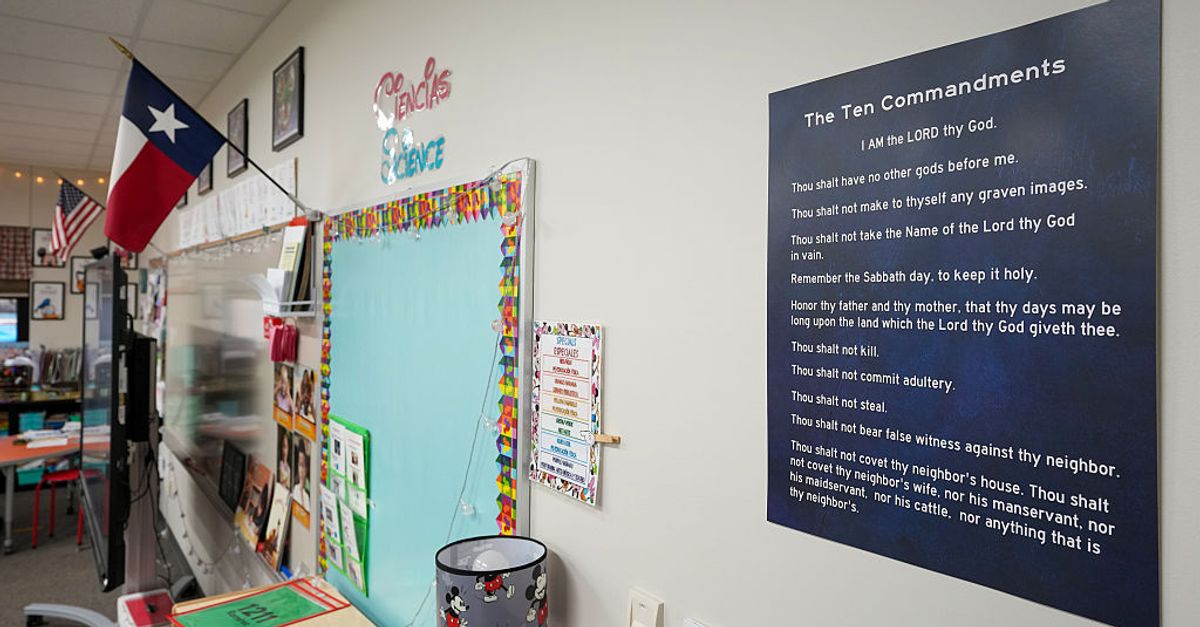
Texas Families Challenge Ten Commandments Display in Public Schools
Summary
- A group of Texas families has asked the US Supreme Court to review a lower court's ruling on the constitutionality of a state law requiring each classroom to display a copy of the Ten Commandments.
- The challengers argue that the lower court 'flouted this Court's binding precedents and gutted the religious-freedom rights of public-school children and parents.'
- The Supreme Court has considered similar laws before, including a 1980 ruling in Stone v. Graham that prohibited displaying the Ten Commandments in classrooms.
- This challenge could set a new precedent or alter existing jurisprudence on the constitutionality of displaying religious texts in public schools.
What Happened
The challengers argue that the lower court 'flouted this Court's binding precedents and gutted the religious-freedom rights of public-school children and parents.'
A group of Texas families with children in public schools has asked the US Supreme Court to review a lower court's ruling on the constitutionality of a state law requiring each classroom to display a copy of the Ten Commandments. The challengers argue that the lower court 'flouted this Court's binding precedents and gutted the religious-freedom rights of public-school children and parents.' This move comes after a similar law was previously considered by the justices in 1980, when they ruled in Stone v. Graham that displaying the Ten Commandments in classrooms violated the Constitution.
The challengers are seeking to have the Supreme Court review a ruling by the U.S. Court of Appeals for the 5th Circuit that upheld the Texas law. This development has significant implications for the ongoing debate over the display of religious texts in public schools.
Legal Context
The Supreme Court's consideration of this case is particularly noteworthy given the court's evolving stance on religious-freedom jurisprudence since the 1980 make-up of the court and its decision in Stone v. Graham. The court's ruling in Stone rested on its conclusion that the Kentucky law failed the 'Lemon test,' which prohibits government actions that advance or inhibit religion. However, the challengers argue that the lower court's upholding of the Texas law ignores this precedent and undermines the rights of public-school children and parents.
The justices have considered similar laws before, including a 1980 ruling in Stone v. Graham that prohibited displaying the Ten Commandments in classrooms due to concerns about favoring one religion over another. This precedent has significant implications for the ongoing debate over the display of religious texts in public schools.
Why It Matters
This challenge could set a new precedent or alter existing jurisprudence on the constitutionality of displaying religious texts in public schools. Lawyers should watch closely as this case unfolds, as it has significant implications for the ongoing debate over the display of religious texts in public schools and the potential changes to the constitutionality of such displays.
The Supreme Court's consideration of this case is particularly noteworthy given the court's evolving stance on religious-freedom jurisprudence since the 1980 make-up of the court and its decision in Stone v. Graham. The outcome of this case could have far-reaching implications for public schools across the country.
Practical Implications
Lawyers should watch for potential changes to the constitutionality of displaying religious texts in public schools, as this challenge could set a new precedent or alter existing jurisprudence.
Source
Source: Original reporting via [Source]
How does this affect you?
Get an AI analysis of this article grounded in your jurisdictions, practice areas, and any policy documents you've uploaded to Wansom.
Wansom is AI and can make mistakes.