
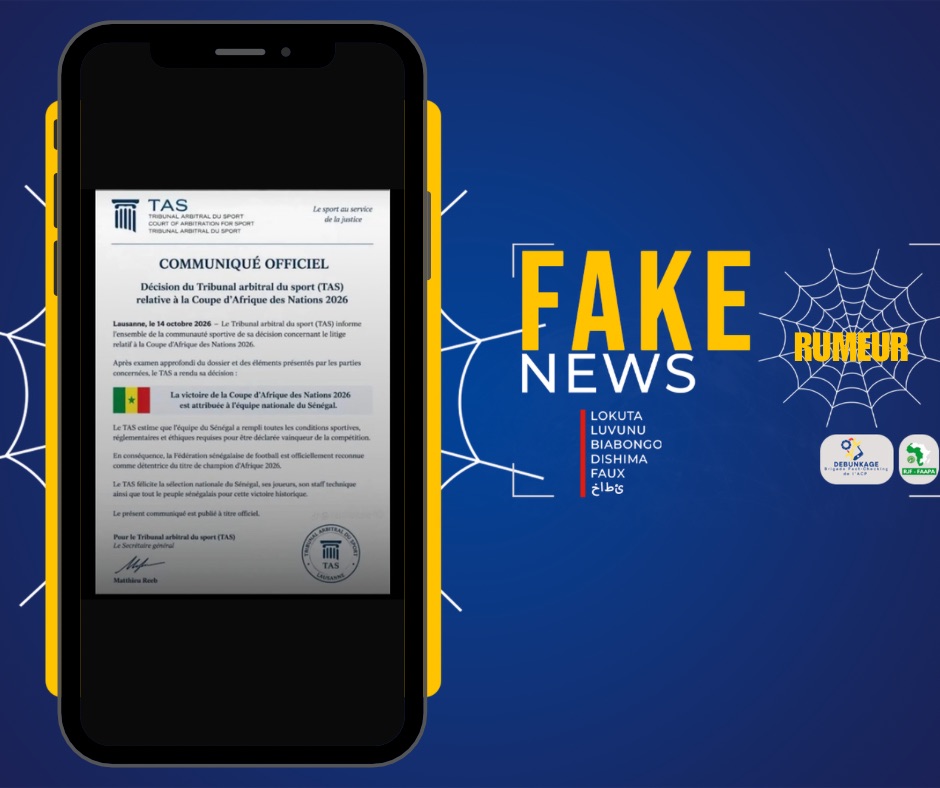
TAS Confirms: Sénégal Maroc Faux Communiqué on CAN 2025 Dispute
Summary
- A communiqué circulating on social media claiming a TAS decision in the Senegal-Morocco CAN 2025 dispute is false.
- The Tribunal Arbitral du Sport (TAS) held a hearing on October 8, 2026, but has not yet issued a definitive ruling.
- The dispute originated from the CAN 2025 final, where Senegal's 1-0 on-field victory was overturned by CAF, awarding Morocco a 3-0 forfeit win.
- The Congolese Press Agency (ACP) confirmed the inauthenticity of the circulating document.
- Verifying official communications from bodies like TAS is crucial to prevent acting on misinformation in high-stakes sports cases.
Disinformation Surrounds CAN 2025 Dispute
Lawyers and compliance officers advising clients in sports law or related fields should be vigilant in verifying the authenticity of official communications, especially concerning high-stakes disputes.
A widely circulated document on social media, purporting to be a definitive ruling from the Tribunal Arbitral du Sport (TAS) concerning the CAN 2025 dispute between Senegal and Morocco, has been confirmed as entirely false. Despite the claims made in this fabricated communiqué, the TAS has not yet rendered a decision in the high-profile case.
The sports arbitration body held an official hearing regarding the matter on October 8, 2026. However, since that date, the final verdict has remained under deliberation and has not been made public. The circulating document, therefore, does not represent an authentic communiqué from the TAS, nor does it constitute a legitimate verdict from the institution tasked with resolving the dispute. This incident highlights a significant challenge in verifying the authenticity of official communications, particularly in high-stakes international sports litigation.
The Genesis of the Controversy
The core of the legal challenge before the TAS stems from the final match of the CAN 2025 tournament. On the field, Senegal had initially secured a 1-0 victory over Morocco following extra time, seemingly clinching the championship title.
However, the outcome was subsequently overturned by the Confederation of African Football (CAF). Following a protest during which Senegalese players temporarily exited the field of play, CAF declared Morocco the winner by forfeit, assigning a 3-0 scoreline. This controversial decision by CAF is what prompted the appeal to the Tribunal Arbitral du Sport, leading to the current litigious situation between the two nations.
TAS's Role and Verification Imperatives
The Tribunal Arbitral du Sport is the designated independent arbitration body responsible for examining and resolving sports-related disputes, including the ongoing CAN 2025 litige Sénégal Maroc. Its role is to provide a definitive and binding resolution to such conflicts. In this specific instance, the Congolese Press Agency (ACP) has explicitly confirmed that the communiqué attributed to the TAS is not authentic, underscoring the importance of relying solely on verified sources.
Lawyers and compliance officers advising clients in sports law or related fields should be vigilant in verifying the authenticity of official communications, especially concerning high-stakes disputes. This incident, involving a faux verdict TAS, highlights the critical risk of misinformation and the paramount importance of relying solely on verified sources from tribunals like the TAS to avoid acting on false premises. The authenticité communiqué TAS is paramount, and any purported Tribunal arbitral du sport décision must be cross-referenced with official channels.
Why Verification Matters
The proliferation of a TAS Sénégal Maroc faux communiqué demonstrates the potential for significant disruption and confusion within the sports community and among the public. Such false reports can mislead stakeholders, including national federations, clubs, athletes, and fans, potentially influencing decisions or public perception based on inaccurate information. The integrity of sports governance and dispute resolution mechanisms relies heavily on the accurate dissemination of information.
Ensuring the authenticity of any purported recourse Sénégal CAF or Tribunal arbitral du sport décision is not merely a procedural formality; it is fundamental to maintaining trust in the legal processes governing international sports. This incident serves as a stark reminder that in an era of rapid digital information sharing, the responsibility to confirm the veracity of official pronouncements rests heavily on all parties involved, from media outlets to legal professionals and the general public.
Practical Implications
Lawyers and compliance officers advising clients in sports law or related fields should be vigilant in verifying the authenticity of official communications, especially concerning high-stakes disputes. This incident highlights the risk of misinformation and the importance of relying solely on verified sources from tribunals like the TAS to avoid acting on false premises.
Source
Source: Original reporting via Senego.
How does this affect you?
Get an AI analysis of this article grounded in your jurisdictions, practice areas, and any policy documents you've uploaded to Wansom.
Finish Reading the Full Story and the Expert Analysis.
Get the latest legal & regulatory intelligence in Senegal
Wansom is AI and can make mistakes.