
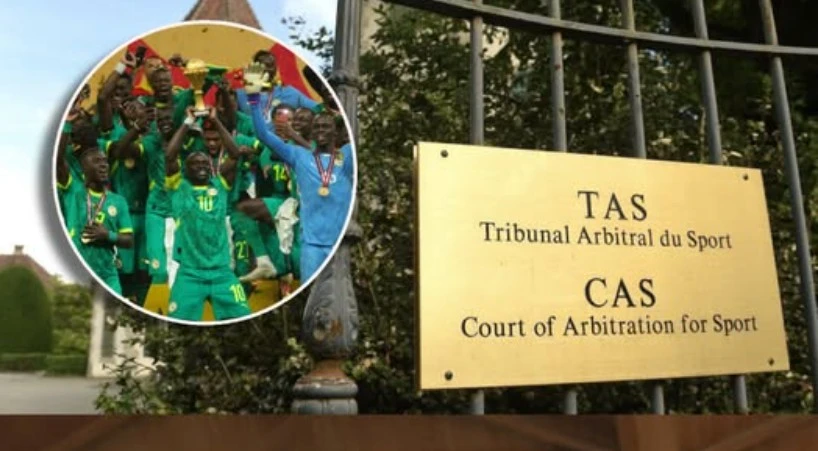
TAS: Issues Sénégal Maroc Football Forfeit Ruling
Summary
- The Tribunal Arbitral du Sport (TAS) held a closed-door hearing on October 8, 2026, regarding a dispute between Senegal, CAF, and Morocco over a forfeited football final.
- Senegal won the final 1-0 after extra time, but CAF later awarded Morocco an administrative 3-0 victory following a brief player protest during the match.
- Senegal's appeal to TAS seeks to annul the CAF sanction and be recognized as the competition winner.
- The TAS will consider whether the temporary protest justified forfeiture, especially since the match resumed and concluded.
- Potential outcomes include annulling CAF's decision, confirming the forfeiture, or a partial annulment without directly awarding the trophy.
The Contested Final and Subsequent Forfeiture
The case ultimately highlights the complex interplay between the authority of the on-field referee, who allowed the game to resume after the protest, and the subsequent disciplinary actions taken by continental sports bodies.
The Tribunal Arbitral du Sport (TAS) convened a closed-door hearing in Lausanne on October 8, 2026, to address a significant dispute involving the Senegalese Football Federation (FSF), the Confederation of African Football (CAF), and the Royal Moroccan Football Federation (FRMF). This high-stakes arbitration centers on the administrative forfeiture of Senegal following a final match that Senegal initially won 1-0 after extra time.
The controversy arose during the match when, after a penalty was awarded to Morocco via video assistance, Senegal's coach, Pape Thiaw, briefly instructed his players to leave the field in protest. Despite this temporary walk-off, the players returned, the game resumed, and Morocco's Brahim Diaz missed the penalty. The match continued to its conclusion, with Pape Gueye scoring the decisive goal for Senegal in extra time.
However, the CAF Appeal Jury subsequently issued a decision on March 17, 2026, declaring Senegal the loser of the final and awarding Morocco an administrative victory with a 3-0 scoreline. This ruling, which effectively nullified Senegal's on-field triumph, prompted the FSF to appeal to the TAS, seeking the annulment of the sanction and official recognition of Senegal as the competition's rightful winner. The `CAF Sénégal Maroc litige` thus escalated to the highest court in sports arbitration.
Legal Arguments and Regulatory Scrutiny
At the heart of the `TAS issues Sénégal Maroc football` is the question of whether the coach's brief protest and the temporary departure of players justified a forfeiture, especially given that play resumed and the match was completed. The FSF's appeal challenges the CAF's interpretation and application of its own regulations, arguing that the circumstances did not warrant such a severe penalty.
Legal analysis surrounding the case points to the distinction between a coach's individual actions and the collective responsibility of a national federation. Abdoulaye Makhtar Diop, a former Sports Minister and former member of the FIFA Ethics Commission, previously stated that the FSF should not be held accountable, as no official members of the federation were directly involved in the on-field incident. The TAS arbitrators will need to consider whether the temporary interruption constituted a violation of specific rules, such as Article 82 of the CAN regulations, and if the sanctions outlined in Article 84 were appropriately applied, particularly in light of the match's resumption.
As an international judicial body based in Switzerland, the `Tribunal Arbitral du Sport Sénégal` applies Swiss law alongside the regulations of the relevant sports federations to resolve disputes. This `arbitrage sportif Sénégal` process requires a careful balancing act between the letter of the law and the specific context of the incident, including the referee's decision to allow the game to continue.
Potential Outcomes from the Tribunal
The three arbitrators overseeing the `Forfait Sénégal football TAS` case now face the critical task of deliberation, with several potential outcomes. One possibility is the annulment of the CAF's decision. This could occur if the arbitrators determine that the rules invoked for the forfeiture were misinterpreted or incorrectly applied, with the resumption of play being a key factor in their assessment. However, an annulment would not automatically mean the TAS would award the trophy directly to Senegal.
Conversely, the tribunal could uphold the forfeiture, confirming the CAF's administrative victory for Morocco. This would require the TAS to conclude that the players' temporary departure indeed violated Article 82 of the CAN regulations and that the sanctions under Article 84 were applicable, even though the match ultimately concluded. In this scenario, Morocco would retain the 3-0 administrative score, overriding the on-field result.
A third potential outcome involves the TAS annulling all or part of the contested decision without fully resolving all administrative consequences, such as the awarding of the trophy. This path would depend on the specific requests made by the parties and the scope of the TAS's jurisdiction in this particular `Décision CAF annulée TAS` scenario. The case ultimately highlights the complex interplay between the authority of the on-field referee, who allowed the game to resume after the protest, and the subsequent disciplinary actions taken by continental sports bodies.
Practical Implications
This case provides a critical example of how the Court of Arbitration for Sport (TAS/CAS) reviews and potentially overturns decisions made by continental sports federations (CAF). Lawyers advising sports organizations or athletes should monitor this outcome for precedents on challenging administrative forfeitures and understanding the scope of TAS/CAS's appellate jurisdiction and its application of Swiss law to sports disputes.
Source
How does this affect you?
Get an AI analysis of this article grounded in your jurisdictions, practice areas, and any policy documents you've uploaded to Wansom.
Finish Reading the Full Story and the Expert Analysis.
Get the latest legal & regulatory intelligence in Senegal
Wansom is AI and can make mistakes.