
TAS: Faux Verdict Circulates on Sénégal CAN 2025 Dispute
Summary
- A fake document falsely declared Senegal the winner of the CAN 2025, claiming the trophy was awarded.
- The Court of Arbitration for Sport (TAS) has not yet issued any decision on the dispute between Senegal and Morocco.
- The fraudulent communiqué contained multiple errors, including an incorrect tournament year and misidentification of TAS Director General Matthieu Reeb.
- Senegal's appeal against the CAF decision, which awarded the trophy to Morocco, was heard by TAS on October 8 and is currently under deliberation.
- The incident underscores the critical importance of verifying official communications to prevent acting on fraudulent information.
A Fabricated Verdict Emerges
Legal professionals and compliance officers must exercise extreme caution and verify the authenticity of official communications, especially in high-profile arbitration cases, to avoid acting on fraudulent information like this fake CAS verdict concerning the CAN final.
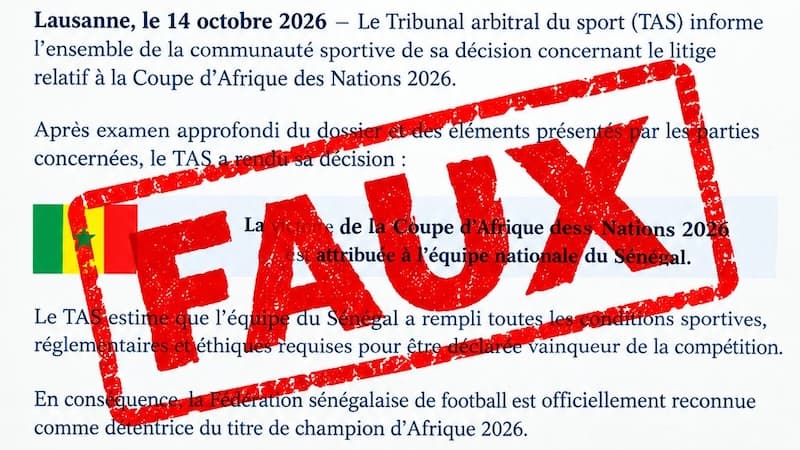
A fraudulent document, purporting to originate from the Court of Arbitration for Sport (TAS), recently circulated, falsely declaring Senegal as the victor of the Africa Cup of Nations (CAN). This fake communiqué went so far as to assert that the Senegalese Football Federation had already taken possession of the championship trophy, creating significant confusion and misrepresentation regarding the ongoing arbitration.
This deceptive communication, dated October 14 from Lausanne, contained multiple glaring inconsistencies that immediately flagged it as inauthentic. Among its errors, the document erroneously referenced the "Coupe d'Afrique des Nations 2026," despite the actual final in contention being for the CAN 2025 tournament, which took place in Rabat on January 18. Such a fundamental factual error underscored the document's lack of legitimacy.
The Real Arbitration Status
Contrary to the claims of the fabricated document, the TAS has not yet issued any ruling in the dispute concerning the CAN 2025 final. The actual legal challenge stems from Senegal's appeal against a decision made by the Confederation of African Football (CAF) appeal jury on March 17. This CAF decision had awarded the trophy to Morocco, simultaneously stripping the Senegalese national team of the title.
Senegal formally registered its appeal with the TAS on March 25. Subsequently, a closed-door hearing involving three arbitrators was conducted in Lausanne on October 8. Following this session, the case was placed under deliberation. Matthieu Reeb, the Director General of the TAS, has publicly committed to releasing a reasoned decision promptly, though no specific date has been set for its announcement. Reports indicate that the official verdict is not anticipated before the period spanning October 18 to October 25.
Anomalies and Verification Challenges
The TAS faux verdict Sénégal CAN document was riddled with several anomalies beyond the incorrect tournament year. It incorrectly identified Matthieu Reeb as the "secretary general" of the TAS, when he in fact holds the position of "director general." Furthermore, the communiqué exhibited various typographical errors, further diminishing its credibility. The date of the fake document, October 14, also did not align with any official announcement schedule, occurring six days after the actual hearing in Lausanne.
This incident is not an isolated one; a similar fake announcement, also proclaiming a Senegalese victory before the TAS, had previously circulated on social media in May. Such occurrences highlight the critical need for rigorous verification of official communications, particularly in high-stakes international sports arbitration like the CAS Senegal Morocco football arbitration. Legal professionals and compliance officers must exercise extreme caution and verify the authenticity of official communications, especially in high-profile arbitration cases, to avoid acting on fraudulent information like this fake CAS verdict concerning the CAN final. This underscores the critical need for due diligence in assessing legal pronouncements and the dangers posed by a Tribunal arbitral du sport communiqué frauduleux.
Practical Implications
Lawyers and compliance officers must exercise extreme caution and verify the authenticity of official communications, especially in high-profile arbitration cases, to avoid acting on fraudulent information like this fake CAS verdict concerning the CAN final. This highlights the critical need for due diligence in assessing legal pronouncements.
Source
Source: Original reporting via Senego
How does this affect you?
Get an AI analysis of this article grounded in your jurisdictions, practice areas, and any policy documents you've uploaded to Wansom.
Finish Reading the Full Story and the Expert Analysis.
Get the latest legal & regulatory intelligence in Senegal
Wansom is AI and can make mistakes.