
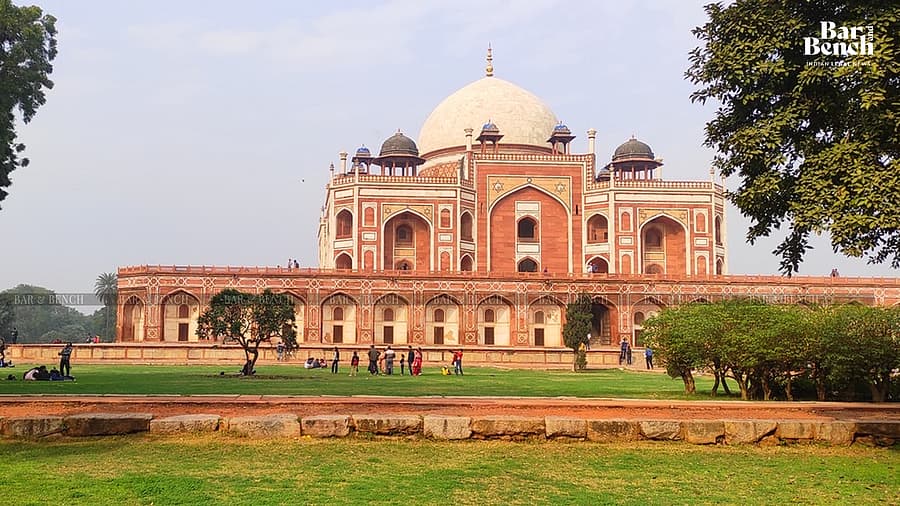
Supreme Court: UPSSSC Humayunnama Exam Mark Dispute
Summary
- The Supreme Court resolved a dispute over a single mark in a 2016 Uttar Pradesh Subordinate Service Selection Commission (UPSSSC) recruitment exam.
- The case, `UPSSSC v. Ashok Yadav`, concerned a general knowledge question asking to identify an incorrectly matched pair from historical texts and figures.
- The UPSSSC identified “Shahjahannama–Mohammad Tahir” as incorrect based on subject matter, while a candidate chose “Humayunnama–Humayun” based on authorship by Gulbadan Begum.
- Justices Manoj Misra and Vijay Bishnoi ruled against the candidate, stating the question did not specify authorship as the basis for identification.
- The decision emphasizes the need for precise question framing in competitive examinations to avoid answer key challenges.
The Disputed Mark
The Court concluded that the candidate could not legitimately claim the additional mark for selecting “Humayunnama–Humayun.”
A seemingly minor disagreement over a single mark in a state recruitment examination recently escalated to the Supreme Court, highlighting the complexities that can arise from ambiguously phrased questions. The dispute originated from a 2016 examination conducted by the Uttar Pradesh Subordinate Service Selection Commission (UPSSSC) for the recruitment of 3,133 Village Development Officers. At the heart of the matter was a general knowledge question that required candidates to identify the incorrectly matched pair from a list of historical texts and figures.
The options provided were: Baburnama–Babur, Shahjahannama–Mohammad Tahir, Humayunnama–Humayun, and Tuzuk-e-Jahangiri–Jahangir. The UPSSSC, in its official answer key, identified “Shahjahannama–Mohammad Tahir” as the incorrect pairing. Their rationale was based on a subject-wise connection, meaning the book was *about* the person listed. However, one candidate, whose challenge eventually led to the case `UPSSSC v. Ashok Yadav`, selected “Humayunnama–Humayun” as the incorrect match, arguing that the `Humayunnama author Gulbadan Begum` was the true writer, not Emperor Humayun himself. This fundamental difference in interpretation regarding the `Supreme Court UPSSSC Humayunnama exam mark` became the core of the legal battle.
Arguments Before the Apex Court
The candidate's contention was that by choosing “Humayunnama–Humayun” as the incorrectly matched pair, he was entitled to an additional mark. His argument hinged on the fact that while Babur, Shah Jahan, and Jahangir were indeed the subjects of their respective texts, and Mohammad Tahir was the author of Shahjahannama, Humayun was neither the author nor the sole subject in the same vein as the others, given Gulbadan Begum's authorship. This `recruitment exam answer key challenge` posited that the question implicitly demanded identification of author-text pairings, not subject-text pairings.
The `Supreme Court exam question dispute` thus centered on the precise interpretation of the phrase "incorrectly matched pair." The candidate believed the most glaring inaccuracy was the attribution of authorship to Humayun, whereas the `Uttar Pradesh Subordinate Service Selection Commission` maintained its interpretation based on the book's subject matter. The case ultimately landed before a bench of Justices Manoj Misra and Vijay Bishnoi, who were tasked with resolving this intricate point of contention.
Clarity from the Bench
After careful consideration, the Supreme Court delivered a definitive ruling on the matter. The Court concluded that the candidate could not legitimately claim the additional mark for selecting “Humayunnama–Humayun.” The crux of the Court’s reasoning was that the original question did not explicitly specify authorship as the criterion for identifying the incorrectly matched pair. Without such a clear directive, the Commission’s interpretation, based on the subject of the book, was deemed acceptable.
Justices Manoj Misra and Vijay Bishnoi emphasized that the question's framing was crucial. Since it merely asked for an "incorrectly matched pair" without stipulating the nature of the match (e.g., author, subject, period), the candidate's assumption that authorship was the intended basis for the answer was not supported by the question's explicit text. This decision effectively upheld the `Uttar Pradesh Subordinate Service Selection Commission`'s original answer key, denying the candidate's claim for the `Supreme Court UPSSSC Humayunnama exam mark`.
Broader Implications for Public Service Exams
This ruling carries significant implications for public service commissions and candidates alike, particularly concerning `recruitment exam answer key challenge` scenarios. It clarifies the Supreme Court's stance on challenges to competitive exam answer keys, especially when questions might appear ambiguous. The Court's emphasis on the explicit premise of a question underscores the importance of precise and unambiguous question framing by examination bodies.
For organizations like the `Uttar Pradesh Subordinate Service Selection Commission`, this judgment highlights the necessity of crafting questions with utmost clarity to prevent future litigation stemming from differing interpretations. Candidates, conversely, are reminded that their claims for marks must align directly with the explicit wording and implied intent of the question, rather than introducing external criteria not specified in the prompt. This decision serves as a critical precedent for managing `Supreme Court exam question dispute` cases, reinforcing that the burden of clarity rests heavily on the question setter.
Practical Implications
This ruling clarifies the Supreme Court's stance on challenges to competitive exam answer keys, particularly regarding ambiguous questions. Lawyers advising public service commissions or candidates should note the Court's emphasis on the question's explicit premise when evaluating claims for marks, highlighting the importance of precise question framing to avoid litigation.
Source
How does this affect you?
Get an AI analysis of this article grounded in your jurisdictions, practice areas, and any policy documents you've uploaded to Wansom.
Finish Reading the Full Story and the Expert Analysis.
Get the latest legal & regulatory intelligence in India
Wansom is AI and can make mistakes.