
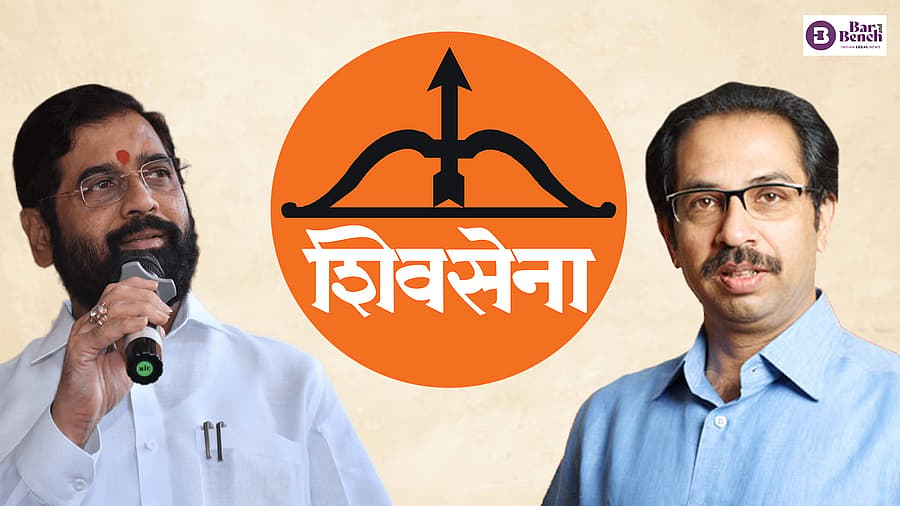
Supreme Court: Examines Shiv Sena Symbol Case Legislature Party Split
Summary
- The Supreme Court is examining whether a split in a political party's legislative wing can extend to its organization and primary membership.
- The Uddhav Thackeray faction is challenging the Election Commission's decision to recognize the Eknath Shinde-led faction as the 'real Shiv Sena' and allot it the 'bow and arrow' symbol.
- Senior Advocate Kapil Sibal argued that a legislative split alone does not constitute a party split, citing the Subhash Desai judgment and the Election Symbols Order.
- Justice Joymalya Bagchi observed that while a split cannot be restricted to the legislature, it could originate there and subsequently reflect in the wider party.
- The court's ruling will clarify legal criteria for determining a political party's identity and symbol in cases of legislative wing splits, impacting future disputes.
The Heart of the Shiv Sena Split
Lawyers advising political parties or involved in election law should closely monitor the Supreme Court's eventual ruling, as it will clarify the legal criteria for determining a political party's identity and symbol in cases of legislative wing splits, impacting future defection and party recognition disputes.
India's Supreme Court is currently examining a pivotal question concerning the identity of political parties amidst internal divisions: whether a split originating within a party's legislative wing can subsequently extend to its broader organizational structure and primary membership. This inquiry forms the core of the Uddhav Thackeray faction's challenge against a decision by the Election Commission of India (EC).
The EC had previously recognized the faction led by Eknath Shinde as the legitimate "real Shiv Sena" and, consequently, allotted it the party's iconic "bow and arrow" symbol. The Supreme Court bench, comprising Chief Justice of India Surya Kant and Justices Joymalya Bagchi and V Mohana, is presiding over the arguments in this high-stakes political and legal dispute.
The proceedings delve into the intricate legal criteria for determining a political party's true identity when its legislative representation fragments. The outcome of this `Shiv Sena symbol case legislature party split` will have significant ramifications for how such divisions are legally interpreted and resolved in India.
Judicial Inquiry into Party Identity
During the arguments, Senior Advocate Kapil Sibal, representing the Thackeray faction, contended that a division solely within the legislative party could not, by itself, constitute a split in the overarching political party. Sibal’s argument drew upon the Constitution Bench judgment in `Subhash Desai v. Principal Secretary, Governor of Maharashtra`, alongside paragraph 15 of the Election Symbols (Reservation and Allotment) Order, to bolster his position that a broader organizational split is required.
However, Justice Joymalya Bagchi offered a nuanced perspective on the matter. He observed that while the Constitution Bench had indeed stated that a proposed split could not be *restricted* to the legislature party, it did not explicitly rule out the possibility of a split originating in the legislative wing and subsequently reflecting within the party's organization and primary membership. Justice Bagchi suggested that such a legislative split could, in fact, serve as the "epicenter" for a wider party division.
The court's ongoing examination seeks to clarify the precise conditions under which a `Supreme Court Shiv Sena party split` is legally recognized, particularly when the initial fissure appears in the legislative rather than the organizational arm of the party.
Shaping India's Political Party Split Law
The Supreme Court's eventual ruling in this `Election Commission Shiv Sena symbol` dispute is poised to significantly shape the landscape of `India political party split law`. The judgment will provide crucial clarity on the legal criteria for determining the authentic identity of a political party and the rightful allocation of its symbol in instances where `Uddhav Thackeray Eknath Shinde factions` emerge.
This case is not merely about the Shiv Sena; it will establish precedents that impact future disputes involving party defections and recognition across the country. Lawyers advising political parties or involved in election law should closely monitor the Supreme Court's eventual ruling, as it will clarify the legal criteria for determining a political party's identity and symbol in cases of legislative wing splits, impacting future defection and party recognition disputes. The interpretation of the `Subhash Desai v. Principal Secretary judgment` and its application to the current scenario will be particularly influential in defining the boundaries of party autonomy versus legislative factionalism.
Practical Implications
Lawyers advising political parties or involved in election law should closely monitor the Supreme Court's eventual ruling, as it will clarify the legal criteria for determining a political party's identity and symbol in cases of legislative wing splits, impacting future defection and party recognition disputes.
Source
Source: Original reporting via Live Law
How does this affect you?
Get an AI analysis of this article grounded in your jurisdictions, practice areas, and any policy documents you've uploaded to Wansom.
Wansom is AI and can make mistakes.