
India: Analyzing Right to Protest and State Restriction Limits
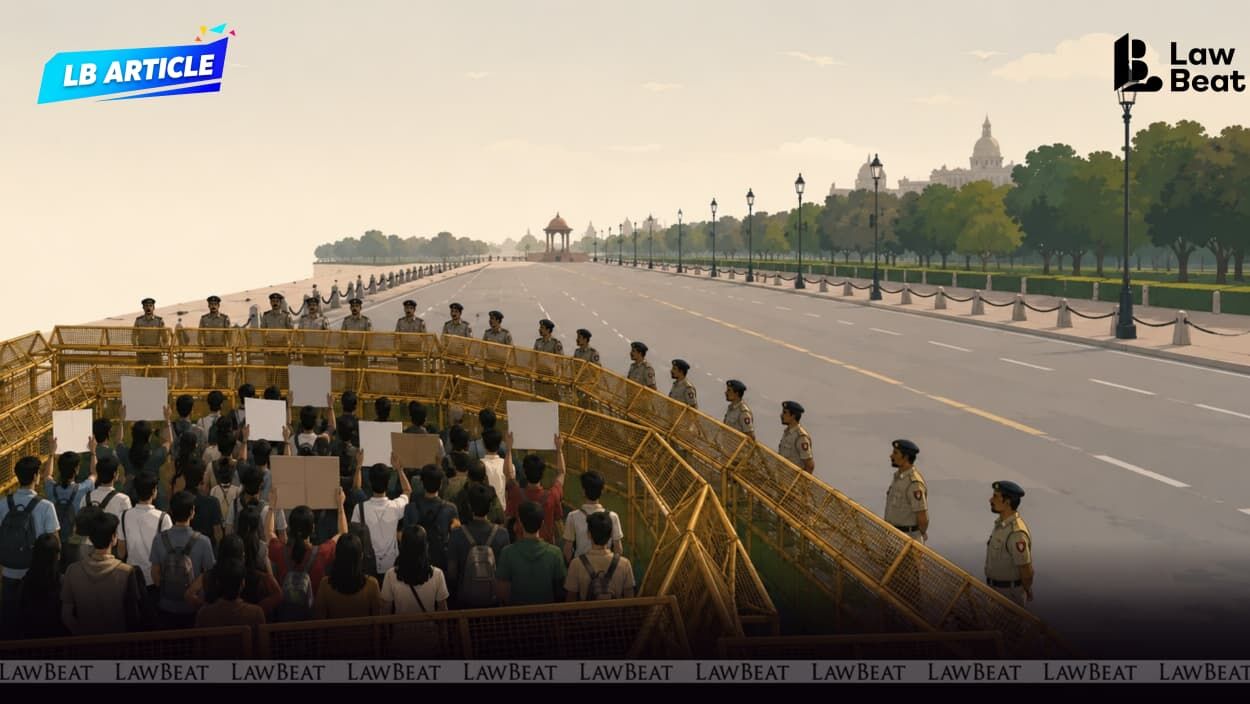
Home / Columns The Right To Protest And The Limits Of State Restriction X In today's era, can legitimate State interests silence dissent, while recognising the need to maintain peace and public order. As prohibitory orders and preventive measures become common, the constitutional question is where legitimate regulation ends and disproportionate restriction begins. On 20 July 2026, Delhi Police confronted a march by Gen-Z protesters demonstrating against the education system and demanding reform . Reports emerged of tear-gas shelling and lathi charges against the protesters . According to the record placed before the Supreme Court by senior advocate Gopal Sankaranarayanan, no prohibitory order under Section 163 of the Bharatiya Nagarik Suraksha Sanhita (“BNSS”) had even been issued for the site, and the Delhi Police’s own standard operating procedure, which requires a loudspeaker warning and a water-cannon stage before lathis and tear gas, to be used, was never followed . Chief Justice Surya Kant himself observed that the guidelines the Supreme Court laid down in 2018 for handling protesters need to be made more stringent in 2026, and signalled his intention to constitute a Special Investigation Team while ordering the release of detained students with no criminal antecedents . Just days earlier, Mumbai Police had invoked Section 37 of the Maharashtra Police Act to ban the “unlawful assembly of five or more persons” across the city for two weeks, before any protest had even been staged . These examples are not isolated; they are symptoms of a larger pattern. India's protest-management apparatus increasingly treats prohibition as the default and permission as a discretionary favour, even though the constitutional text and the Supreme Court's own doctrine require exactly the opposite. Articles 19(1)(a) and 19(1)(b) of the Constitution of India lay down the rule; Articles 19(2) and 19(3) are narrow exceptions to it. Under the settled maxims for construing derogation clauses, the burden of justification falls on the authority seeking to limit the right, not on the citizen seeking to exercise it. The implication is clear: limitations on the right to protest must be interpreted strictly – narrowly worded, confined to enumerated grounds, and proportionate in application – because that is precisely what the Court's own precedent prescribes. Constitutional Framework Kaushal Kishor v. State of U.P. (2023) saw a five-judge bench unanimously hold that the grounds listed in Article 19(2) are exhaustive, and that no restriction can be traced to a reason lying outside that closed list. There is no principled reason why the same exhaustive-list reading should not extend equally to the analogous provision in Article 19(3). That a Section 163 BNSS order has stood, year after year, along Parliament Street, or that a preventive ban has been clamped on an entire city in anticipation of some future assembly, cannot be justified merely by invoking the words “public order” when the real reason is administrative convenience or the fear of unpopularity. This is precisely what Himat Lal K. Shah v. Commissioner of Police (1973) established over five decades ago: the right to assemble, part of Article 19(1)(b), may be regulated by the state, but regulation cannot be turned into prohibition. In Mazdoor Kisan Shakti Sangathan v. Union of India (2018), the Delhi Police Commissioner was directed to devise a mechanism for regulating protests rather than simply interdicting the right or displacing it through relocation. In Re: Ramlila Maidan Incident (2012), the Court held that an order under Section 144 of the Code of Criminal Procedure, the forerunner to Section 163 of the BNSS, must rest on underlying material facts, an imminent threat, and a genuine need for preventive steps. It cannot be deployed pre-emptively simply to forestall trouble. Measured against that standard, neither the Mumbai orders nor the practice of “rolling” prohibitory orders, raised by co
How does this affect you?
Get an AI analysis of this article grounded in your jurisdictions, practice areas, and any policy documents you've uploaded to Wansom.
Wansom is AI and can make mistakes.