
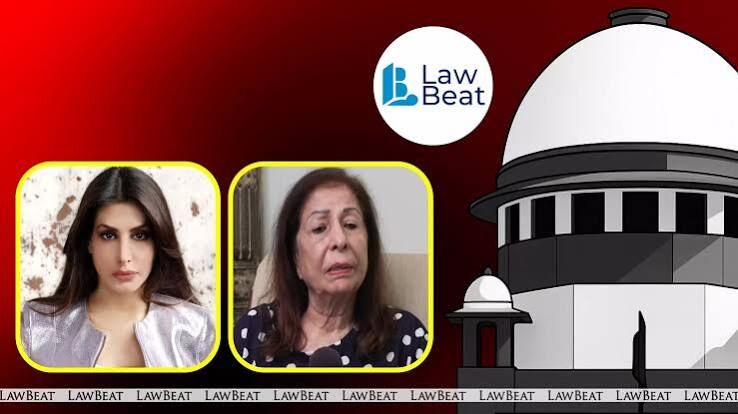
Supreme Court Sees 'Happy Resolution' In Sunjay Kapur Family Trust Dispute; Extends DY Chandrachud-Led Mediation
Home / Top Stories Supreme Court Sees 'Happy Resolution' In Sunjay Kapur Family Trust Dispute; Extends DY Chandrachud-Led Mediation X The Supreme Court expressed optimism over an amicable settlement in the Sunjay Kapur family trust dispute and directed that mediator DY Chandrachud's fees be paid from the RK Family Trust The Supreme Court noted positive progress in the mediation between Rani Kapur and Priya Kapur, directed the RK Family Trust to bear former CJI DY Chandrachud's mediation fees, and granted time until November 2 for an amicable settlement The Supreme Court on Thursday expressed optimism that the ongoing mediation between the family members of late industrialist Sunjay Kapur would culminate in an amicable settlement, noting that the parties were "close to a happy resolution" in the dispute over the RK Family Trust and the family estate. The Bench of Justices JB Pardiwala and K. Vinod Chandran was informed that mediation, being conducted by former Chief Justice of India DY Chandrachud, had progressed substantially, with six sessions already held and all family members participating in detailed discussions. The dispute involves Sunjay Kapur's mother, Rani Kapur , and his wife, Priya Kapur , over issues concerning the family trust and estate. At the outset, Senior Advocate Siddharth Dave, appearing for Rani Kapur, informed the Court that while mediation was progressing, a dispute had arisen regarding the mediator's fees. "The mediation is continuing. There is one difficulty we are having," Dave submitted. Senior Advocate Sheryl Trehan , appearing for Priya Kapur, informed the Court that another mediation session had been held just two days earlier. Taking note of the progress, the Court observed, "The report seems to be positive." Dave, however, submitted that his client, an 80-year-old woman, was unable to bear the mediation expenses. "She is 80 years old and does not have the money," he said. Senior Advocate Abhimanyu Bhandari suggested that the issue could be resolved between the parties themselves. Dave responded by remarking that the opposite side had "deep pockets" and could continue bearing the expenses. The Bench indicated that it would resolve the issue itself. Dave further urged the Court to list the matter before November, submitting that Rani Kapur was not in good health and feared that the proceedings should not be delayed. Addressing the senior counsel, the Bench remarked, "Who will pay the mediator? I am not talking about your clients. I am asking the senior advocates here." The Court then directed that the mediation expenses would, for the present, be borne by the RK Family Trust. "After going through the report, we are very sure that you are all close to a happy resolution, " the Bench observed. Court appreciate progress in Mediation Recording the preliminary mediation report submitted by former CJI Chandrachud, the Court noted that mediation had so far been conducted over six sessions. " The learned Mediator has interacted with all members of the family. We are happy to note that the mediation is proceeding quite satisfactorily. We are happy to note that parties are cooperating," the order recorded. The Court further noted that the parties had engaged in detailed discussions and had agreed to continue mediation for a holistic resolution of all pending disputes. It also took note of the mediator's assistance from a senior Chartered Accountant during the proceedings, observing that the complexity of the financial issues warranted such assistance. The Bench also appreciated the personal participation of one of the parties represented by Senior Advocate Mahesh Jethmalani during the mediation process. Time granted till November 2 The Court accepted the mediator's request to continue the process until November 2, 2026. "The learned Mediator has made an earnest request to allow time till November 2, 2026. We are sure and very much hopeful, in the manner in which the parties have cooperated, all disputes ma
How does this affect your business?
Get an AI analysis of this article grounded in your jurisdictions, practice areas, and any policy documents you've uploaded to Wansom.
Wansom is AI and can make mistakes.