
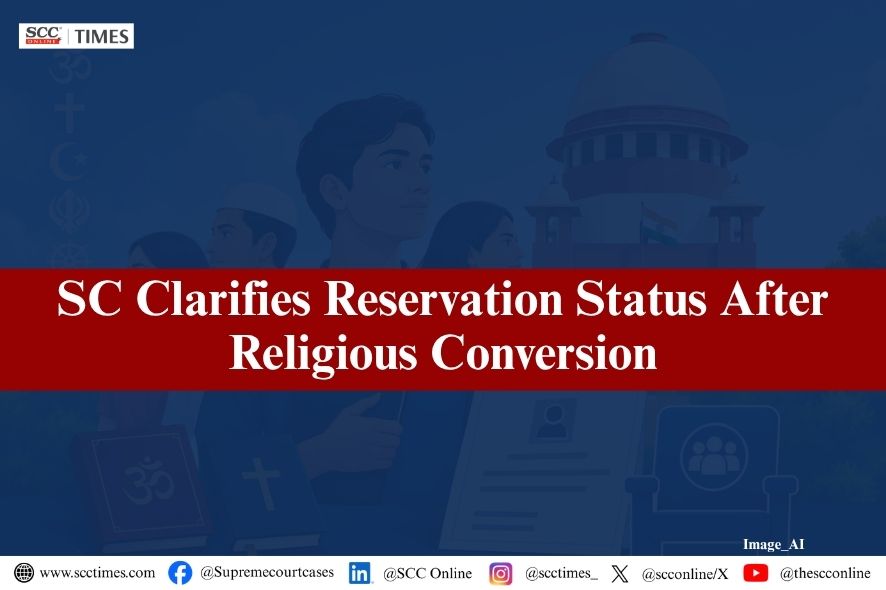
Supreme Court: SC Conversion Islam Reservation Benefits Not Automatic
Summary
- The Supreme Court ruled that converting to Islam does not automatically grant membership to a Backward Class Muslim community.
- Religious conversion alone does not automatically entitle a person to reservation benefits under Article 16(4).
- The Court emphasized that religious identity is distinct from community status for reservation purposes.
- Eligibility for reservation and community status must independently meet constitutional and statutory requirements.
- This decision clarifies the criteria for claiming reservation benefits after a religious conversion in India.
Supreme Court Clarifies Reservation Eligibility Post-Conversion
Lawyers advising clients on reservation eligibility must understand that religious conversion to Islam alone does not automatically confer Backward Class Muslim status or reservation benefits; independent satisfaction of constitutional and statutory requirements for community status is crucial for successful claims.
The Supreme Court of India has issued a significant ruling clarifying the criteria for accessing reservation benefits, specifically addressing instances of religious conversion. The apex court unequivocally stated that merely converting to Islam does not automatically qualify an individual for membership in a recognized Backward Class Muslim community. This decision underscores a crucial distinction between an individual's religious identity and their community status for the purpose of state-sponsored affirmative action.
The ruling further elaborated that such a conversion, while establishing a new religious affiliation, does not inherently entitle the convert to reservation benefits as outlined under Article 16(4) of the Constitution. The Court emphasized that eligibility for these benefits, and indeed the very recognition of community status, must be independently established through adherence to existing constitutional and statutory requirements. This means that factors beyond religious identity play a determinative role in the allocation of reservation benefits, particularly concerning SC conversion Islam reservation benefits.
Legal Framework for Community Status and Reservations
The legal context for this pronouncement lies within Article 16(4) of the Indian Constitution, which empowers the state to make provisions for the reservation of appointments or posts in favor of any backward class of citizens that, in the opinion of the state, is not adequately represented in the services under the state. The intent behind such provisions is to address historical and systemic disadvantages faced by certain communities, ensuring their equitable representation in public life and employment. However, the Supreme Court India religious conversion ruling highlights that this framework is not a blanket provision triggered solely by a change in faith.
For an individual to be recognized as belonging to a Backward Class Muslim community and thus eligible for reservation, their community status must satisfy specific legal criteria. This involves a rigorous assessment that goes beyond a simple declaration of religious identity. The Court's stance reinforces that the constitutional and statutory requirements for determining backwardness and community affiliation are paramount, ensuring that the benefits of reservation are directed towards those genuinely identified as backward classes, rather than being automatically conferred through religious identity vs community status.
Implications for Reservation Claims
This judgment carries substantial implications for individuals seeking to claim Backward Class Muslim status reservation following a religious conversion. It clarifies that the act of conversion to Islam, by itself, is insufficient to secure such status or the associated benefits. Instead, claimants must demonstrate that they meet the established constitutional and statutory prerequisites for being recognized as part of a backward community, irrespective of their religious change.
Lawyers advising clients on reservation eligibility must understand that religious conversion to Islam alone does not automatically confer Backward Class Muslim status or reservation benefits; independent satisfaction of constitutional and statutory requirements for community status is crucial for successful claims. The ruling serves as a vital clarification, ensuring that the principles governing Article 16(4) eligibility conversion are applied consistently and that the criteria for reservation benefits remain rooted in the objective assessment of backwardness and community affiliation, rather than solely on religious identity.
Practical Implications
Lawyers advising clients on reservation eligibility must understand that religious conversion to Islam alone does not automatically confer Backward Class Muslim status or reservation benefits; independent satisfaction of constitutional and statutory requirements for community status is crucial for successful claims.
Source
How does this affect you?
Get an AI analysis of this article grounded in your jurisdictions, practice areas, and any policy documents you've uploaded to Wansom.
Finish Reading the Full Story and the Expert Analysis.
Wansom is AI and can make mistakes.