
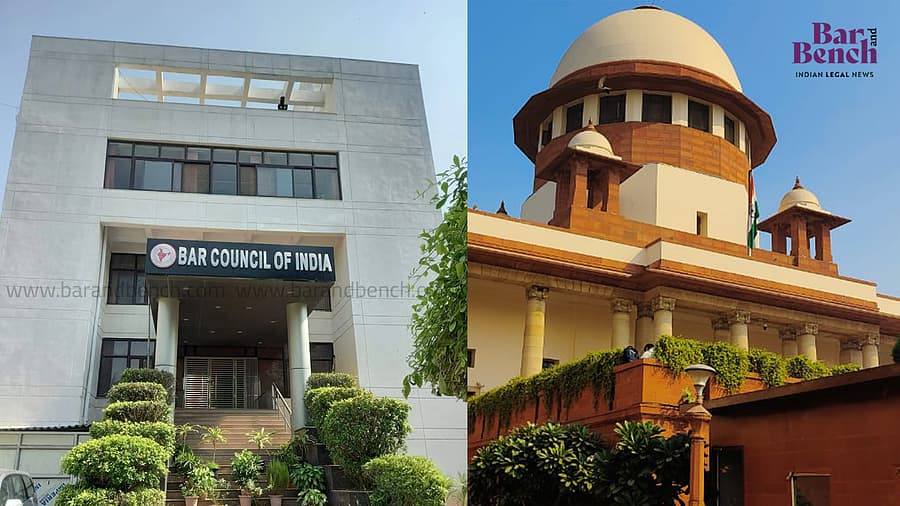
Supreme Court: BCI No Disciplinary Power Over Law Students
Summary
- The Supreme Court ruled that the Bar Council of India (BCI) lacks jurisdiction over law students' conduct before their enrollment as advocates.
- This decision arose from a petition concerning the BCI's withdrawn attempt to bar enrollment for NALSAR Hyderabad's 2026 batch over a student campaign.
- The Advocates Act, 1961, does not grant the BCI express or implied power for disciplinary action against students.
- Disciplinary authority over law students rests exclusively with their respective universities or educational institutions.
- The BCI's powers over a law graduate begin only after formal enrollment with the statutory body.
Supreme Court Clarifies BCI's Authority Over Students
For legal professionals advising educational institutions or law students, this judgment confirms that pre-enrollment conduct falls exclusively under the purview of the respective university or institution, not the BCI, thereby defining clear jurisdictional boundaries and preventing potential overreach by the Bar Council of India.
The Supreme Court of India recently delivered a significant ruling, asserting that the Bar Council of India (BCI) lacks the statutory competence and jurisdiction to address the conduct of individuals pursuing legal education prior to their formal enrollment as advocates. This definitive pronouncement came from a bench comprising Chief Justice of India Surya Kant, Justice Joymalya Bagchi, and Justice V Mohana, on a Thursday.
The Court's observation was made while adjudicating a petition titled `Mihira Sood and another v. Bar Council of India and others`. This particular case stemmed from a now-rescinded decision by the BCI, which had sought to prevent the enrollment of students from NALSAR Hyderabad's 2026 batch. The BCI's initial action was a response to these students' involvement in a campaign critical of the Chief Justice of India. The Supreme Court BCI no disciplinary power law students ruling clarifies the precise boundaries of the BCI's regulatory reach.
Jurisdictional Limits Under the Advocates Act
Central to the Supreme Court's decision was an interpretation of the Advocates Act, 1961, the foundational legislation governing legal practice in India. The Court explicitly stated that this Act does not grant the Bar Council of India any express or implied authority to impose disciplinary measures on students engaged in legal studies. Instead, the power to oversee and discipline students is exclusively vested in the respective university or educational institution where they are enrolled.
While the BCI is empowered to establish and enforce standards for legal education, in line with statutory provisions and applicable regulations, this authority does not extend to disciplinary actions against law students. Chief Justice Kant further elaborated on this distinction, remarking that the BCI's powers over a law graduate only become exercisable once that individual has formally enrolled with the statutory body. This ruling underscores that the Bar Council of India law student conduct falls squarely within the purview of their educational institutions, not the national regulatory body for advocates, thus clarifying the Advocates Act 1961 BCI jurisdiction.
Implications for Legal Education and Practice
This Supreme Court BCI no disciplinary power law students ruling provides crucial clarity regarding the Bar Council of India's jurisdiction, particularly concerning the conduct of aspiring legal professionals. It firmly establishes that the BCI's disciplinary authority commences only upon an individual's enrollment as an advocate, thereby delineating a clear separation of powers between the regulatory body and educational institutions.
The decision in `Mihira Sood v Bar Council of India` reinforces the autonomy of universities and law schools in managing student conduct, free from the direct disciplinary intervention of the BCI. This has significant implications for legal education, ensuring that internal institutional mechanisms remain the primary means of addressing student behavior. For legal professionals advising educational institutions or law students, this judgment confirms that pre-enrollment conduct falls exclusively under the purview of the respective university or institution, not the BCI, thereby defining clear jurisdictional boundaries and preventing potential overreach by the Bar Council of India. The NALSAR students BCI disciplinary action case highlights that the Supreme Court India BCI powers are thus confined to enrolled advocates.
Practical Implications
This ruling clarifies that the Bar Council of India's disciplinary authority over legal professionals commences only upon their enrollment as advocates. Lawyers advising educational institutions or law students should note that pre-enrollment conduct falls exclusively under the purview of the respective university or institution, not the BCI, thereby defining clear jurisdictional boundaries.
Source
How does this affect you?
Get an AI analysis of this article grounded in your jurisdictions, practice areas, and any policy documents you've uploaded to Wansom.
Finish Reading the Full Story and the Expert Analysis.
Wansom is AI and can make mistakes.