
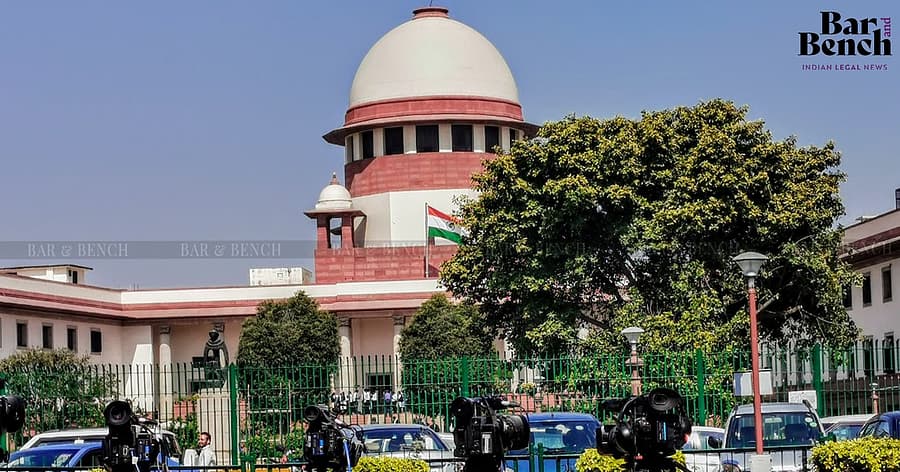
Supreme Court: Rejects Objections to Jaishree Thakur P&H Bar Council Co-option
Summary
- The Supreme Court rejected objections to the co-option of former Justice Jaishree Thakur as a member of the Bar Council of Punjab and Haryana.
- A Bench including CJI Surya Kant dismissed concerns about Justice Thakur's prior role as an election returning officer, emphasizing her qualifications.
- This decision aligns with the Supreme Court's December 8, 2025, directive in `Yogamaya MG vs. Union of India`, mandating 30% women's representation in State Bar Councils.
- The directive specifies that 10% of these seats are to be filled through co-option, with a mechanism established on August 4 for co-opting two women from former judges.
- The ruling underscores the Court's commitment to prioritizing increased women's participation in legal bodies over procedural objections.
Supreme Court Upholds Justice Jaishree Thakur's Co-option
This ruling reinforces the Supreme Court's commitment to its directives on women's representation in State Bar Councils, particularly the co-option mechanism.
The Supreme Court recently dismissed objections raised against the co-option of Justice Jaishree Thakur, a former judge of the Punjab and Haryana High Court, as a member of the Bar Council of Punjab and Haryana. This decision came during a hearing focused on the implementation of the Court's own directives aimed at increasing women's representation within State Bar Councils.
A Bench comprising Chief Justice of India (CJI) Surya Kant, Justice Joymalya Bagchi, and Justice V Mohana heard the arguments. A counsel presented an objection, noting that Justice Thakur had previously served as the returning officer for the Punjab and Haryana Bar Council elections. The counsel began to articulate concerns about the returning officer being subsequently nominated as a member.
However, the Supreme Court promptly rejected these objections. CJI Kant, in a notable remark, questioned the basis of the opposition, stating, "What is the problem with you people? One of the finest judges and the strongest judges has been nominated for Punjab. They are so happy that she is there. People are afraid of her." This firm stance underscores the Court's commitment to its broader goals for women's representation, even when procedural questions arise regarding specific appointments.
Mandate for Women's Representation in State Bar Councils
The context for this ruling lies in the Supreme Court's ongoing efforts to enhance women's participation in legal bodies. A significant directive was issued on December 8, 2025, in the case of `Yogamaya MG vs. Union of India and others`, which mandated that women should constitute 30 percent of the membership in State Bar Councils. This directive outlined a dual approach for achieving this target.
Under the `Yogamaya MG vs. Union of India` directives, 20 percent of the mandated 30 percent representation for women is to be filled through electoral processes. The remaining 10 percent is designated to be filled through a co-option mechanism. This structured approach aims to ensure a substantial and consistent presence of women in these crucial legal governance bodies.
Further elaborating on this framework, the Court, on August 4 of the current year, established the specific mechanism for the 10 percent co-option component. This subsequent directive provided clear guidelines on how these co-opted positions should be filled, reinforcing the Court's intent to see these representation goals realized effectively.
The Co-option Mechanism and Its Significance
The specific co-option mechanism, as detailed by the Supreme Court on August 4, mandates that two women are to be co-opted from the pool of former women judges within the respective jurisdiction. This particular method for the `Punjab Haryana Bar Council women co-option` highlights a strategic choice to bring experienced judicial minds into the Bar Council structure, ensuring high-caliber representation.
The `Supreme Court Jaishree Thakur P&H Bar Council co-option` directly falls under this directive. The Court's decision to reject the objection regarding Justice Thakur's prior role as a returning officer signals a strong prioritization of the overarching objective: increasing the number of qualified women in State Bar Councils. The `SC rejects Jaishree Thakur objection` demonstrates the judiciary's resolve to implement its directives, even in the face of procedural challenges.
This ruling reinforces the Supreme Court's commitment to its directives on women's representation in State Bar Councils, particularly the co-option mechanism. The Court's firm stance indicates that it is likely to uphold appointments made under these directives, prioritizing the goal of increasing women's participation.
Implications for Women's Representation in Legal Bodies
The Supreme Court's decisive action regarding the `Supreme Court Jaishree Thakur P&H Bar Council co-option` sends a clear message about the importance it places on `Women representation State Bar Councils`. By swiftly dismissing the objection, the Bench, including `CJI Surya Kant Bar Council`, underscored that the broader objective of fostering diversity and inclusion in legal governance outweighs specific procedural concerns, especially when the appointee is highly qualified.
This outcome suggests that the Court is prepared to defend the integrity and purpose of its directives, ensuring that the mechanisms put in place to achieve gender parity are not easily undermined. The emphasis on co-opting former women judges, as seen with Justice Jaishree Thakur, is a strategic move to integrate seasoned legal professionals who can contribute significantly to the Bar Council's functions.
Ultimately, this ruling reinforces the judiciary's resolve to transform the landscape of legal representation. It serves as a strong affirmation that the directives, particularly those concerning co-option, are to be implemented robustly, thereby advancing the goal of greater gender balance and diverse perspectives within State Bar Councils across the nation.
Practical Implications
This ruling reinforces the Supreme Court's commitment to its directives on women's representation in State Bar Councils, particularly the co-option mechanism. Lawyers should note that the Court is likely to uphold appointments made under these directives, even when procedural objections are raised, prioritizing the goal of increasing women's participation.
Source
How does this affect you?
Get an AI analysis of this article grounded in your jurisdictions, practice areas, and any policy documents you've uploaded to Wansom.
Finish Reading the Full Story and the Expert Analysis.
Get the latest legal & regulatory intelligence in India
Wansom is AI and can make mistakes.