
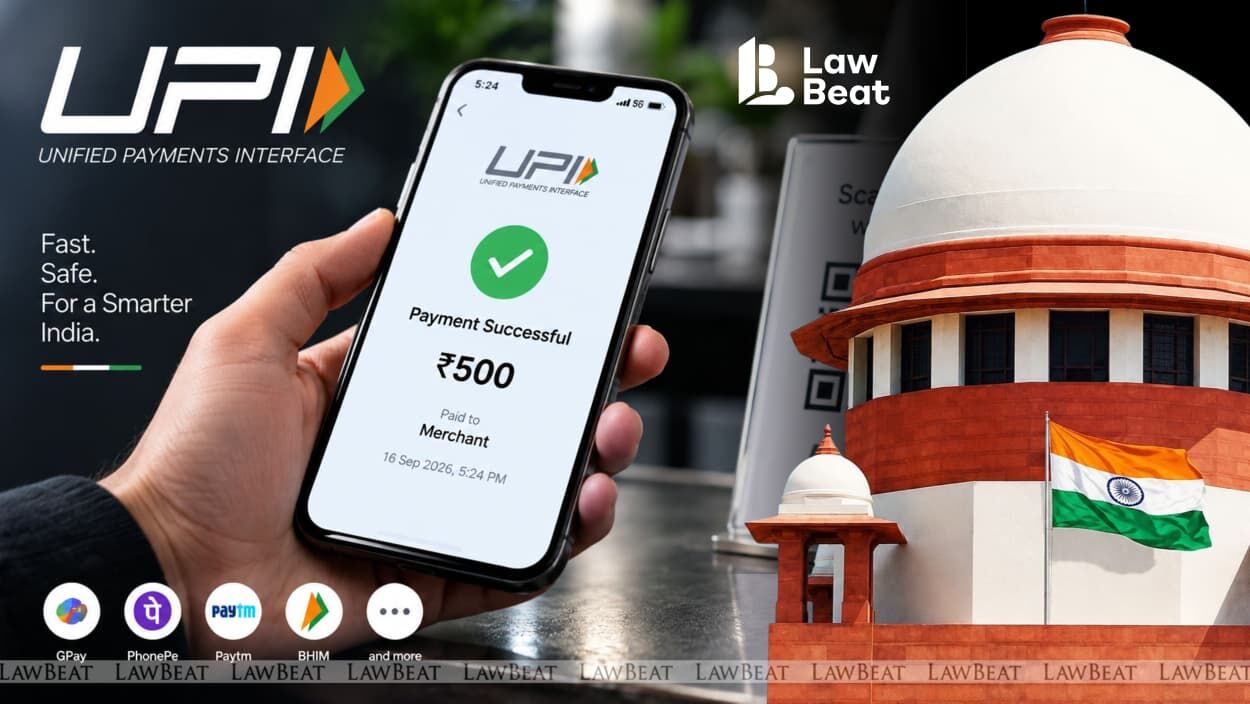
Supreme Court: Refuses Stay on UPI MDR ₹2000 Charges
Summary
- The Supreme Court refused to stay the Centre's new Merchant Discount Rate (MDR) on UPI transactions exceeding ₹2,000.
- This decision means the charges, introduced via a September 2026 Gazette Notification, are scheduled to become applicable from October 15, 2026, ending a 'no-charge' regime for high-value UPI payments.
- A Public Interest Litigation (PIL) filed by advocate Anjan Datta challenges the framework's implementation, citing a lack of transparency and supporting data.
- The new structure includes a 0.4% MDR above ₹2,000, with specific caps and exemptions for certain transaction types and small merchants.
- The petitioner argues the policy is arbitrary, discriminatory, and violates constitutional rights due to its selective application and method of introduction.
Court Upholds New UPI Charges
The Supreme Court's refusal to stay the new Merchant Discount Rate on UPI transactions exceeding ₹2,000 means these charges are scheduled to become applicable from October 15, 2026, marking a significant shift in India's digital payment landscape.
The Supreme Court has declined to issue a stay on the central government's recently implemented framework that permits the imposition of a Merchant Discount Rate (MDR) on specific Unified Payments Interface (UPI) transactions exceeding ₹2,000. This decision, rendered by a bench led by Chief Justice Surya Kant, means that the new India UPI MDR charges are scheduled to become applicable from October 15, 2026, marking a significant shift in the country's digital payment landscape.
The Court's refusal to stay the policy came in response to a Public Interest Litigation (PIL) filed by advocate Anjan Datta, represented by Advocate-on-Record Ashutosh Dubey. The PIL specifically challenges a Gazette Notification published on September 14, 2026, along with the detailed framework announced the following day, September 15, 2026. These measures introduce MDR on specified person-to-merchant (P2M) UPI transactions over ₹2,000, effectively ending a 'no-charge' protection that had been in place since December 2019 for such transactions. Notably, RuPay-powered debit card transactions continue to enjoy this protection without any monetary ceiling.
Details of the Challenged Framework
The new framework, which the Supreme Court refuses to stay, outlines a multi-tiered structure for Merchant Discount Rate UPI transactions. Person-to-person (P2P) transfers remain free of charge, as do P2M payments up to ₹2,000. However, a 0.4% MDR is now applicable to UPI P2M transactions over 2000. For very high-value transactions, specifically those of ₹75,000 and above, the MDR is capped at ₹300.
Further differentiations exist within the policy: specified essential sectors are subject to a flat charge of ₹5, while capital-market payments attract a 0.02% MDR. Additionally, P2PM merchants whose monthly receipts do not exceed ₹1 lakh are exempt from these charges. The Centre has publicly stated that merchants are not permitted to pass these MDR costs onto consumers, a point of contention highlighted in the legal challenge.
Legal Arguments Against the Policy
The PIL does not dispute the legitimate objective of fostering a secure and resilient payment infrastructure but rather challenges the *method* by which this nationwide compulsory payment burden has been established and distributed. The petitioner argues that the framework lacks transparency, having been introduced without the publication of a complete operative instrument, a clear statutory source, an underlying cost study, minutes, methodology, safeguards, or an enforceable anti-pass-through mechanism. The Gazette Notification UPI charges were issued under Section 10A of the Payment and Settlement Systems Act, 2007 (PSS Act), as amended by the Taxation and Other Laws (Amendment) Act, 2026.
The petition further contends that the specific thresholds and classifications within the framework—such as the ₹2,000 transaction limit, the ₹1 lakh monthly-receipt classification, the differential sector rates, and the ₹75,000 cap—are arbitrary and unsupported by publicly disclosed data or determining principles. For instance, a transaction of ₹2,001 incurs a percentage charge while one of ₹2,000 does not, and a merchant might lose protection by exceeding a monthly aggregate boundary unrelated to their margin or turnover. The petitioner asserts that these 'cliffs' could distort behavior and discriminate between similarly situated merchants.
Ultimately, the petitioner argues that this selective and unequal withdrawal of the 'no-charge' protection, coupled with the fixation of a detailed financial levy through a press release rather than a notified statutory instrument, violates Articles 14 and 19(1)(g) of the Constitution. The challenge to the Payment and Settlement Systems Act amendment also highlights concerns about excessive and impermissible delegation of essential legislative and fiscal functions.
Practical Implications
The Supreme Court's refusal to stay the new Merchant Discount Rate (MDR) on UPI transactions over ₹2000 means these charges are now applicable. Lawyers and compliance officers must advise businesses, particularly merchants, to immediately review their pricing strategies, accounting practices, and operational procedures to incorporate these new costs and ensure compliance with the detailed MDR framework, while also monitoring the ongoing legal challenge to the notification.
Source
How does this affect you?
Get an AI analysis of this article grounded in your jurisdictions, practice areas, and any policy documents you've uploaded to Wansom.
Finish Reading the Full Story and the Expert Analysis.
Get the latest legal & regulatory intelligence in India
Wansom is AI and can make mistakes.