
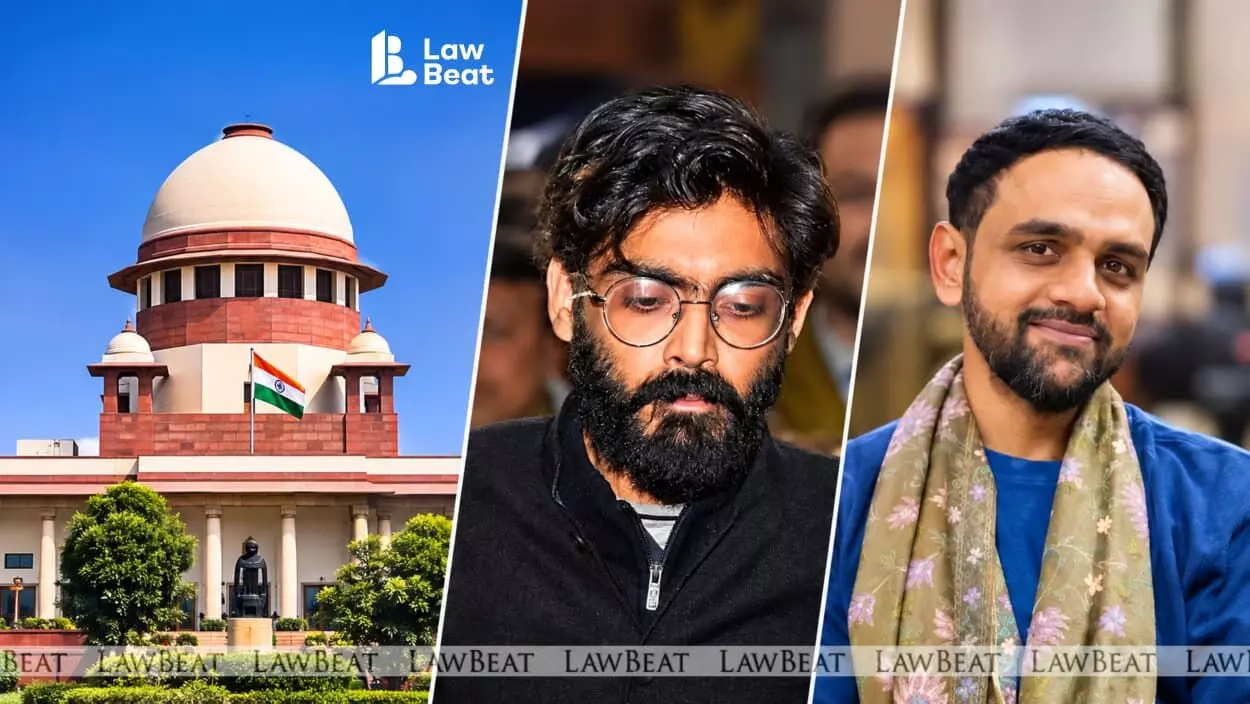
Supreme Court: Refuses Interim Bail for Sharjeel Imam, Umar Khalid
The Supreme Court of India, led by CJI Surya Kant, recently refused to grant interim bail to Sharjeel Imam and Umar Khalid, who are accused in the 2020 northeast Delhi riots "larger conspiracy" case under the Unlawful Activities (Prevention) Act (UAPA), while issuing notice on their main bail pleas.
In this development, a bench led by CJI Surya Kant of the Supreme Court issued notice on the bail pleas filed by Sharjeel Imam and Umar Khalid, who are facing prosecution under the stringent Unlawful Activities (Prevention) Act (UAPA) in connection with the 2020 Delhi riots. However, the Court explicitly declined to grant interim bail to the two accused without first hearing the Delhi police. Senior Advocate Kapil Sibal's request for interim relief was met with a firm "Not today" from CJI Kant. The Supreme Court has indicated its intention to constitute a three-judge bench to hear the substantive bail pleas. The accused have argued that their prolonged incarceration, coupled with the fact that charges are yet to be framed, violates their right to a speedy trial. This appeal follows the Delhi High Court's refusal of bail on September 30, which cited its inability to modify conditions set by a Supreme Court order from January 5, 2026.
This decision carries significant legal implications, particularly for cases involving the UAPA. The Supreme Court's refusal of interim bail, even while acknowledging the need for a full hearing by issuing notice, highlights the stringent judicial approach to pre-trial liberty in UAPA matters. It reinforces the high threshold for bail under this anti-terrorism legislation, where the burden is on the accused to demonstrate that the accusations are prima facie untrue. For legal practitioners, this signals that even arguments pertaining to fundamental rights like speedy trial may not automatically secure interim relief, especially when the prosecution has not yet been heard. The indication of a three-judge bench also suggests the complexity and potential precedential value of the issues involved, particularly concerning the interpretation and application of UAPA bail provisions.
The legal context of this case is deeply rooted in the Unlawful Activities (Prevention) Act (UAPA), 1967, specifically its stringent bail provisions under Section 43D(5), which impose a higher burden on the accused compared to ordinary criminal law. The arguments for a speedy trial invoke Article 21 of the Indian Constitution, which guarantees the right to life and personal liberty, interpreted by courts to include the right to a timely trial. The case also involves the appellate jurisdiction of the Supreme Court over decisions of the Delhi High Court, and the binding nature of Supreme Court precedents, as evidenced by the High Court's reference to a previous Supreme Court order. Key parties involved are the Supreme Court of India (CJI Surya Kant-led bench), Sharjeel Imam and Umar Khalid as the accused, the Delhi High Court (Justices Prathiba M. Singh and Dinesh Bhatt), the Delhi Police, and Senior Advocate Kapil Sibal representing the accused.
Practitioners handling UAPA cases must recognize the formidable challenges in securing bail, particularly interim bail, and the judicial caution exercised in such matters. It is crucial to meticulously prepare arguments addressing the stringent conditions for bail under UAPA, while also vigorously pursuing the constitutional right to a speedy trial, especially when charges are delayed. Attorneys should advise clients that even with strong constitutional arguments, interim relief may be difficult to obtain without a full hearing. Monitoring the constitution of the three-judge bench and the subsequent proceedings will be vital, as the outcome could further clarify the application of UAPA bail provisions and the right to speedy trial in complex conspiracy cases.
How does this affect you?
Get an AI analysis of this article grounded in your jurisdictions, practice areas, and any policy documents you've uploaded to Wansom.
Finish Reading the Full Story and the Expert Analysis.
Get the latest legal & regulatory intelligence in India
Wansom is AI and can make mistakes.