
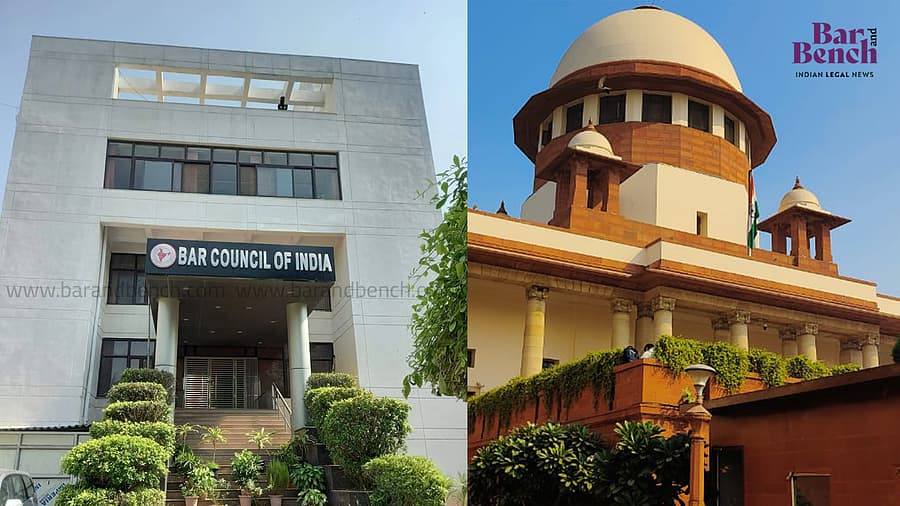
Supreme Court: BCI Control Over Law Colleges Is Academic, Not Administrative
Summary
- The Supreme Court questioned the Bar Council of India's authority to control the administration of law colleges.
- The Court clarified that the BCI can regulate curriculum and promote legal education but not manage college operations.
- This observation was made during a hearing in `Girish Mittal v. Bar Council of India and ors`.
- The case involves concerns raised by petitioner Girish Mittal regarding `BCI Trust PEARL-First funds` and the creation of two law colleges.
- Chief Justice Surya Kant highlighted that experts, not the BCI, are better suited for controlling legal education institutions.
Supreme Court Clarifies BCI's Authority
During a hearing, the apex court verbally indicated that while the BCI holds a significant role in shaping the curriculum, determining the duration of study, and generally fostering legal education, it does not possess the power to manage the day-to-day operations of law colleges.
The Supreme Court recently questioned the extent of the Bar Council of India's (BCI) involvement in the administration of legal education institutions. During a hearing, the apex court verbally indicated that while the BCI holds a significant role in shaping the curriculum, determining the duration of study, and generally fostering legal education, it does not possess the power to manage the day-to-day operations of law colleges. This crucial distinction was highlighted in the case of `Girish Mittal v. Bar Council of India and ors`.
This observation from the `Supreme Court` underscores a critical boundary regarding the `BCI control` over `law colleges`. The bench, comprising Chief Justice of India Surya Kant, Justice Joymalya Bagchi, and Justice V Mohana, emphasized that the BCI's mandate is primarily promotional and regulatory concerning academic standards, not administrative oversight of educational institutions. The court's stance suggests a clear demarcation between setting academic benchmarks and dictating the internal functioning of colleges.
Genesis of the Dispute
The specific matter before the Supreme Court involved a plea concerning the utilization of funds transferred to the `BCI Trust PEARL-First`. This trust, established in 2020, succeeded an earlier BCI trust that had been in operation since 1974. Petitioner Girish Mittal initiated the proceedings, raising significant questions about the establishment and operational aspects of two distinct law colleges.
These institutions, located in Goa and Andhra Pradesh, were reportedly created following agreements between the `BCI Trust PEARL-First` and the respective state governments. Mr. Mittal's petition specifically challenged the methods by which `BCI funds` were being channeled and ultimately deployed for these projects. Advocate Prashant Bhushan, representing the petitioner, reiterated these concerns during the court proceedings, highlighting perceived irregularities in the financial arrangements.
Judicial Scrutiny of Regulatory Powers
The Supreme Court's inquiry delved into the very `scope` of `BCI legal education regulation`. Chief Justice Kant pointedly remarked on the limitations of the BCI's expertise in managing educational institutions, stating that while it could prescribe academic frameworks like curriculum content or study periods (e.g., four or five years), its authority did not extend to controlling the colleges themselves. He suggested that experts in legal education, rather than the BCI, were better equipped for such administrative roles.
This judicial scrutiny directly addresses the `India Supreme Court BCI powers` concerning educational governance. The court's comments serve as a reminder that the BCI's role, while vital for maintaining standards in legal education, must operate within defined parameters, focusing on academic promotion and standardization rather than institutional management. The observation aims to prevent potential regulatory overreach into the autonomous functioning of law colleges.
Why It Matters
The Supreme Court's clear articulation of the `BCI control law colleges` boundary holds significant implications for the governance of legal education across India. By distinguishing between the power to regulate curriculum and the power to administer colleges, the court has provided a crucial clarification on jurisdictional limits. This could influence future interactions between the BCI and legal educational institutions, potentially fostering greater autonomy for colleges in their day-to-day management.
This precedent is particularly relevant for educational institutions and legal practitioners advising them, as it clarifies that challenges to BCI directives related to college administration or funding mechanisms, distinct from curriculum matters, may find support in this judicial observation. The ruling reinforces the principle that while a regulatory body can set standards, it cannot usurp the administrative functions of the entities it oversees, especially when questions of financial propriety, such as those raised concerning `BCI Trust PEARL-First funds`, are at stake.
Practical Implications
This Supreme Court observation clarifies the jurisdictional limits of the Bar Council of India over the administration and running of law colleges, distinguishing it from curriculum regulation. Lawyers advising educational institutions or challenging BCI directives related to college management or funding should note this precedent regarding regulatory overreach.
Source
How does this affect you?
Get an AI analysis of this article grounded in your jurisdictions, practice areas, and any policy documents you've uploaded to Wansom.
Finish Reading the Full Story and the Expert Analysis.
Get the latest legal & regulatory intelligence in India
Wansom is AI and can make mistakes.