
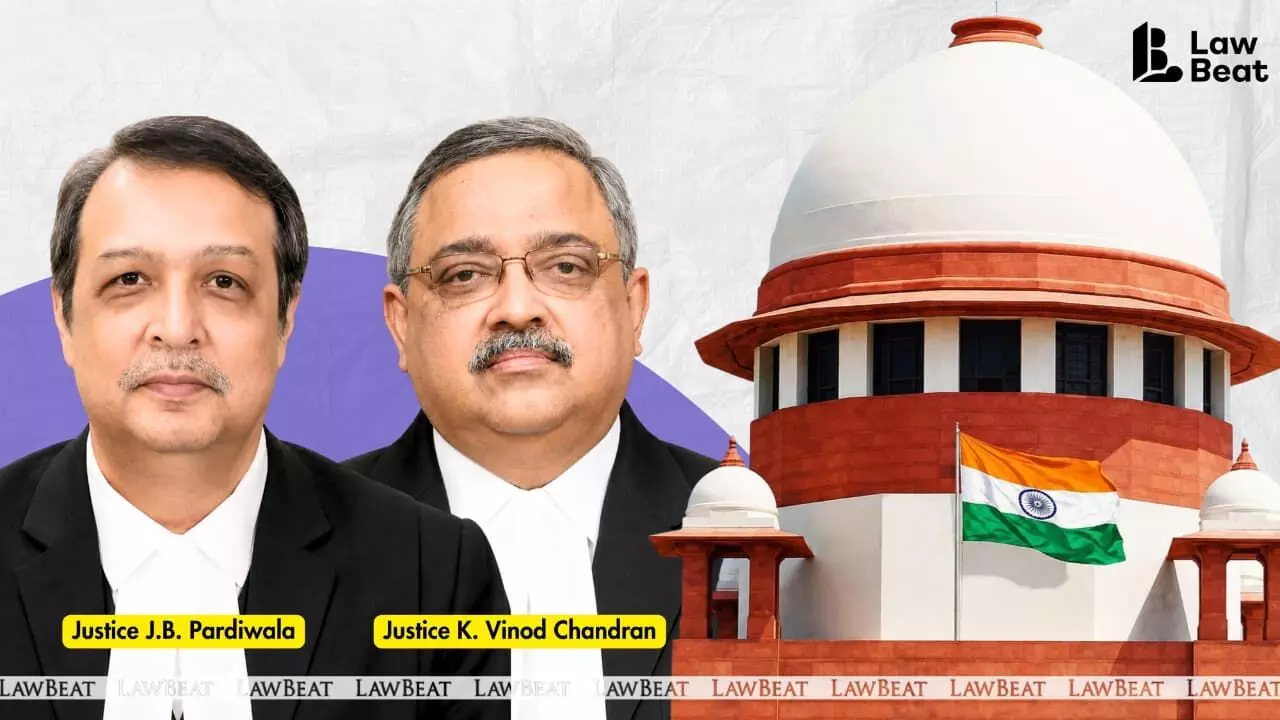
Supreme Court: Stricter Probation Of Offenders Act Criteria Mandated
Summary
- The Supreme Court ruled that probation under Section 4 of the Probation of Offenders Act is not automatic.
- Courts must strictly consider the nature of the offense, circumstances, and the offender's criminal antecedents.
- Justices Pardiwala and Chandran stated probation should not be granted for offenders with prior criminal records or brutal crimes.
- The ruling overturned an Allahabad High Court decision that granted probation despite the accused's criminal history and the victim's grievous injuries.
- The accused, Onkar Nath and Shiv Kumar, had multiple prior criminal cases, which the High Court failed to adequately consider.
Supreme Court Clarifies Probation Criteria
Justices J B Pardiwala and K Vinod Chandran, presiding over the bench, explicitly stated that courts should refrain from extending the benefit of probation when an offender possesses a history of criminal activity or when the sheer brutality of the crime necessitates a punitive sentence to act as a deterrent.
The Supreme Court of India has recently underscored that granting probation under Section 4 of the Probation of Offenders Act, 1958, is not an automatic entitlement. Instead, it mandates a rigorous evaluation of the offense's nature, the specific circumstances surrounding the case, and the character of the individual offender. This clarification comes as a significant directive for lower courts, emphasizing a more stringent application of the law.
Justices J B Pardiwala and K Vinod Chandran, presiding over the bench, explicitly stated that courts should refrain from extending the benefit of probation when an offender possesses a history of criminal activity or when the sheer brutality of the crime necessitates a punitive sentence to act as a deterrent. This ruling sets a clear precedent, moving away from a more lenient interpretation of probation eligibility and reinforcing the strict Supreme Court Probation Of Offenders Act criteria.
The Umesh Chand Appeal
This pivotal decision arose from an appeal lodged by Umesh Chand, the victim's brother, challenging an order issued by the Allahabad High Court. The High Court had previously granted probation to two accused individuals, Onkar Nath and Shiv Kumar, despite their documented criminal antecedents and the severe injuries sustained by the victim in the assault. The Supreme Court found that the Allahabad High Court had misapplied Section 4 of the Probation of Offenders Act, failing to adequately consider the accused's prior criminal record and the violent nature of the offense.
The Supreme Court bench characterized the original handling of the case as "doomed from its inception" concerning justice for the victim, highlighting the lasting impact of the brutal attack and the grievous injuries inflicted. The trial court, specifically the Additional Sessions Judge, Bahraich, had initially sentenced Onkar Nath and Shiv Kumar to five years of rigorous imprisonment along with a fine of Rs 20,000 each, with a default sentence of one year of simple imprisonment, under Section 110 of the Bharatiya Nyaya Sanhita, 2023 (formerly Section 308 of the Indian Penal Code). The Supreme Court observed that the High Court had been "very indulgent" in its decision to release the accused on probation, leading to the Umesh Chand appeal Allahabad High Court decision being overturned.
Offence Severity and Criminal History
The prosecution's account detailed that the accused had attacked the victim out of anger after the victim opened a shop adjacent to theirs. The victim suffered both cut injuries and gunshot wounds, which the Supreme Court noted would typically qualify as "grievous hurt" under Section 116 of the BNS (formerly Section 320 of the IPC), rather than merely "hurt" as defined by Section 114 of the BNS (formerly Section 319). The Court further remarked that the offense likely fell under Section 109 of the BNS (formerly Section 307 of the IPC), pertaining to attempted murder, rather than the lesser Section 110 of the BNS (formerly Section 308 of the IPC) under which the charge was framed, though it acknowledged that little could be done to alter the charge at that advanced stage of the proceedings.
Crucially, the India Supreme Court probation criminal antecedents review determined that the accused were not first-time offenders. A report from the Probation Officer revealed that Onkar Nath had been involved in five criminal cases, while Shiv Kumar had faced six. The appellant's counsel also highlighted the accused's continued involvement in various criminal cases throughout the trial and appeal processes. The State further informed the Court that preventive detention had been recommended for the accused and that their criminal histories had been explicitly brought to the High Court's attention. Moreover, the State pointed out that the High Court had failed to request or review the Probation Officer's report before granting the benefit of Section 4 of the PoO Act. The accused, in their defense, cited the incident's occurrence in 2003, their continuous bail, and their current age of over 60 with family responsibilities, but the Justices Pardiwala Chandran probation ruling prioritized the probation nature of offence guidelines and criminal history.
Practical Implications
This ruling clarifies that probation under Section 4 of the Probation of Offenders Act is not automatic and requires strict consideration of the offender's criminal antecedents and the brutality of the crime. Lawyers must advise clients that courts are now directed to apply these stricter criteria, making it more challenging to obtain probation for repeat offenders or those involved in severe crimes, and should tailor their arguments accordingly, whether prosecuting or defending.
Source
How does this affect you?
Get an AI analysis of this article grounded in your jurisdictions, practice areas, and any policy documents you've uploaded to Wansom.
Wansom is AI and can make mistakes.