
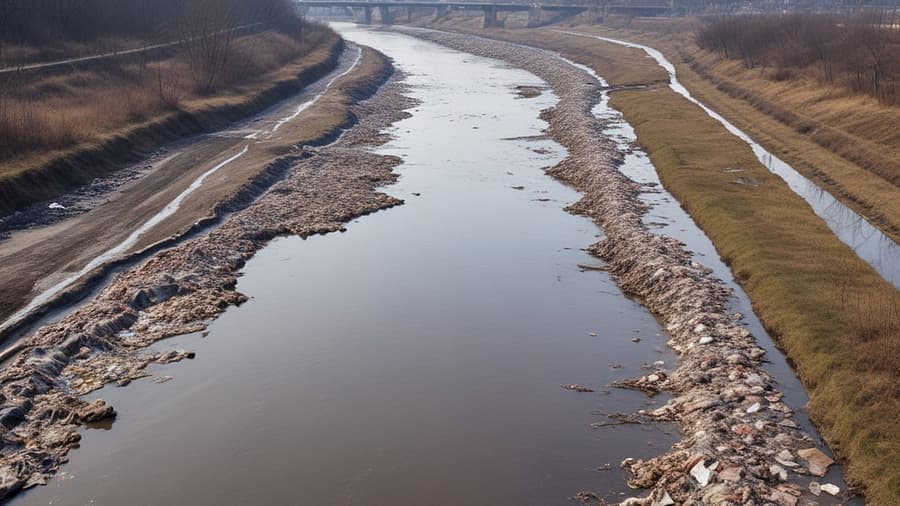
Supreme Court: Jojari River 100m Construction Ban Imposed
Summary
- The Supreme Court has banned all construction within 100 meters of Rajasthan's Jojari River.
- This interim ban will last until scientific determination of flood lines and ecological buffer zones.
- Additionally, hazardous industries are prohibited within 500 meters of the river's flood line or flow path.
- The order was issued in a suo motu case concerning industrial pollution in Rajasthan rivers.
- Justices Vikram Nath and Sandeep Mehta issued the directive to safeguard the riverine ecosystem.
Interim Restrictions Imposed
The Supreme Court of India has issued a significant directive, immediately halting all construction and development activities within a 100-meter radius from the banks of Rajasthan's Jojari River.
The Supreme Court of India has issued a significant directive, immediately halting all construction and development activities within a 100-meter radius from the banks of Rajasthan's Jojari River. This interim Supreme Court Jojari River construction ban will remain in effect until a comprehensive scientific assessment can determine and delineate the river's high flood line and necessary ecological buffer zones. The order, delivered by a bench comprising Justices Vikram Nath and Sandeep Mehta on Monday, underscores a proactive approach to environmental protection in the region, aiming to prevent further degradation of this vital waterway.
Beyond the immediate construction prohibition, the Court also mandated an additional, broader safeguard against environmental degradation. It decreed that no hazardous industry or any activity known to cause pollution shall be permitted to operate within 500 meters on either side of the river's existing flood line. In instances where a flood line has not yet been formally identified, this 500-meter restriction applies to the river's current flow path. This broader restriction on polluting activities is also temporary, pending the final scientific determination of the flood lines and ecological buffer zones for the Jojari River, reflecting a comprehensive strategy to mitigate environmental risks.
Legal Context and Rationale
The Supreme Court's intervention stems from a suo motu case, meaning the Court initiated proceedings on its own accord, titled `In Re: 2 Million Lives At Risk, Contamination In Jojari River, Rajasthan`. This case specifically addresses the widespread issue of industrial pollution affecting rivers throughout Rajasthan, with a particular focus on the Jojari River. The Court's decision highlights a deep concern for the ecological health of these vital waterways and the potential impact on human populations.
In its ruling, the bench articulated that these interim measures are essential to establish a "definite and measurable area of protection." The primary objective is to adequately safeguard the riverine ecosystem while the crucial scientific exercise of determining and demarcating the high flood line and requisite ecological buffer zones is underway. This proactive stance aims to prevent further environmental damage and ensure the long-term viability of the river system, emphasizing the importance of India environmental law construction ban principles.
Future Determinations and Ongoing Safeguards
The current restrictions, encompassing both the Rajasthan Jojari River 100m construction prohibition and the 500-meter hazardous industry exclusion zone, are explicitly designed as temporary safeguards. Their duration is directly tied to the completion of the scientific study that will precisely map the Jojari River ecological buffer zone and its high flood lines. This scientific determination is critical for establishing permanent regulatory frameworks for development and industrial activity along the river, ensuring that future planning is based on robust environmental data.
The Court's order signifies an ongoing commitment to addressing Rajasthan river pollution Supreme Court concerns and protecting the region's natural heritage. Once the scientific data is available, it will inform future, more permanent guidelines for land use and industrial operations near the Jojari River, potentially leading to revised or reinforced environmental regulations. Until then, the stringent interim bans remain firmly in place, reflecting the judiciary's resolve to protect natural resources and the well-being of the communities dependent on them from further contamination.
Practical Implications
Lawyers and compliance officers advising clients with existing or planned construction/development projects, or hazardous industries, near Rajasthan's Jojari River must immediately assess compliance with the interim 100-meter construction ban and 500-meter hazardous industry restriction, and monitor the ongoing scientific determination of flood lines and buffer zones for future regulatory changes.
Source
How does this affect you?
Get an AI analysis of this article grounded in your jurisdictions, practice areas, and any policy documents you've uploaded to Wansom.
Wansom is AI and can make mistakes.