
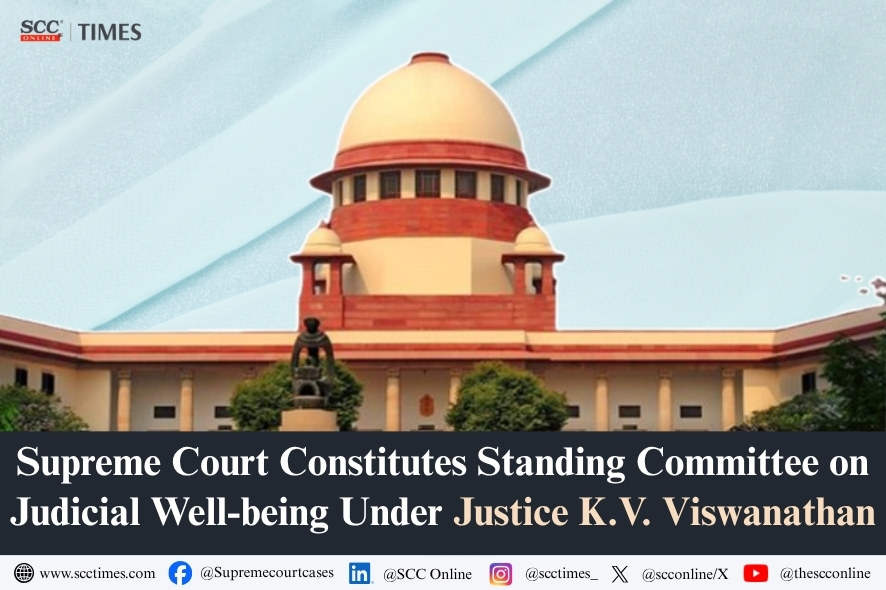
Supreme Court India: Justice Viswanathan to Lead Judicial Committee
Summary
- Chief Justice of India Surya Kant has established a new Standing Committee on Judicial Well-being.
- The committee operates under the Supreme Court and is chaired by Justice K.V. Viswanathan.
- Its primary purpose is to address various challenges impacting judicial officers.
- This initiative reflects the Supreme Court's internal focus on judicial welfare.
- The committee's work may indirectly improve court processes and judicial appointments in the future.
Establishment of a Dedicated Committee
This development signals the Indian Supreme Court's internal focus on judicial welfare, marking a notable administrative evolution.
The Supreme Court of India has recently taken a significant step towards enhancing the support systems for its judicial personnel. Chief Justice of India Surya Kant has officially established a new body, the Standing Committee on Judicial Well-being, which operates directly under the apex court's purview. This crucial initiative underscores a proactive approach to internal administrative and welfare matters within the judicial system.
This newly formed committee is set to be led by Justice K.V. Viswanathan, a sitting judge of the Supreme Court. His appointment as chair signals the high-level importance attached to the committee's mandate. The formation of such a specialized committee, with a Supreme Court judge at its helm, highlights a concerted effort to systematically address concerns impacting the judiciary.
The primary objective of this Supreme Court India Justice Viswanathan judicial committee is to confront and resolve various challenges currently affecting judicial officers across the country. Its creation reflects a recognition of the complex issues faced by those serving in the judiciary, aiming to foster a more conducive and supportive environment for their work.
Focus on Judicial Well-being
The explicit mandate of the Standing Committee on Judicial Well-being is to delve into and mitigate the difficulties encountered by judicial officers. This focus on "Indian judiciary welfare" indicates a commitment to ensuring that the individuals responsible for upholding justice are themselves adequately supported and resourced. The committee's work is expected to cover a broad spectrum of issues that contribute to the overall well-being and operational effectiveness of the judiciary.
By concentrating on "challenges affecting judicial officers," the committee aims to identify systemic issues that might impede their performance or personal welfare. Such an internal mechanism, operating at the highest judicial level, provides a dedicated forum for understanding and responding to the specific needs of judges and magistrates. This proactive stance is vital for maintaining the integrity and efficiency of the judicial process.
The establishment of this committee under Chief Justice Surya Kant's leadership signifies a strategic move to bolster the foundational strength of the justice delivery system. A robust and well-supported judiciary is fundamental to the rule of law, and this initiative represents a direct investment in the human capital that drives the legal framework of the nation.
Broader Implications for the Indian Judiciary
This development signals the Indian Supreme Court's internal focus on judicial welfare, marking a notable administrative evolution. While the formation of the Supreme Court India Justice Viswanathan judicial committee does not directly alter legal practice or compliance requirements for external parties, it represents a significant internal reform. The emphasis on the well-being of judicial officers could have far-reaching, albeit indirect, consequences for the broader legal landscape.
The potential for improved working conditions and enhanced efficiency among judicial officers, stemming from the committee's work, could subtly influence court processes and even future judicial appointments in the long term. A more supported and efficient judiciary might lead to better case management, reduced backlogs, and a more attractive environment for prospective judicial talent. This internal strengthening is crucial for the sustained health of the justice system.
It is important to note that, as of now, there are no immediate actionable implications for lawyers or compliance officers arising directly from the constitution of this committee. Its impact is primarily directed inward, focusing on the administrative and welfare aspects of the judiciary itself, with any external effects expected to manifest gradually over time through an improved and more resilient judicial system.
Practical Implications
This development signals the Indian Supreme Court's internal focus on judicial welfare. While not directly impacting legal practice or compliance, it may reflect a broader effort to improve the working conditions and efficiency of judicial officers, which could indirectly affect court processes or judicial appointments in the long term. There is no immediate actionable implication for lawyers or compliance officers.
Source
How does this affect you?
Get an AI analysis of this article grounded in your jurisdictions, practice areas, and any policy documents you've uploaded to Wansom.
Finish Reading the Full Story and the Expert Analysis.
Get the latest legal & regulatory intelligence in India
Wansom is AI and can make mistakes.