
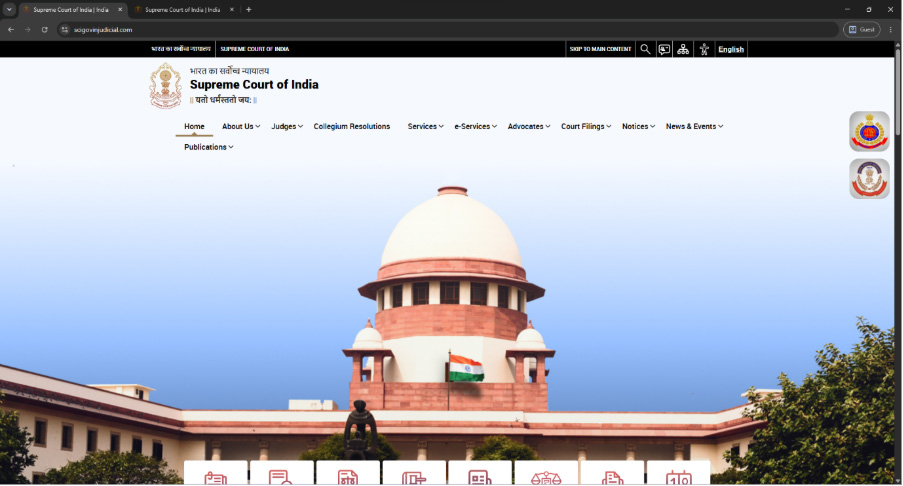
Supreme Court India: Warns Public on Fake Website scigovinjudicial.com
Summary
- The Supreme Court of India issued an advisory on November 3, 2026, flagging scigovinjudicial.com as a new fraudulent phishing domain.
- This fake website aims to steal sensitive personal information and confidential credentials from users.
- The official domain for the Supreme Court of India is sci.gov.in, and users are advised to verify all URLs carefully.
- This is the latest in a series of warnings since August 2023 against various deceptive domains impersonating the Supreme Court.
- Users are urged to update passwords and notify banks if they suspect compromise, and to always verify electronic communications.
Latest Alert on Digital Impersonation
The repeated issuance of these public advisories by the Supreme Court of India underscores a significant and ongoing cybersecurity challenge.
The Supreme Court of India has recently issued a public advisory, dated November 3, 2026, to warn the public about a newly identified fraudulent website attempting to impersonate its official digital presence. This latest Supreme Court cyber security alert specifically flags scigovinjudicial.com as a deceptive domain. The Registry indicates that this site is likely being used for phishing, with the aim of illicitly obtaining sensitive personal information and confidential credentials from unsuspecting users.
This scigovinjudicial.com fraud poses a significant risk of data theft. The advisory strongly cautions all stakeholders, including litigants and legal professionals, against providing any personal or financial details through this fraudulent portal. The Supreme Court's official and registered domain remains sci.gov.in, and users are advised to meticulously verify website addresses, for instance, by hovering over links, before proceeding to access or input any information.
A Pattern of Deception: Previous Warnings
This recent Supreme Court public advisory is not an isolated incident but rather the latest in a series of warnings issued by the Indian Supreme Court Registry concerning fake websites. Since August 2023, the Registry has consistently alerted the public to various deceptive domains designed to mimic its official online portal. Earlier notices, specifically on July 16, 2025, April 28, 2026, and August 13, 2026, had already highlighted other such fraudulent sites.
The initial alert on August 31, 2023, identified a phishing website operating under the URLs http://cbins/scigv.com and https://cbins.scigv.com/offence. This particular fraudulent page prominently displayed the heading "Offence of Money-Laundering" and was designed to solicit personal and confidential information. The Registry promptly advised against disclosing such data and reported the cyber threat to law enforcement agencies for investigation. Subsequently, a notice on January 9, 2025, identified fifteen fraudulent domains, including www.judiciarycheck.in, www.scis.scigovss.net, www.judicialsearchinia.com, and www.govt.judicialauthority.com, reiterating that the Supreme Court would never request personal or financial details through such unofficial channels. A later advisory expanded this list to sixteen domains, adding www.supremecourtofindiagov.com to the previously identified sites.
Ongoing Threats and User Safeguards
The persistent nature of these Indian Supreme Court phishing scam attempts is evident from further advisories. On April 28, 2026, the Registry identified another deceptive domain, scigovjudicial.com, again warning users against sharing personal or financial information and confirming that this cyber threat had also been reported to law enforcement. Just months later, on August 13, 2026, sp-court-in.com was flagged as a fraudulent site capable of obtaining sensitive personal data and confidential credentials.
In light of these continuous threats, the Supreme Court Registry has provided crucial advice for users to secure their online accounts. Individuals who suspect they may have been compromised by any phishing attempt are urged to immediately update passwords for all their online accounts and to inform their respective banks about any unauthorized access. The Registry consistently emphasizes the critical importance of verifying all electronic communications and website addresses before interacting with them, underscoring that sci.gov.in remains the sole sci.gov.in official domain for the Supreme Court of India.
The Critical Need for Vigilance
The repeated issuance of these public advisories by the Supreme Court of India underscores a significant and ongoing cybersecurity challenge. The proliferation of Supreme Court India fake website scigovinjudicial.com and similar fraudulent domains highlights the sophisticated tactics employed by cybercriminals to exploit trust in official institutions. These scams are not merely an inconvenience; they represent a direct threat of data theft and compromise of sensitive information, which could have severe repercussions for individuals and the legal process.
For lawyers, litigants, and other stakeholders, maintaining extreme vigilance is paramount. The consistent advice to verify URLs and exercise caution before sharing any personal or financial information is a fundamental defense against these pervasive phishing attempts. The continuous efforts by the Supreme Court Registry to identify and flag these deceptive sites serve as a crucial reminder that digital security is a shared responsibility, requiring constant awareness and proactive measures from all users interacting with judicial portals.
Practical Implications
Lawyers and compliance officers must be vigilant against phishing attempts targeting official judicial portals, particularly the Supreme Court of India's website. This specific alert regarding 'scigovinjudicial.com' highlights the ongoing risk of data theft and compromise of sensitive legal information, necessitating careful verification of URLs before accessing or sharing any data, and advising clients likewise.
Source
How does this affect you?
Get an AI analysis of this article grounded in your jurisdictions, practice areas, and any policy documents you've uploaded to Wansom.
Wansom is AI and can make mistakes.